
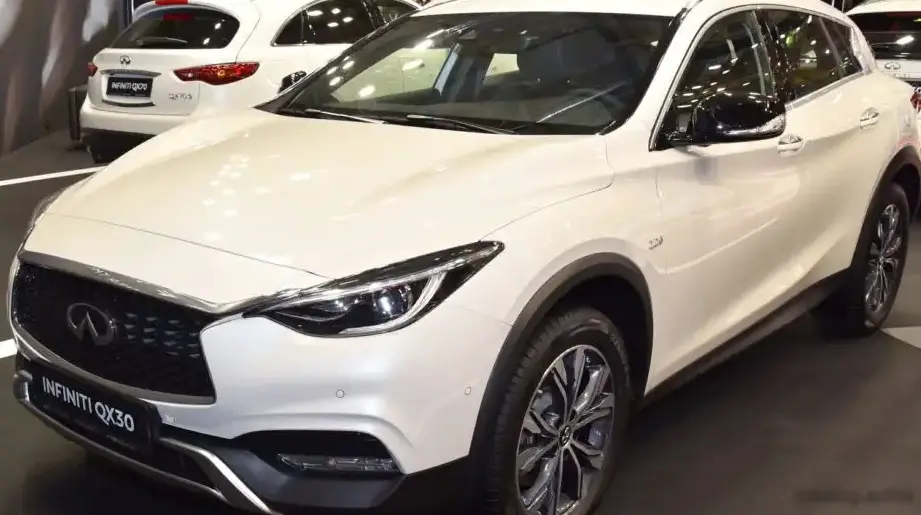
The Infiniti QX30 2.0t AWD DCT, launched in 2017, represents a unique offering within the luxury compact crossover segment. Built upon the Mercedes-Benz GLA platform – a result of the Daimler-Renault-Nissan alliance – the QX30 aimed to bring Infiniti’s signature styling and a more accessible price point to a growing market. This particular variant, equipped with the 2.0-liter turbocharged engine and a seven-speed dual-clutch transmission (DCT) paired with all-wheel drive, occupied a mid-range position in the QX30 lineup, offering a balance between performance and fuel efficiency. Production continued through 2019, with the model primarily targeted towards the North American and European markets.
Technical Specifications
| Brand | Infiniti |
| Model | QX30 |
| Generation | QX30 |
| Type (Engine) | 2.0t (211 Hp) AWD DCT |
| Start of production | 2017 |
| Powertrain Architecture | Internal Combustion engine |
| Body type | Hatchback, Crossover |
| Seats | 5 |
| Doors | 5 |
| Fuel consumption (urban) | 8.7 l/100 km (27 US mpg, 32.5 UK mpg, 11.5 km/l) |
| Fuel consumption (extra urban) | 5.5 l/100 km (42.8 US mpg, 51.4 UK mpg, 18.2 km/l) |
| Fuel consumption (combined) | 6.7 l/100 km (35.1 US mpg, 42.2 UK mpg, 14.9 km/l) |
| CO2 emissions | 155 g/km |
| Fuel Type | Petrol (Gasoline) |
| Acceleration 0 – 100 km/h | 7.3 sec |
| Acceleration 0 – 62 mph | 7.3 sec |
| Acceleration 0 – 60 mph | 6.9 sec |
| Maximum speed | 230 km/h (142.92 mph) |
| Emission standard | Euro 6 |
| Weight-to-power ratio | 7 kg/Hp, 143.8 Hp/tonne |
| Weight-to-torque ratio | 4.2 kg/Nm, 238.6 Nm/tonne |
| Power | 211 Hp @ 5500 rpm |
| Power per litre | 106 Hp/l |
| Torque | 350 Nm @ 1200-4000 rpm (258.15 lb.-ft. @ 1200-4000 rpm) |
| Engine layout | Front, Transverse |
| Engine Model/Code | M 270.920 |
| Engine displacement | 1991 cm3 (121.5 cu. in.) |
| Number of cylinders | 4 |
| Engine configuration | Inline |
| Number of valves per cylinder | 4 |
| Fuel injection system | Direct injection |
| Engine aspiration | Turbocharger, Intercooler |
| Valvetrain | DOHC |
| Engine oil capacity | 5.6 l (5.92 US qt | 4.93 UK qt) |
| Coolant | 7.6 l (8.03 US qt | 6.69 UK qt) |
| Kerb Weight | 1467 kg (3234.18 lbs.) |
| Max. weight | 1990 kg (4387.2 lbs.) |
| Max load | 523 kg (1153.02 lbs.) |
| Trunk (boot) space – minimum | 430 l (15.19 cu. ft.) |
| Fuel tank capacity | 56 l (14.79 US gal | 12.32 UK gal) |
| Permitted trailer load with brakes (12%) | 1800 kg (3968.32 lbs.) |
| Permitted trailer load without brakes | 750 kg (1653.47 lbs.) |
| Length | 4425 mm (174.21 in.) |
| Width | 1815 mm (71.46 in.) |
| Width including mirrors | 2083 mm (82.01 in.) |
| Height | 1530 mm (60.24 in.) |
| Wheelbase | 2700 mm (106.3 in.) |
| Front track | 1572 mm (61.89 in.) |
| Rear (Back) track | 1573 mm (61.93 in.) |
| Ride height (ground clearance) | 202-232 mm (7.95 – 9.13 in.) |
| Drag coefficient (Cd) | 0.33 |
| Minimum turning circle (turning diameter) | 11.2 m (36.75 ft.) |
| Drive wheel | All wheel drive (4×4) |
| Number of gears and type of gearbox | 7 gears, automatic transmission DCT |
| Front suspension | Independent type McPherson |
| Rear suspension | Independent multi-link suspension |
| Front brakes | Ventilated discs |
| Rear brakes | Disc |
| Assisting systems | ABS (Anti-lock braking system) |
| Steering type | Steering rack and pinion |
| Power steering | Electric Steering |
| Tires size | 235/50 R18 |
| Wheel rims size | 18 |
Powertrain & Engine Architecture
At the heart of the QX30 2.0t lies the Mercedes-Benz M270.920 2.0-liter inline-four cylinder engine. This engine, part of the modular M270 family, features direct fuel injection, a single turbocharger with an intercooler, and a dual overhead camshaft (DOHC) valvetrain. The engine produces 211 horsepower at 5500 rpm and 350 Nm (258 lb-ft) of torque between 1200 and 4000 rpm. This broad torque curve, characteristic of turbocharged engines, provides responsive acceleration in everyday driving situations. The engine is transversely mounted in the front of the vehicle. The seven-speed dual-clutch transmission (DCT) delivers quick and precise gear changes, enhancing both performance and fuel efficiency. The DCT, sourced from Getrag, offers both automatic and manual shifting modes, allowing drivers to tailor the driving experience to their preferences.
Driving Characteristics
The QX30 2.0t AWD DCT offers a comfortable and refined driving experience. The DCT provides smooth and rapid gear changes, contributing to brisk acceleration. The 0-60 mph sprint takes approximately 6.9 seconds, making it competitive within its class. While not a sports car, the QX30 delivers adequate power for merging onto highways and overtaking maneuvers. The all-wheel-drive system provides enhanced traction and stability, particularly in inclement weather conditions. Compared to the base 1.6-liter engine option, the 2.0t offers a significant performance upgrade. The DCT, while generally responsive, can exhibit some low-speed jerkiness in certain situations, a common characteristic of some DCT implementations. Compared to a traditional automatic transmission, the DCT prioritizes efficiency and responsiveness over absolute smoothness.
Equipment & Trim Levels
The QX30 2.0t AWD DCT typically came well-equipped, reflecting its positioning as a mid-range trim. Standard features included leatherette upholstery, a 7-inch touchscreen infotainment system with navigation, a rearview camera, automatic climate control, and keyless entry. Available options included a panoramic sunroof, heated front seats, a premium audio system, and various driver-assistance features such as blind-spot monitoring and lane departure warning. Interior trim options varied, with choices in wood or metallic accents. The exterior styling featured Infiniti’s signature double-arch grille and sculpted body lines, giving it a distinctive appearance.
Chassis & Braking
The QX30 utilizes a McPherson strut front suspension and a multi-link rear suspension, providing a comfortable ride and predictable handling. The suspension is tuned to prioritize comfort over outright sportiness. The vehicle is equipped with ventilated disc brakes at the front and solid disc brakes at the rear. Anti-lock braking system (ABS) is standard. The steering is electrically assisted, providing light and precise control. The all-wheel-drive system is primarily front-biased, automatically distributing torque to the rear wheels when needed to enhance traction.
Market Reception & Comparison
The Infiniti QX30 2.0t AWD DCT received generally positive reviews from automotive critics. It was praised for its stylish design, comfortable interior, and responsive powertrain. However, some reviewers noted that the rear seat space was somewhat limited compared to competitors. Fuel economy was considered respectable, averaging around 35 mpg in combined driving. Compared to rivals like the BMW X1 and Audi Q3, the QX30 offered a more affordable entry point, but lacked the brand prestige of its German competitors. The 2.0t variant was often seen as the sweet spot in the QX30 lineup, offering a compelling balance of performance, features, and price.
Legacy
The Infiniti QX30, while a relatively short-lived model, offered a unique alternative in the luxury compact crossover segment. The 2.0t engine and DCT transmission proved to be a reliable combination, with few widespread mechanical issues reported. On the used car market, the QX30 2.0t AWD DCT remains a relatively affordable option, offering a stylish and well-equipped vehicle for those seeking a luxury crossover experience. Maintenance costs are generally comparable to other vehicles in its class, with routine servicing being relatively straightforward. The QX30’s reliance on Mercedes-Benz components ensures a readily available supply of parts and qualified technicians.
