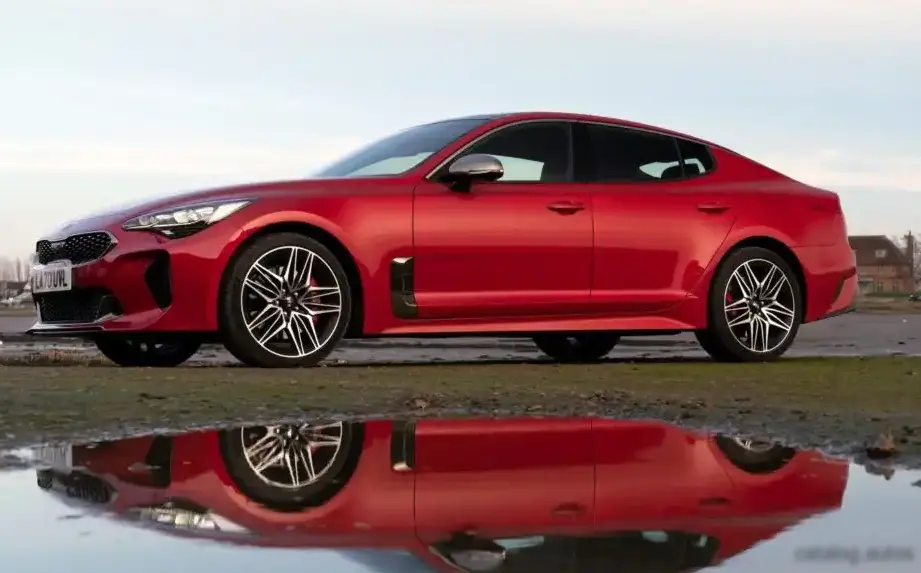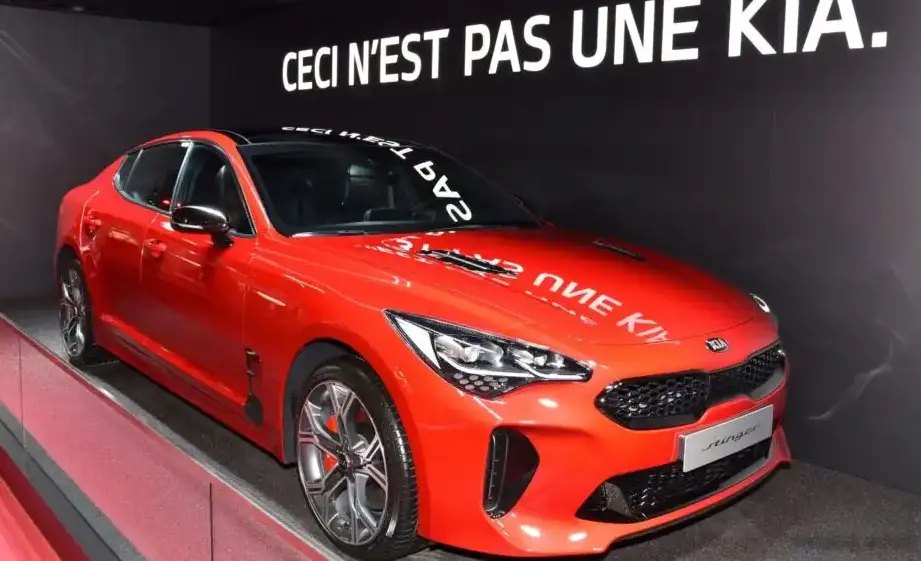
The Kia Stinger 2.0 GDI Automatic, produced from 2017 to 2018, represents the entry point into the first generation (BC) of Kia’s performance-oriented liftback. Positioned below the more powerful 3.3L twin-turbo V6 model, the 2.0 GDI offered a compelling blend of style, performance, and value within the burgeoning sports sedan segment. Built on Kia’s rear-wheel-drive platform, the Stinger aimed to challenge established European marques and redefine Kia’s brand image. This variant was primarily marketed towards buyers seeking a sporty driving experience without the higher price tag and fuel consumption associated with the V6.
Technical Specifications
| Brand | Kia |
| Model | Stinger |
| Generation | Stinger (BC) |
| Type (Engine) | 2.0 GDI (256 Hp) Automatic |
| Start of production | 2017 |
| End of production | 2018 |
| Powertrain Architecture | Internal Combustion engine |
| Body type | Liftback |
| Seats | 5 |
| Doors | 5 |
| Fuel consumption (urban) | 10.6-11.2 l/100 km (22.2 – 21 US mpg) |
| Fuel consumption (extra urban) | 6.4-6.7 l/100 km (36.8 – 35.1 US mpg) |
| Fuel consumption (combined) | 7.9-8.3 l/100 km (29.8 – 28.3 US mpg) |
| CO2 emissions | 181-190 g/km |
| Fuel Type | Petrol (Gasoline) |
| Acceleration 0 – 100 km/h | 6 sec |
| Acceleration 0 – 62 mph | 6 sec |
| Acceleration 0 – 60 mph | 5.7 sec |
| Maximum speed | 232 km/h (144.16 mph) |
| Emission standard | Euro 6 |
| Weight-to-power ratio | 6.4 kg/Hp |
| Weight-to-torque ratio | 4.7 kg/Nm |
| Power | 256 Hp @ 6200 rpm |
| Torque | 353 Nm @ 1400-4000 rpm (260.36 lb.-ft.) |
| Engine layout | Front, Longitudinal |
| Engine Model/Code | G4KL |
| Engine displacement | 1998 cm3 (121.93 cu. in.) |
| Number of cylinders | 4 |
| Engine configuration | Inline |
| Cylinder Bore | 86 mm (3.39 in.) |
| Piston Stroke | 86 mm (3.39 in.) |
| Compression ratio | 10:1 |
| Number of valves per cylinder | 4 |
| Fuel injection system | Direct injection |
| Engine aspiration | Turbocharger, Intercooler |
| Valvetrain | DOHC |
| Engine oil capacity | 5.7 l (6.02 US qt | 5.02 UK qt) |
| Coolant | 8.8 l (9.3 US qt | 7.74 UK qt) |
| Kerb Weight | 1642 kg (3619.99 lbs.) |
| Max. weight | 2185 kg (4817.1 lbs.) |
| Max load | 543 kg (1197.11 lbs.) |
| Trunk (boot) space – minimum | 406 l (14.34 cu. ft.) |
| Trunk (boot) space – maximum | 1114 l (39.34 cu. ft.) |
| Fuel tank capacity | 60 l (15.85 US gal | 13.2 UK gal) |
| Permitted trailer load with brakes (12%) | 1500 kg (3306.93 lbs.) |
| Permitted trailer load without brakes | 750 kg (1653.47 lbs.) |
| Length | 4830 mm (190.16 in.) |
| Width | 1870 mm (73.62 in.) |
| Height | 1400 mm (55.12 in.) |
| Wheelbase | 2905 mm (114.37 in.) |
| Front track | 1596 mm (62.83 in.) |
| Rear (Back) track | 1619 mm (63.74 in.) |
| Front overhang | 830 mm (32.68 in.) |
| Rear overhang | 1095 mm (43.11 in.) |
| Drag coefficient (Cd) | 0.30 |
| Minimum turning circle (turning diameter) | 11.2 m (36.75 ft.) |
| Drivetrain Architecture | Rear wheel drive |
| Drive wheel | Rear wheel drive |
| Number of gears and type of gearbox | 8 gears, automatic transmission |
| Front suspension | Independent, type McPherson with coil spring and anti-roll bar |
| Rear suspension | Independent multi-link suspension |
| Front brakes | Ventilated discs |
| Rear brakes | Ventilated discs |
| Assisting systems | ABS (Anti-lock braking system) |
| Steering type | Steering rack and pinion |
| Power steering | Electric Steering |
| Tires size | 225/45 R18 |
| Wheel rims size | 8.0J x 18 |
INTRODUCTION
The Kia Stinger 2.0 GDI Automatic, launched in 2017, marked a significant departure for the Korean automaker. Kia aimed to create a genuine sports sedan, and the Stinger was the result. The 2.0 GDI variant served as the more accessible entry point to the Stinger lineup, offering a balance between performance and fuel efficiency. It was designed to appeal to a broader audience than the range-topping 3.3L twin-turbo model, providing a stylish and engaging driving experience at a more attainable price point. The Stinger, built on the rear-wheel-drive platform shared with the Hyundai Genesis, was a bold statement of intent from Kia, signaling their ambition to compete with established European brands.
Powertrain & Engine Architecture
At the heart of the Stinger 2.0 GDI lies the Theta II 2.0-liter turbocharged inline-four cylinder engine, designated the G4KL engine code. This engine utilizes direct injection (GDI) technology, enhancing fuel efficiency and power output. The engine produces 256 horsepower at 6,200 rpm and 260 lb-ft of torque between 1,400 and 4,000 rpm. The turbocharger, coupled with an intercooler, provides a broad torque curve, contributing to responsive acceleration. The engine features a double overhead camshaft (DOHC) valvetrain with four valves per cylinder. The Stinger 2.0 GDI is paired with a Hyundai-developed eight-speed automatic transmission. This transmission offers smooth and quick shifts, and is tuned for both performance and fuel economy. The transmission features a wide gear ratio spread, optimizing acceleration and highway cruising.
Driving Characteristics
The Stinger 2.0 GDI Automatic delivers a surprisingly engaging driving experience. While not as brutally fast as the 3.3L V6, the 2.0L turbo provides ample power for everyday driving and spirited acceleration. The rear-wheel-drive configuration contributes to balanced handling and a sporty feel. The eight-speed automatic transmission is well-programmed, offering smooth shifts and responsive downshifts. The gear ratios are optimized for both acceleration and fuel efficiency. Compared to the V6 model, the 2.0 GDI feels slightly less urgent off the line, but still manages a 0-60 mph time of around 5.7 seconds. The suspension is tuned for a comfortable ride, but still provides good body control in corners. The steering is precise and well-weighted, offering good feedback to the driver.
Equipment & Trim Levels
The Stinger 2.0 GDI Automatic typically came standard with a generous array of features. Standard equipment included leather upholstery, a touchscreen infotainment system with Apple CarPlay and Android Auto compatibility, a rearview camera, automatic climate control, and a suite of advanced safety features such as forward collision warning, lane departure warning, and automatic emergency braking. Optional extras included a premium audio system, a panoramic sunroof, and adaptive cruise control. Interior trim levels varied, with options for different color schemes and materials. The dashboard layout is driver-focused, with a clean and modern design.
Chassis & Braking
The Stinger’s chassis is a rigid and well-engineered platform, providing a solid foundation for its sporty driving dynamics. The front suspension utilizes a McPherson strut design with coil springs and an anti-roll bar, while the rear suspension employs an independent multi-link setup. This configuration provides a good balance between ride comfort and handling precision. The Stinger 2.0 GDI is equipped with ventilated disc brakes on all four wheels, providing ample stopping power. An Anti-lock Braking System (ABS) is standard, enhancing safety and control during emergency braking situations. The standard tire size is 225/45 R18, providing good grip and handling characteristics.
Market Reception & Comparison
The Kia Stinger 2.0 GDI Automatic was generally well-received by automotive critics. Reviewers praised its stylish design, engaging driving dynamics, and generous standard features. Compared to the 3.3L V6 model, the 2.0 GDI offered a more affordable entry point into the Stinger lineup, making it accessible to a wider range of buyers. Fuel economy was also a key advantage of the 2.0 GDI, with combined fuel consumption figures around 29.8-28.3 US mpg. However, some critics noted that the 2.0L engine lacked the outright performance of the V6. Compared to competitors such as the Audi A5 Sportback and BMW 4 Series Gran Coupe, the Stinger offered a compelling value proposition, with more features for the price.
Legacy
The Kia Stinger 2.0 GDI Automatic, while only produced for two model years, has established a loyal following among enthusiasts. The G4KL engine, while generally reliable, requires regular maintenance, including oil changes and timing chain inspections. The eight-speed automatic transmission has also proven to be durable, but proper fluid changes are essential. On the used car market, the Stinger 2.0 GDI represents a good value, offering a stylish and engaging driving experience at an affordable price. Its unique blend of performance, practicality, and value has cemented its place as a standout model in Kia’s history.