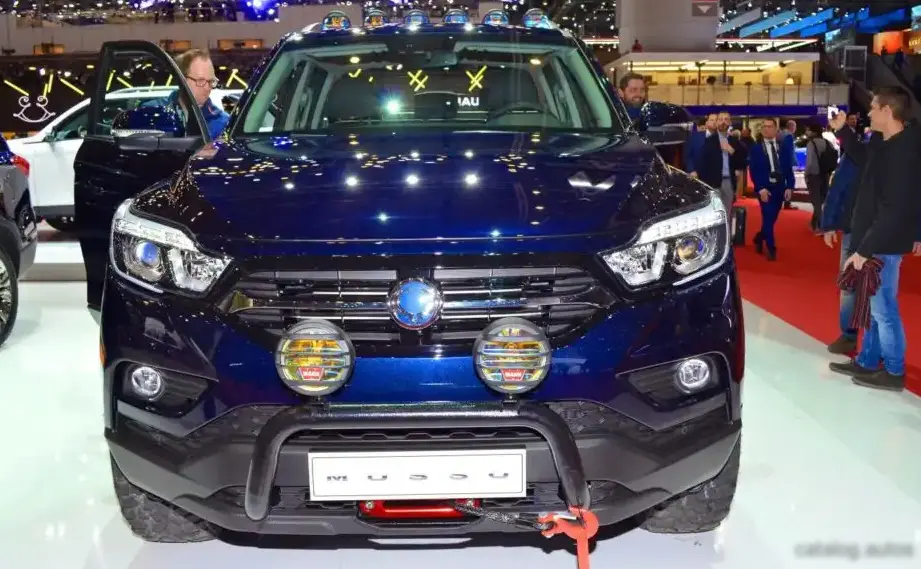
The SsangYong Musso I 2.3 i 16V, produced from 1999 to 2005, represented SsangYong’s entry into the burgeoning SUV market. Positioned as a mid-size, body-on-frame vehicle, the Musso aimed to provide a robust and practical alternative to established Japanese and European competitors. This particular variant, equipped with the 2.3-liter inline-four engine producing 140 horsepower, served as the base engine option for the Musso in many markets, offering a balance between affordability and capability. It was a key model for SsangYong as they sought to expand their international presence, particularly in Europe where demand for SUVs was rapidly increasing. The Musso I was built upon a ladder frame chassis, a design choice prioritizing durability and off-road performance over the more refined ride quality of unibody construction.
Technical Specifications
| Brand | SsangYong |
| Model | Musso |
| Generation | Musso I |
| Type (Engine) | 2.3 i 16V (140 Hp) |
| Start of production | 1999 |
| End of production | 2005 |
| Powertrain Architecture | Internal Combustion engine |
| Body type | SUV |
| Seats | 5 |
| Doors | 5 |
| Fuel consumption (urban) | 16.4 l/100 km (14.3 US mpg) |
| Fuel consumption (extra urban) | 10 l/100 km (23.5 US mpg) |
| Fuel Type | Petrol (Gasoline) |
| Acceleration 0 – 100 km/h | 17 sec |
| Acceleration 0 – 62 mph | 17 sec |
| Acceleration 0 – 60 mph | 16.2 sec |
| Maximum speed | 176 km/h (109.36 mph) |
| Weight-to-power ratio | 13.5 kg/Hp |
| Weight-to-torque ratio | 9.3 kg/Nm |
| Power | 140 Hp @ 5300 rpm |
| Torque | 204 Nm @ 4500 rpm (150.46 lb.-ft. @ 4500 rpm) |
| Engine layout | Front, Longitudinal |
| Engine displacement | 2295 cm3 (140.05 cu. in.) |
| Number of cylinders | 4 |
| Engine configuration | Inline |
| Cylinder Bore | 90.9 mm (3.58 in.) |
| Piston Stroke | 88.4 mm (3.48 in.) |
| Compression ratio | 10.4:1 |
| Number of valves per cylinder | 4 |
| Fuel injection system | Multi-port manifold injection |
| Engine aspiration | Naturally aspirated engine |
| Valvetrain | DOHC |
| Engine oil capacity | 6 l (6.34 US qt | 5.28 UK qt) |
| Coolant capacity | 10 l (10.57 US qt | 8.8 UK qt) |
| Kerb Weight | 1895 kg (4177.76 lbs.) |
| Max. weight | 2520 kg (5555.65 lbs.) |
| Max load | 625 kg (1377.89 lbs.) |
| Trunk (boot) space – minimum | 780 l (27.55 cu. ft.) |
| Trunk (boot) space – maximum | 1920 l (67.8 cu. ft.) |
| Fuel tank capacity | 80 l (21.13 US gal | 17.6 UK gal) |
| Length | 4640 mm (182.68 in.) |
| Width | 1864 mm (73.39 in.) |
| Height | 1735 mm (68.31 in.) |
| Wheelbase | 2630 mm (103.54 in.) |
| Front track | 1510 mm (59.45 in.) |
| Rear track | 1520 mm (59.84 in.) |
| Drive wheel | All wheel drive (4×4) |
| Number of gears | 5 |
| Gearbox type | Manual transmission |
| Front suspension | Torsion |
| Rear suspension | Coil spring |
| Front brakes | Ventilated discs |
| Rear brakes | Disc |
| Assisting systems | ABS (Anti-lock braking system) |
| Steering type | Steering rack and pinion |
| Power steering | Hydraulic Steering |
| Tires size | 235/75 R15 |
Powertrain & Engine Architecture
The heart of the Musso I 2.3 i 16V is the SsangYong-developed 2.3-liter inline-four cylinder engine. This engine, designated with various codes depending on the specific market, featured a double overhead camshaft (DOHC) valvetrain operating four valves per cylinder. This configuration allowed for improved breathing and higher engine speeds compared to older single overhead cam designs. Fuel delivery was handled by a multi-port fuel injection system, providing precise fuel metering for optimal combustion. The engine’s 140 horsepower output at 5300 rpm and 204 Nm (150.46 lb-ft) of torque at 4500 rpm were considered adequate for the vehicle’s weight, but not particularly sporty. The engine was mounted longitudinally in the chassis, and power was transmitted to all four wheels via a five-speed manual transmission. While an automatic transmission was offered in some markets, the 2.3-liter engine was most commonly paired with the manual gearbox.
Driving Characteristics
The Musso I 2.3 i 16V offered a utilitarian driving experience. Acceleration was modest, taking approximately 17 seconds to reach 60 mph. The engine felt strained when pushed hard, and the five-speed manual transmission required frequent shifting to maintain momentum, especially when loaded or tackling inclines. Compared to the more powerful 3.2-liter Mercedes-Benz sourced engine available in higher trims, the 2.3-liter felt underpowered. However, the engine’s torque delivery was relatively smooth, making it suitable for everyday driving and light off-road work. The all-wheel-drive system provided enhanced traction on slippery surfaces, but the Musso wasn’t designed for serious off-roading. The gear ratios were tuned for fuel economy and practicality rather than performance.
Equipment & Trim Levels
The 2.3 i 16V trim typically represented the entry-level Musso, focusing on providing essential features at an affordable price point. Standard equipment generally included power steering, central locking, and basic instrumentation. Interior upholstery was typically cloth, and the dashboard featured a functional, if somewhat spartan, design. Optional extras included air conditioning, power windows, and an upgraded audio system. Higher trim levels, such as those equipped with the 3.2-liter engine, offered more luxurious appointments, including leather upholstery, wood trim, and additional convenience features.
Chassis & Braking
The Musso I utilized a traditional body-on-frame construction, providing a robust and durable chassis. Front suspension consisted of torsion bars, while the rear employed coil springs. This setup offered a reasonable ride quality, although it wasn’t as refined as the independent suspension systems found in some competing SUVs. Braking duties were handled by ventilated discs at the front and solid discs at the rear. An anti-lock braking system (ABS) was standard, enhancing safety and control during emergency braking situations. The steering system employed a rack and pinion setup with hydraulic power assistance, providing relatively precise steering feel.
Market Reception & Comparison
The SsangYong Musso I 2.3 i 16V received mixed reviews from automotive critics. While praised for its rugged construction and practicality, it was often criticized for its underpowered engine and somewhat basic interior. Compared to rivals like the Toyota RAV4 or Honda CR-V, the Musso offered a more utilitarian experience, prioritizing durability and off-road capability over refinement and performance. Fuel economy was also a concern, with the 2.3-liter engine returning around 16.4 l/100 km in urban driving. However, the Musso’s lower price point made it an attractive option for budget-conscious buyers.
Legacy
The SsangYong Musso I, including the 2.3 i 16V variant, established SsangYong as a player in the SUV market. While not a sales leader, the Musso gained a reputation for reliability and durability, particularly among those who valued a robust and practical vehicle. Today, the Musso I is a relatively rare sight on the roads, but well-maintained examples are sought after by enthusiasts and collectors. The 2.3-liter engine, while not known for its performance, has proven to be reasonably reliable, and parts availability remains adequate. The Musso I paved the way for subsequent generations of SsangYong SUVs, and its legacy continues to influence the brand’s approach to vehicle design and engineering.