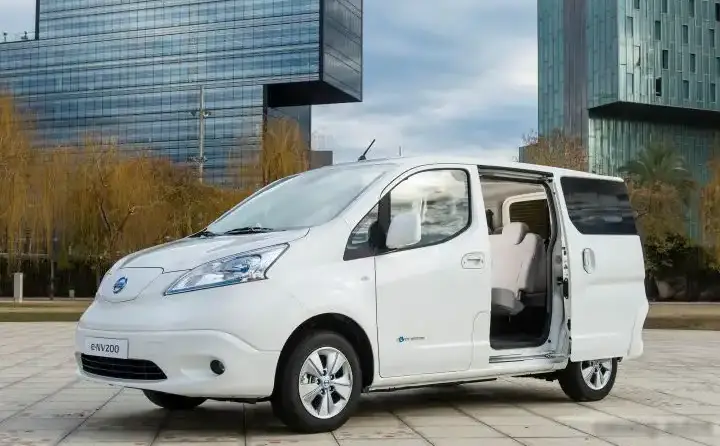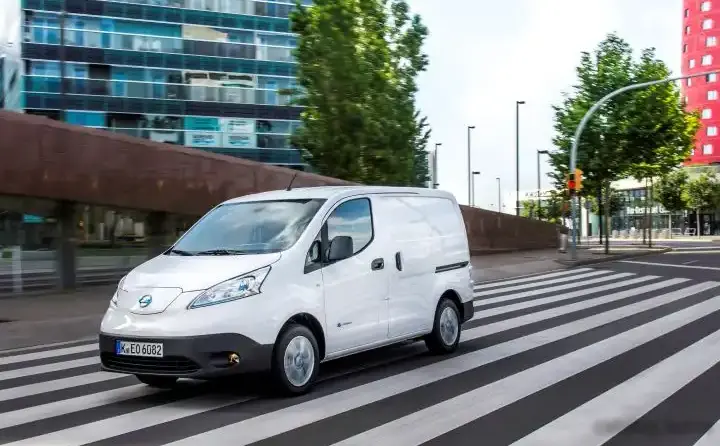
The Nissan e-NV200 40 kWh, producing 109 horsepower, was an all-electric compact van produced by Nissan from 2017 to 2021. Designed primarily for commercial use, particularly in urban environments, the e-NV200 represented Nissan’s entry into the burgeoning electric light commercial vehicle (LCV) segment. It was based on the NV200 platform, sharing many structural components with its gasoline-powered counterpart, but distinguished by its fully electric powertrain. The 40 kWh battery pack version was the mainstay of the lineup, offering a balance between range and affordability, and was particularly popular in European and Asian markets where LCV demand is high and emissions regulations are stringent.
Technical Specifications
| Brand | Nissan |
| Model | NV200 |
| Generation | e-NV200 |
| Type (Engine) | 40 kWh (109 Hp) |
| Start of production | 2017 |
| End of production | 2021 |
| Powertrain Architecture | BEV (Electric Vehicle) |
| Body type | Minivan |
| Seats | 2 |
| Doors | 5 |
| Fuel Type | Electricity |
| Acceleration 0 – 100 km/h | 14 sec |
| Acceleration 0 – 62 mph | 14 sec |
| Acceleration 0 – 60 mph | 13.3 sec |
| Maximum speed | 123 km/h (76.43 mph) |
| Weight-to-power ratio | 14.1 kg/Hp, 70.9 Hp/tonne |
| Weight-to-torque ratio | 6.1 kg/Nm, 165.3 Nm/tonne |
| Gross battery capacity | 40 kWh |
| Net (usable) battery capacity | 38 kWh |
| Battery voltage | 360 V |
| Battery technology | Lithium-ion (Li-Ion) |
| Battery location | Below the floor |
| All-electric range (NEDC) | 280 km (173.98 mi) |
| Average Energy consumption (NEDC) | 16.5 kWh/100 km (26.55 kWh/100 mi) |
| Electric motor power | 109 Hp @ 3008-10000 rpm |
| Electric motor Torque | 254 Nm @ 0-3008 rpm (187.34 lb.-ft. @ 0-3008 rpm) |
| Electric motor model/code | EM57 |
| Electric motor location | Front axle, Transverse |
| System power | 109 Hp @ 3008-10000 rpm |
| System torque | 254 Nm @ 0-3008 rpm (187.34 lb.-ft. @ 0-3008 rpm) |
| Kerb Weight | 1537 kg (3388.5 lbs) |
| Max. weight | 2240 kg (4938.35 lbs) |
| Max load | 703 kg (1549.85 lbs) |
| Trunk (boot) space – maximum | 4200 l (148.32 cu. ft.) |
| Max. roof load | 100 kg (220.46 lbs) |
| Permitted towbar download | 75 kg (165.35 lbs) |
| Length | 4560 mm (179.53 in) |
| Width | 1755 mm (69.09 in) |
| Width including mirrors | 2011 mm (79.17 in) |
| Height | 1858 mm (73.15 in) |
| Wheelbase | 2725 mm (107.28 in) |
| Front track | 1530 mm (60.24 in) |
| Rear (Back) track | 1530 mm (60.24 in) |
| Front overhang | 985 mm (38.78 in) |
| Rear overhang | 850 mm (33.46 in) |
| Ride height (ground clearance) | 153 mm (6.02 in) |
| Minimum turning circle | 11.13 m (36.52 ft) |
| Drivetrain Architecture | One electric motor drives the front wheels |
| Drive wheel | Front wheel drive |
| Number of gears and type of gearbox | 1 gears, automatic transmission |
| Front suspension | Independent type McPherson, Transverse stabilizer |
| Rear suspension | Leaf spring, Torsion |
| Front brakes | Ventilated discs, 283×28 mm |
| Rear brakes | Ventilated discs, 292×16 mm |
| Steering type | Steering rack and pinion |
| Power steering | Electric Steering |
| Tires size | 185/65 R15 |
| Wheel rims size | 6J x 15 |
INTRODUCTION
The Nissan e-NV200 40 kWh was introduced in 2017 as a fully electric variant of the popular NV200 light commercial vehicle. It was designed to cater to the growing demand for zero-emission vehicles, particularly in urban delivery and service applications. The “40 kWh” designation refers to the capacity of the lithium-ion battery pack, which provides a usable capacity of 38 kWh. Positioned as a practical and environmentally friendly alternative to traditional gasoline or diesel vans, the e-NV200 aimed to provide businesses with a cost-effective and sustainable transportation solution. Production ceased in 2021, with Nissan focusing on newer electric vehicle platforms.
Powertrain & Engine Architecture
The e-NV200’s powertrain centers around the EM57 electric motor, delivering 109 horsepower and 254 Nm (187.34 lb-ft) of torque. The motor is transversely mounted at the front of the vehicle, driving the front wheels. The 40 kWh battery pack, composed of lithium-ion cells, is located under the floor, contributing to a lower center of gravity and improved stability. The vehicle utilizes a single-speed automatic transmission, typical of electric vehicles, providing seamless acceleration. The e-NV200 employs a standard charging port, compatible with both AC and DC fast charging. The onboard charger allows for AC charging at up to 6.6 kW, while DC fast charging can replenish the battery to 80% capacity in approximately 40 minutes, depending on the charging station’s output.
Driving Characteristics
The 109 hp electric motor provides adequate, though not exhilarating, performance for urban driving. Acceleration from 0-60 mph takes around 13.3 seconds, and the top speed is limited to 76.43 mph. The instant torque delivery characteristic of electric motors provides brisk acceleration from a standstill, making it well-suited for stop-and-go traffic. The single-speed transmission simplifies the driving experience, eliminating the need for gear changes. Compared to higher-powered versions of the NV200, the e-NV200 prioritizes efficiency and smoothness over outright speed. The regenerative braking system helps to recapture energy during deceleration, extending the vehicle’s range. The low center of gravity, thanks to the underfloor battery pack, contributes to stable handling.
Equipment & Trim Levels
The e-NV200 40 kWh was typically offered in a relatively basic trim level, reflecting its commercial focus. Standard features included air conditioning, power windows, and a basic audio system. Safety features such as ABS and airbags were also standard. The interior was functional and durable, designed for frequent use. Optional extras included a rearview camera, navigation system, and upgraded upholstery. The van’s spacious interior and large cargo area (4200 liters/148.32 cu. ft. with the rear seats folded) were key selling points. The two-seat configuration maximized cargo capacity, making it ideal for delivery services and tradespeople.
Chassis & Braking
The e-NV200 utilizes an independent McPherson strut suspension at the front and a leaf spring suspension at the rear. The front suspension incorporates a transverse stabilizer bar to reduce body roll. The braking system consists of ventilated discs on all four wheels, providing adequate stopping power. The electric power steering system offers light and precise steering feel. The vehicle’s relatively low weight, due to the absence of a heavy internal combustion engine, contributes to improved handling and braking performance. The 15-inch wheels and 185/65 R15 tires provide a comfortable ride quality.
Market Reception & Comparison
The Nissan e-NV200 40 kWh received generally positive reviews for its practicality, low running costs, and environmental credentials. Critics praised its spacious interior, comfortable ride, and ease of driving. However, some reviewers noted its limited range and relatively slow acceleration compared to gasoline-powered vans. Compared to other electric vans available at the time, such as the Renault Kangoo Z.E., the e-NV200 offered a competitive range and cargo capacity. Its fuel economy, expressed as 127 MPGe, was significantly higher than that of comparable gasoline vehicles. Reliability reports suggest that the e-NV200’s electric powertrain is generally reliable, although battery degradation can occur over time.
Legacy
The Nissan e-NV200 40 kWh played a significant role in popularizing electric light commercial vehicles. It demonstrated the viability of electric vans for urban delivery and service applications. While production has ceased, the e-NV200 remains a popular choice in the used car market, particularly among businesses seeking a cost-effective and environmentally friendly transportation solution. The lessons learned from the e-NV200 have informed Nissan’s development of its newer electric vehicle platforms, such as the e-NV200 Combi and the Townstar EV, continuing Nissan’s commitment to electric mobility.