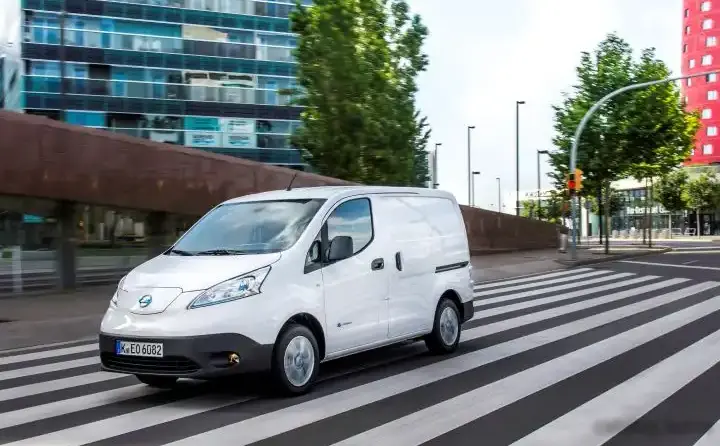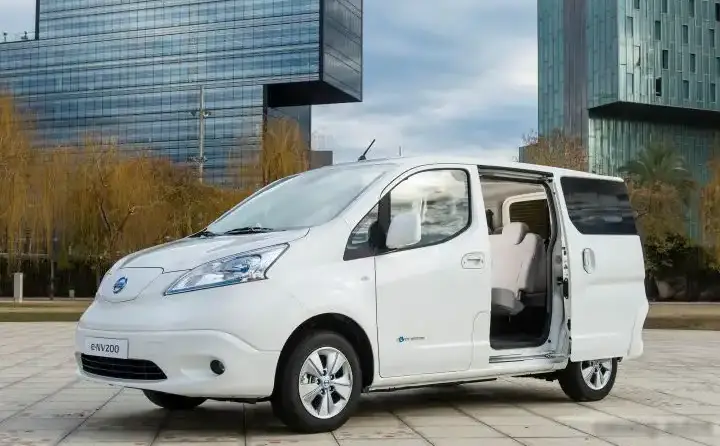
The Nissan e-NV200 Evalia 24 kWh, producing 109 horsepower, was an all-electric minivan produced by Nissan from 2013 to 2018. Designed primarily for the European and Japanese markets, it represented Nissan’s early foray into the commercial electric vehicle segment, offering a practical and zero-emission transport solution for families and businesses. The Evalia was based on the NV200 platform, but significantly modified to accommodate the electric powertrain and battery pack. This variant, with its 24 kWh battery, served as the entry point into the e-NV200 range, offering a balance between range, cost, and practicality. It was positioned as a versatile vehicle capable of both passenger and light commercial duties.
Technical Specifications
| Brand | Nissan |
| Model | NV200 |
| Generation | e-NV200 Evalia |
| Type (Engine) | 24 kWh (109 Hp) |
| Start of production | 2013 |
| End of production | 2018 |
| Powertrain Architecture | BEV (Electric Vehicle) |
| Body type | Minivan |
| Seats | 7 |
| Doors | 5 |
| Fuel Type | Electricity |
| Acceleration 0 – 100 km/h | 14 sec |
| Acceleration 0 – 62 mph | 14 sec |
| Acceleration 0 – 60 mph | 13.3 sec |
| Maximum speed | 123 km/h (76.43 mph) |
| Weight-to-power ratio | 15.1 kg/Hp, 66.4 Hp/tonne |
| Weight-to-torque ratio | 6.5 kg/Nm, 154.8 Nm/tonne |
| Gross battery capacity | 24 kWh |
| Net (usable) battery capacity | 22 kWh |
| Battery voltage | 360 V |
| Battery technology | Lithium-ion (Li-Ion) |
| Battery location | Below the floor |
| All-electric range (NEDC) | 170 km (105.63 mi) |
| Average Energy consumption (NEDC) | 16.5 kWh/100 km (26.55 kWh/100 mi) |
| Electric motor power | 109 Hp @ 3008-10000 rpm |
| Electric motor Torque | 254 Nm @ 0-3008 rpm (187.34 lb.-ft. @ 0-3008 rpm) |
| Electric motor model/code | EM57 |
| Maximum revolutions of the electric motor | 10500 rpm |
| Electric motor location | Front axle, Transverse |
| System power | 109 Hp @ 3008-10000 rpm |
| System torque | 254 Nm @ 0-3008 rpm (187.34 lb.-ft. @ 0-3008 rpm) |
| Kerb Weight | 1641-1677 kg (3617.79 – 3697.15 lbs) |
| Max. weight | 2220 kg (4894.26 lbs) |
| Max load | 543-579 kg (1197.11 – 1276.48 lbs) |
| Trunk (boot) space – minimum | 870 l (30.72 cu. ft.) |
| Trunk (boot) space – maximum | 2940 l (103.83 cu. ft.) |
| Length | 4560 mm (179.53 in) |
| Width | 1755 mm (69.09 in) |
| Width including mirrors | 2011 mm (79.17 in) |
| Height | 1858 mm (73.15 in) |
| Wheelbase | 2725 mm (107.28 in) |
| Front track | 1530 mm (60.24 in) |
| Rear (Back) track | 1530 mm (60.24 in) |
| Front overhang | 988 mm (38.9 in) |
| Rear overhang | 847 mm (33.35 in) |
| Ride height (ground clearance) | 153 mm (6.02 in) |
| Minimum turning circle | 11.3 m (37.07 ft) |
| Drivetrain Architecture | One electric motor drives the front wheels |
| Drive wheel | Front wheel drive |
| Number of gears and type of gearbox | 1 gears, automatic transmission |
| Front suspension | Independent type McPherson, Transverse stabilizer |
| Rear suspension | Leaf spring, Torsion |
| Front brakes | Ventilated discs, 283×28 mm |
| Rear brakes | Ventilated discs, 292×16 mm |
| Assisting systems | ABS (Anti-lock braking system) |
| Steering type | Steering rack and pinion |
| Power steering | Electric Steering |
| Tires size | 185/65 R15 |
| Wheel rims size | 6J x 15 |
Powertrain & Engine Architecture
The e-NV200 Evalia’s powertrain centers around the EM57 electric motor, delivering 109 horsepower and 254 Nm (187 lb-ft) of torque. This motor is mounted transversely at the front of the vehicle, driving the front wheels. The 24 kWh lithium-ion battery pack is located under the floor, contributing to a lower center of gravity and maximizing interior space. The battery operates at 360 volts. The vehicle utilizes a single-speed automatic transmission, typical of most electric vehicles, providing seamless acceleration. The motor’s torque is available instantly, offering brisk acceleration from a standstill, although top-end speed is limited to 123 km/h (76.43 mph). The charging port location varied depending on the market, but generally supported both AC and DC fast charging.
Driving Characteristics
The 109 hp and single-speed automatic configuration of the e-NV200 Evalia resulted in a driving experience focused on practicality and efficiency rather than performance. Acceleration to 60 mph took approximately 13.3 seconds. The instant torque delivery of the electric motor made city driving effortless, with responsive acceleration for merging and overtaking. However, on highways, the limited horsepower became noticeable, particularly when fully loaded or climbing hills. The single-speed transmission meant there was no gear shifting, simplifying the driving experience but also lacking the flexibility of a multi-gear system. Compared to potential higher-output variants (which were not widely available), this version prioritized range and affordability over outright speed.
Equipment & Trim Levels
The e-NV200 Evalia 24 kWh typically came with a reasonable level of standard equipment, reflecting its role as a family-oriented vehicle. Features included air conditioning, power windows, central locking, and an audio system with USB connectivity. Higher trim levels, available in some markets, added features such as navigation, rear parking sensors, and a rearview camera. Interior upholstery was typically cloth, with a durable and practical design. Optional extras included alloy wheels, upgraded audio systems, and various cargo solutions for commercial users. The seven-seat configuration offered flexibility for families, while the rear seats could be folded or removed to create a larger cargo area.
Chassis & Braking
The e-NV200 Evalia utilized a McPherson strut independent suspension at the front and a leaf spring torsion beam suspension at the rear. This setup provided a comfortable ride quality, suitable for everyday driving. The front brakes were ventilated discs, measuring 283x28mm, while the rear brakes were also ventilated discs, at 292x16mm. Anti-lock Braking System (ABS) was standard. The steering was electric power-assisted, providing light and easy steering feel. The vehicle’s weight, ranging from 1641 to 1677 kg (3617.79 to 3697.15 lbs), influenced its handling characteristics, making it feel somewhat less agile than smaller vehicles.
Market Reception & Comparison
The Nissan e-NV200 Evalia received mixed reviews. Critics praised its practicality, spacious interior, and zero-emission operation. However, the limited range of the 24 kWh battery (approximately 170 km or 105.63 miles on the NEDC cycle) was a common criticism, particularly compared to later electric vehicles with larger battery packs. Fuel economy, expressed as 16.5 kWh/100 km (26.55 kWh/100 mi), translated to 127 MPGe. Compared to the gasoline-powered NV200, the e-NV200 offered significantly lower running costs, but a higher initial purchase price. Against competitors like the Renault Kangoo Z.E., the e-NV200 offered a similar level of practicality and range, with Nissan’s reputation for reliability being a key selling point.
Legacy
The Nissan e-NV200 Evalia, particularly the 24 kWh variant, played a significant role in establishing Nissan as a pioneer in the electric vehicle market. While its range was limited by today’s standards, it provided a viable electric option for urban commuters and businesses. On the used car market, these models are generally considered reliable, with the electric powertrain proving to be durable. Battery degradation is a concern with any used electric vehicle, and potential buyers should have the battery health checked before purchase. The e-NV200 Evalia paved the way for Nissan’s subsequent electric vehicle offerings, including the LEAF and the newer e-NV200 models with larger battery packs.