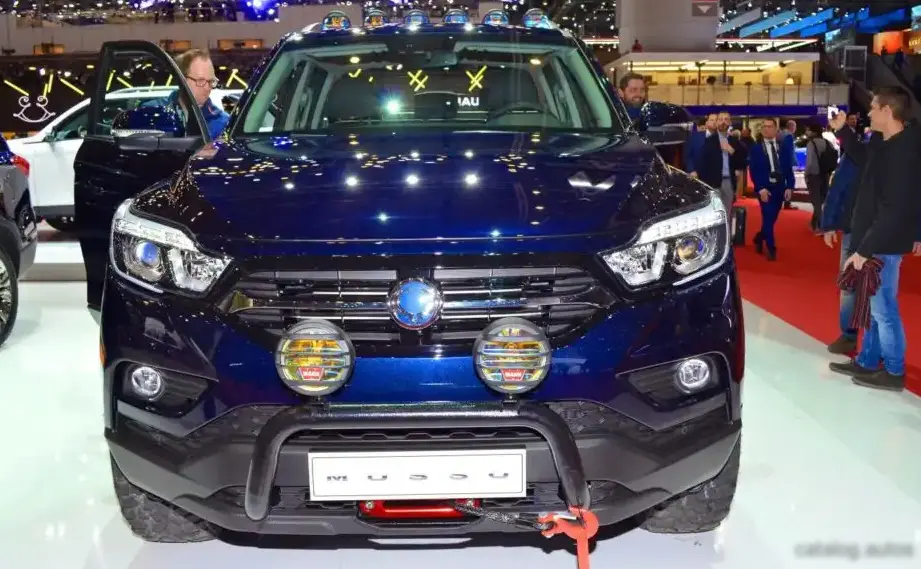
The SsangYong Musso I 2.9 TD Automatic, produced between 1999 and 2005, represented a significant step for the South Korean automaker into the mid-size SUV market. Built upon a body-on-frame chassis, the Musso aimed to provide a robust and capable vehicle, particularly appealing to those needing a workhorse with off-road potential. This specific variant, equipped with the 2.9-liter turbodiesel engine and a four-speed automatic transmission, occupied a middle ground in the Musso lineup, offering a balance between performance, fuel economy, and ease of use. It was positioned as a more accessible option compared to the higher-powered gasoline engines, while still providing the convenience of an automatic gearbox for everyday driving.
Technical Specifications
| Brand | SsangYong |
| Model | Musso |
| Generation | Musso I |
| Type (Engine) | 2.9 TD (129 Hp) Automatic |
| Start of production | 1999 |
| End of production | 2005 |
| Powertrain Architecture | Internal Combustion engine |
| Body type | SUV |
| Seats | 5 |
| Doors | 5 |
| Fuel consumption (urban) | 14 l/100 km (16.8 US mpg, 20.2 UK mpg, 7.1 km/l) |
| Fuel consumption (extra urban) | 7.6 l/100 km (30.9 US mpg, 37.2 UK mpg, 13.2 km/l) |
| Fuel consumption (combined) | 10 l/100 km (23.5 US mpg, 28.2 UK mpg, 10 km/l) |
| Fuel Type | Diesel |
| Acceleration 0 – 100 km/h | 16 sec |
| Acceleration 0 – 62 mph | 16 sec |
| Acceleration 0 – 60 mph | 15.2 sec |
| Maximum speed | 160 km/h (99.42 mph) |
| Weight-to-power ratio | 14.3 kg/Hp, 69.7 Hp/tonne |
| Weight-to-torque ratio | 7.4 kg/Nm, 135.1 Nm/tonne |
| Power | 129 Hp @ 4500 rpm |
| Power per litre | 44.9 Hp/l |
| Torque | 250 Nm @ 2400 rpm (184.39 lb.-ft. @ 2400 rpm) |
| Engine layout | Front, Longitudinal |
| Engine Model/Code | OM 662 |
| Engine displacement | 2874 cm3 (175.38 cu. in.) |
| Number of cylinders | 5 |
| Engine configuration | Inline |
| Cylinder Bore | 89 mm (3.5 in.) |
| Piston Stroke | 92.4 mm (3.64 in.) |
| Compression ratio | 22:1 |
| Number of valves per cylinder | 2 |
| Fuel injection system | Precombustion chamber injection |
| Engine aspiration | Turbocharger |
| Valvetrain | OHC |
| Engine oil capacity | 7.5 l (7.93 US qt | 6.6 UK qt) |
| Coolant capacity | 10.5 l (11.1 US qt | 9.24 UK qt) |
| Kerb Weight | 1850 kg (4078.55 lbs.) |
| Max. weight | 2520 kg (5555.65 lbs.) |
| Max load | 670 kg (1477.1 lbs.) |
| Trunk (boot) space – minimum | 780 l (27.55 cu. ft.) |
| Trunk (boot) space – maximum | 1920 l (67.8 cu. ft.) |
| Fuel tank capacity | 80 l (21.13 US gal | 17.6 UK gal) |
| Length | 4640 mm (182.68 in.) |
| Width | 1864 mm (73.39 in.) |
| Height | 1735 mm (68.31 in.) |
| Wheelbase | 2630 mm (103.54 in.) |
| Front track | 1510 mm (59.45 in.) |
| Rear (Back) track | 1520 mm (59.84 in.) |
| Drive wheel | All wheel drive (4×4) |
| Number of gears | 4 |
| Gearbox type | automatic transmission |
| Front suspension | Torsion |
| Rear suspension | Coil spring |
| Front brakes | Ventilated discs |
| Rear brakes | Disc |
| Assisting systems | ABS (Anti-lock braking system) |
| Steering type | Steering rack and pinion |
| Power steering | Hydraulic Steering |
| Tires size | 235/75 R15 |
| Wheel rims size | 15 |
Powertrain & Engine Architecture
The heart of this Musso variant is the Mercedes-Benz OM662 2.9-liter inline five-cylinder diesel engine. SsangYong had a long-standing technical partnership with Mercedes-Benz, and this engine was a product of that collaboration. The OM662 utilized a precombustion chamber injection system, a common technology for diesel engines of the era, offering a balance between efficiency and reduced emissions. A turbocharger was employed to boost power output to 129 horsepower and 250 Nm (184 lb-ft) of torque. The engine’s longitudinal mounting within the chassis contributed to a more balanced weight distribution. The four-speed automatic transmission, while providing convenience, was a relatively older design. It featured a traditional torque converter and lacked the sophistication of more modern automatic gearboxes. Gear ratios were tuned for practicality and towing capability rather than outright performance.
Driving Characteristics
The 2.9 TD Automatic Musso wasn’t designed for sporty driving. Acceleration was modest, taking around 16 seconds to reach 60 mph. The automatic transmission, while smooth, could feel somewhat sluggish, particularly during kickdown maneuvers. However, the engine’s torque output provided adequate pulling power for everyday driving and towing. The all-wheel-drive system, selectable via a transfer case, enhanced traction in slippery conditions, making it a capable off-roader for light to moderate terrain. The ride quality, typical of body-on-frame SUVs, was firm but generally comfortable, absorbing bumps reasonably well. Compared to the manual transmission versions, the automatic offered a more relaxed driving experience, but at the cost of some responsiveness. The higher-powered gasoline engines provided significantly quicker acceleration, but sacrificed fuel economy.
Equipment & Trim Levels
The 2.9 TD Automatic trim typically included features such as air conditioning, power windows, central locking, and an AM/FM radio. Higher trim levels added options like leather upholstery, a sunroof, and upgraded audio systems. Interior materials were generally durable and functional, reflecting the Musso’s utilitarian character. The dashboard layout was straightforward and easy to use, prioritizing practicality over aesthetics. Safety features were relatively basic for the time, typically including ABS brakes and a driver’s airbag.
Chassis & Braking
The Musso I utilized a traditional body-on-frame construction, providing a robust and durable platform. The front suspension employed torsion bars, while the rear featured coil springs. This setup offered a good balance between ride comfort and load-carrying capacity. Braking duties were handled by ventilated discs at the front and solid discs at the rear. The ABS system helped to maintain steering control during hard braking. The steering system was a hydraulic rack-and-pinion setup, providing reasonably precise steering feel.
Market Reception & Comparison
The SsangYong Musso I 2.9 TD Automatic was generally well-received as a capable and affordable SUV. Critics praised its robust construction, all-wheel-drive capability, and relatively fuel-efficient diesel engine. However, the automatic transmission was sometimes criticized for its lack of responsiveness. Compared to competitors like the Toyota RAV4 or Honda CR-V, the Musso offered a more rugged and utilitarian experience, but lacked the refinement and fuel economy of those smaller, car-based SUVs. Within the Musso lineup, the 2.9 TD Automatic appealed to buyers who prioritized practicality and ease of use over outright performance.
Legacy
The SsangYong Musso I, particularly the 2.9 TD Automatic variant, has developed a reputation for reliability, especially the engine itself. The OM662 diesel is known for its durability and longevity, provided it receives regular maintenance. In the used car market, these vehicles are often sought after by those needing a dependable and affordable workhorse. While parts availability can sometimes be a challenge, the relatively simple mechanical design makes them relatively easy to maintain for experienced DIY mechanics. The Musso I laid the foundation for SsangYong’s continued presence in the SUV market, and its robust design continues to appeal to a dedicated following today.