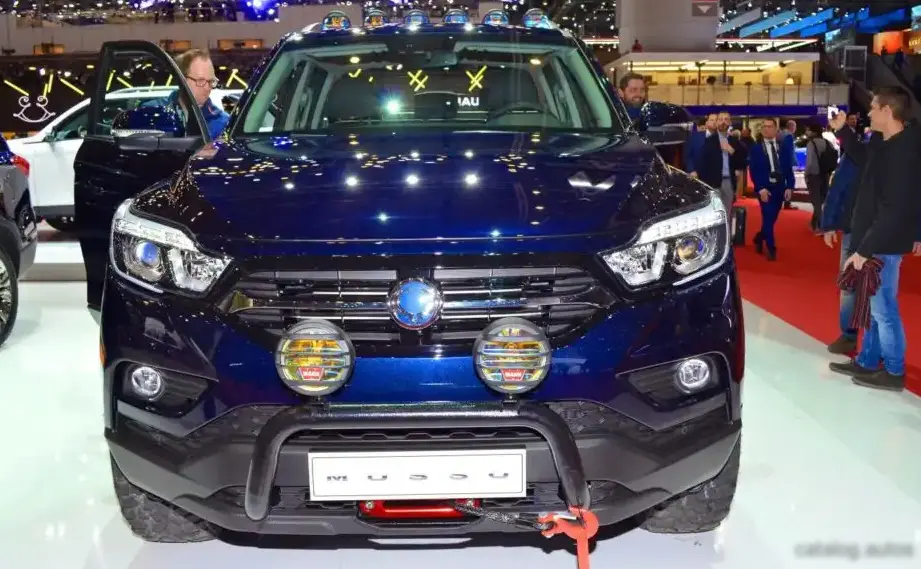
The SsangYong Musso I 3.2 i 24V, produced from 1995 to 2005, represents the initial offering in SsangYong’s Musso line of Sport Utility Vehicles (SUVs). Positioned as a robust, body-on-frame vehicle, the Musso aimed to provide a blend of off-road capability and on-road comfort, primarily targeting buyers in South Korea and export markets, including Europe and limited sales in the United States. This particular 3.2-liter variant, generating 220 horsepower, served as a higher-performance option within the Musso I range, sitting above the smaller displacement engines and offering a more refined driving experience. The Musso I was based on the Mercedes-Benz W460 platform, a legacy of SsangYong’s technical collaboration with the German automaker.
Technical Specifications
| Brand | SsangYong |
| Model | Musso |
| Generation | Musso I |
| Type (Engine) | 3.2 i 24V (220 Hp) |
| Start of production | 1995 |
| End of production | 2005 |
| Powertrain Architecture | Internal Combustion engine |
| Body type | SUV |
| Seats | 5 |
| Doors | 5 |
| Fuel consumption (urban) | 18.5 l/100 km (12.7 US mpg) |
| Fuel consumption (extra urban) | 13.4 l/100 km (17.6 US mpg) |
| Fuel consumption (combined) | 14.3 l/100 km (16.4 US mpg) |
| Fuel Type | Petrol (Gasoline) |
| Acceleration 0 – 100 km/h | 10.2 sec |
| Acceleration 0 – 62 mph | 10.2 sec |
| Acceleration 0 – 60 mph | 9.7 sec |
| Maximum speed | 194 km/h (120.55 mph) |
| Weight-to-power ratio | 8.4 kg/Hp |
| Weight-to-torque ratio | 6 kg/Nm |
| Power | 220 Hp @ 5500 rpm |
| Torque | 310 Nm @ 3750 rpm (228.64 lb.-ft. @ 3750 rpm) |
| Engine layout | Front, Longitudinal |
| Engine displacement | 3199 cm3 (195.21 cu. in.) |
| Number of cylinders | 6 |
| Engine configuration | Inline |
| Cylinder Bore | 89.9 mm (3.54 in.) |
| Piston Stroke | 84 mm (3.31 in.) |
| Compression ratio | 10:1 |
| Number of valves per cylinder | 4 |
| Fuel injection system | Multi-port manifold injection |
| Engine aspiration | Naturally aspirated engine |
| Valvetrain | DOHC |
| Engine oil capacity | 6.7 l (7.08 US qt | 5.9 UK qt) |
| Coolant capacity | 11 l (11.62 US qt | 9.68 UK qt) |
| Kerb Weight | 1855 kg (4089.57 lbs.) |
| Max. weight | 2520 kg (5555.65 lbs.) |
| Max load | 665 kg (1466.07 lbs.) |
| Trunk (boot) space – minimum | 780 l (27.55 cu. ft.) |
| Trunk (boot) space – maximum | 1920 l (67.8 cu. ft.) |
| Fuel tank capacity | 75 l (19.81 US gal | 16.5 UK gal) |
| Length | 4640 mm (182.68 in.) |
| Width | 1905 mm (75 in.) |
| Height | 1735 mm (68.31 in.) |
| Wheelbase | 2630 mm (103.54 in.) |
| Front track | 1490 mm (58.66 in.) |
| Rear (Back) track | 1500 mm (59.06 in.) |
| Drive wheel | All wheel drive (4×4) |
| Number of gears | 5 |
| Gearbox type | Manual transmission |
| Front suspension | Torsion |
| Rear suspension | Coil spring |
| Front brakes | Ventilated discs |
| Rear brakes | Disc |
| Assisting systems | ABS (Anti-lock braking system) |
| Steering type | Steering rack and pinion |
| Power steering | Hydraulic Steering |
| Tires size | 235/75 R15 H |
Powertrain & Engine Architecture
The heart of the Musso I 3.2 i 24V is the Mercedes-Benz M104 inline-six cylinder engine. SsangYong licensed this engine design as part of their collaboration with Daimler-Benz. The 3.2-liter version, internally designated with various codes depending on the specific year and market, features a dual overhead camshaft (DOHC) valvetrain with four valves per cylinder, contributing to its relatively high output for the time. Fuel delivery is managed by a multi-port fuel injection system, optimizing combustion efficiency. The engine’s robust construction and relatively simple design (compared to later, more complex engines) contribute to its reputation for durability. The 5-speed manual transmission was the standard offering for this variant, providing direct control over the engine’s power. The engine is longitudinally mounted, driving all four wheels through a part-time four-wheel-drive system.
Driving Characteristics
The 3.2-liter Musso I offered a noticeable performance upgrade over the lower-displacement engine options. Acceleration to 60 mph was achieved in approximately 9.7 seconds, and it could reach a top speed of around 120 mph. While not a sports car, the 220 horsepower and 228 lb-ft of torque provided ample power for both highway cruising and off-road excursions. The manual transmission allowed for precise gear selection, maximizing control in various driving conditions. Compared to the later automatic transmission options, the manual offered a more engaging driving experience and slightly improved fuel economy. The Musso’s body-on-frame construction resulted in a more truck-like ride compared to contemporary unibody SUVs, with a noticeable but acceptable level of body roll during cornering.
Equipment & Trim Levels
The Musso I 3.2 i 24V typically came equipped with a reasonable level of standard features, though trim levels varied depending on the market. Generally, buyers could expect power steering, air conditioning, and basic audio systems. Higher trim levels added features such as leather upholstery, power windows and locks, and upgraded audio systems. Optional extras included a sunroof, alloy wheels, and a more sophisticated four-wheel-drive system with low-range gearing. Interior appointments were functional and durable, reflecting the Musso’s intended use as a rugged utility vehicle. The dashboard layout was straightforward, prioritizing ease of use over stylistic flair.
Chassis & Braking
The Musso I utilized a traditional body-on-frame construction, providing a robust and durable chassis. Front suspension consisted of torsion bars, while the rear employed coil springs. This setup offered a good balance between ride comfort and off-road capability. Braking duties were handled by ventilated discs at the front and solid discs at the rear. An Anti-lock Braking System (ABS) was standard, enhancing safety and control during emergency braking situations. The steering system was a rack-and-pinion setup with hydraulic power assistance, providing responsive and precise steering feel.
Market Reception & Comparison
The SsangYong Musso I 3.2 i 24V received mixed reviews. Critics generally praised its robust construction, off-road capability, and the performance of the 3.2-liter engine. However, it was often criticized for its relatively basic interior, truck-like ride quality, and somewhat dated design. Compared to other SUVs in its class, such as the Toyota Land Cruiser Prado or the Mitsubishi Pajero, the Musso offered a more affordable price point but lacked the refinement and brand recognition of its Japanese competitors. Fuel economy was also a concern, with the 3.2-liter engine consuming a significant amount of fuel, especially in urban driving conditions.
Legacy
The SsangYong Musso I 3.2 i 24V, while not a mainstream success, established SsangYong as a player in the SUV market. The M104 engine proved to be remarkably durable, and well-maintained examples continue to operate reliably today. In the used car market, the 3.2-liter variant is often sought after by enthusiasts who appreciate its robust construction and relatively high performance. However, potential buyers should be aware of the potential for age-related issues, such as corrosion and wear on suspension components. The Musso I paved the way for subsequent generations of Musso SUVs, which have continued to evolve and improve upon the original’s strengths.