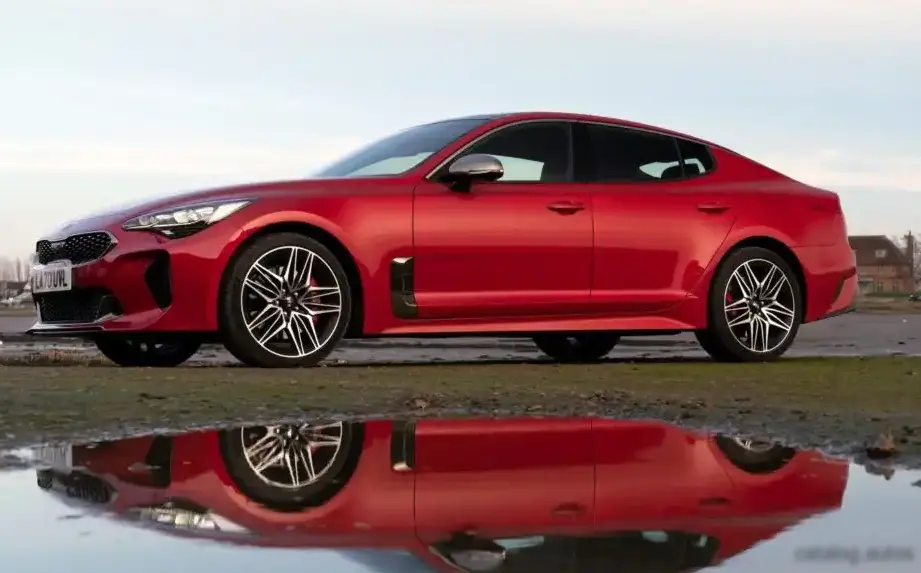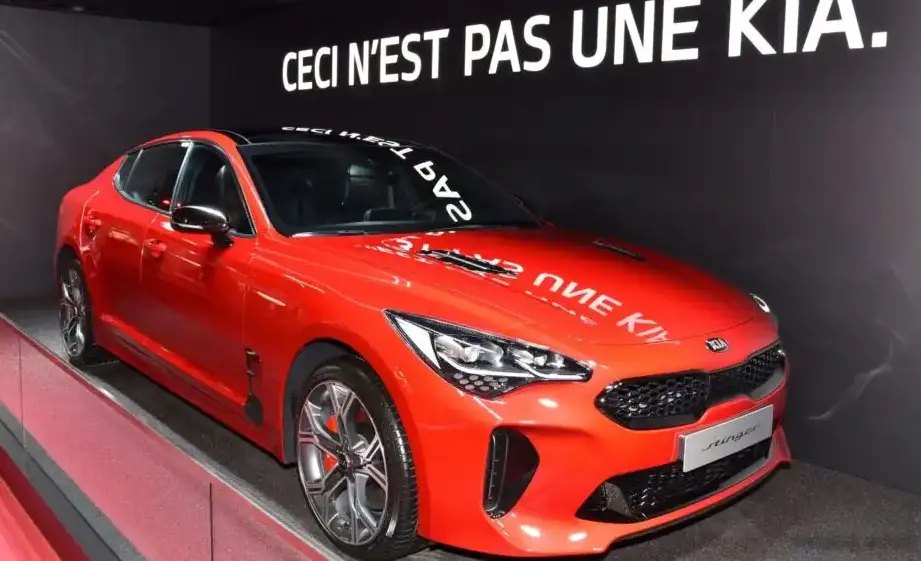
The Kia Stinger GT 3.3 GDI Automatic, produced from 2017 to 2018, represents Kia’s ambitious entry into the performance liftback segment. Positioned as the flagship trim of the first-generation Stinger (AD), this variant aimed to challenge established European sports sedans with a compelling blend of power, style, and value. Built on Kia’s rear-wheel-drive platform, the Stinger GT 3.3 offered a distinctly different driving experience compared to other vehicles in the Kia lineup, and marked a significant step forward in the brand’s image. It was primarily marketed towards enthusiasts seeking a practical yet engaging performance car.
Technical Specifications
| Brand | Kia |
| Model | Stinger |
| Generation | Stinger |
| Type (Engine) | GT 3.3 GDI (370 Hp) Automatic |
| Start of production | 2017 |
| End of production | 2018 |
| Powertrain Architecture | Internal Combustion engine |
| Body type | Liftback |
| Seats | 5 |
| Doors | 5 |
| Fuel consumption (economy) – urban | 13.6 l/100 km (17.3 US mpg, 20.8 UK mpg, 7.4 km/l) |
| Fuel consumption (economy) – extra urban | 7.8 l/100 km (30.2 US mpg, 36.2 UK mpg, 12.8 km/l) |
| Fuel consumption (economy) – combined | 9.9 l/100 km (23.8 US mpg, 28.5 UK mpg, 10.1 km/l) |
| CO2 emissions | 225 g/km |
| Fuel Type | Petrol (Gasoline) |
| Acceleration 0 – 100 km/h | 4.9 sec |
| Acceleration 0 – 62 mph | 4.9 sec |
| Acceleration 0 – 60 mph | 4.7 sec |
| Maximum speed | 270 km/h (167.77 mph) |
| Emission standard | Euro 6 |
| Weight-to-power ratio | 4.8 kg/Hp, 207.9 Hp/tonne |
| Weight-to-torque ratio | 3.5 kg/Nm, 286.5 Nm/tonne |
| Power | 370 Hp @ 6000 rpm |
| Power per litre | 110.7 Hp/l |
| Torque | 510 Nm @ 1300-4500 rpm (376.16 lb.-ft. @ 1300-4500 rpm) |
| Engine layout | Front, Longitudinal |
| Engine Model/Code | G6DP |
| Engine displacement | 3342 cm3 (203.94 cu. in.) |
| Number of cylinders | 6 |
| Engine configuration | V-engine |
| Cylinder Bore | 92 mm (3.62 in.) |
| Piston Stroke | 83.8 mm (3.3 in.) |
| Compression ratio | 10:1 |
| Number of valves per cylinder | 4 |
| Fuel injection system | Direct injection |
| Engine aspiration | Twin-Turbo, Intercooler |
| Valvetrain | DOHC |
| Engine oil capacity | 6.9 l (7.29 US qt | 6.07 UK qt) |
| Coolant | 11.6 l (12.26 US qt | 10.21 UK qt) |
| Kerb Weight | 1780 kg (3924.23 lbs.) |
| Max. weight | 2260 kg (4982.45 lbs.) |
| Max load | 480 kg (1058.22 lbs.) |
| Trunk (boot) space – minimum | 406 l (14.34 cu. ft.) |
| Trunk (boot) space – maximum | 1114 l (39.34 cu. ft.) |
| Fuel tank capacity | 60 l (15.85 US gal | 13.2 UK gal) |
| Permitted trailer load with brakes (12%) | 1500 kg (3306.93 lbs.) |
| Permitted trailer load without brakes | 750 kg (1653.47 lbs.) |
| Length | 4830 mm (190.16 in.) |
| Width | 1870 mm (73.62 in.) |
| Height | 1400 mm (55.12 in.) |
| Wheelbase | 2905 mm (114.37 in.) |
| Front track | 1596 mm (62.83 in.) |
| Rear (Back) track | 1619 mm (63.74 in.) |
| Front overhang | 830 mm (32.68 in.) |
| Rear overhang | 1095 mm (43.11 in.) |
| Drag coefficient (Cd) | 0.30 |
| Minimum turning circle (turning diameter) | 11.2 m (36.75 ft.) |
| Drivetrain Architecture | The Internal combustion engine (ICE) drives the rear wheels of the vehicle. |
| Drive wheel | Rear wheel drive |
| Number of gears and type of gearbox | 8 gears, automatic transmission |
| Front suspension | Independent, type McPherson with coil spring and anti-roll bar |
| Rear suspension | Independent multi-link suspension |
| Front brakes | Ventilated discs |
| Rear brakes | Ventilated discs |
| Assisting systems | ABS (Anti-lock braking system) |
| Steering type | Steering rack and pinion |
| Power steering | Electric Steering |
| Tires size | 225/40 R19; 255/35 R19 |
| Wheel rims size | 8.0J x 19; 8.5J x 19 |
Powertrain & Engine Architecture
At the heart of the Stinger GT 3.3 GDI lies the Lambda II 3.3-liter twin-turbocharged V6 engine, designated as the G6DP. This engine produces 370 horsepower at 6,000 rpm and 510 Nm (376 lb-ft) of torque between 1,300 and 4,500 rpm. The engine utilizes direct injection, a key technology for maximizing power and efficiency. The twin-scroll turbochargers minimize turbo lag and provide a broad torque curve. The engine’s architecture is a 60-degree V6, offering a balance between smoothness and compactness. The engine is longitudinally mounted, contributing to the rear-wheel-drive layout. The Stinger GT 3.3 exclusively paired with a Hyundai-developed eight-speed automatic transmission. This transmission features a wide gear ratio spread, optimized for both acceleration and fuel economy. Paddle shifters were included for manual gear selection, enhancing driver engagement.
Driving Characteristics
The Stinger GT 3.3 Automatic delivers a noticeably different driving experience compared to the base 2.0-liter turbocharged four-cylinder model. The V6 provides significantly more power and torque, resulting in brisk acceleration. The 0-60 mph sprint takes approximately 4.7 seconds. The eight-speed automatic transmission shifts smoothly and responsively, although some reviewers noted a slight hesitation in Sport+ mode. The rear-wheel-drive configuration contributes to a balanced chassis and engaging handling. While not as sharp as some European sports sedans, the Stinger GT 3.3 offers a comfortable ride and predictable handling characteristics. The gear ratios are tuned to prioritize acceleration in the lower gears, while higher gears are geared for efficient cruising.
Equipment & Trim Levels
The Stinger GT 3.3 Automatic came standard with a comprehensive list of features, including leather upholstery, heated and ventilated front seats, a 7-inch touchscreen infotainment system with Apple CarPlay and Android Auto, a premium sound system, and a suite of advanced driver-assistance systems (ADAS) such as forward collision warning, lane keep assist, and adaptive cruise control. Optional extras included a larger 8-inch touchscreen, a head-up display, and Nappa leather upholstery. The interior design was modern and driver-focused, with a sporty steering wheel and well-placed controls. Exterior styling cues included unique GT badging, quad exhaust outlets, and larger alloy wheels.
Chassis & Braking
The Stinger GT 3.3 features a fully independent suspension system, with a McPherson strut setup at the front and a multi-link setup at the rear. The suspension is tuned for a balance between comfort and handling. The GT model received stiffer springs and dampers compared to lower trims. Braking duties are handled by ventilated discs on all four wheels. The braking system provides ample stopping power and good pedal feel. ABS (Anti-lock Braking System) is standard. The Stinger GT 3.3 also features an electronic stability control system to help maintain control in challenging driving conditions.
Market Reception & Comparison
The Kia Stinger GT 3.3 Automatic was generally well-received by automotive critics. It was praised for its performance, styling, and value. However, some reviewers noted that the interior quality, while improved over previous Kia models, still didn’t quite match that of its European rivals. Fuel economy was also a point of concern, with the combined fuel consumption rated at 9.9 l/100 km (23.8 US mpg). Compared to the base 2.0-liter model, the GT 3.3 offered a significant performance upgrade but came at a higher price point. Compared to competitors like the BMW 4 Series Gran Coupe and Audi A5 Sportback, the Stinger GT 3.3 offered a more aggressive price and a longer warranty.
Legacy
The Kia Stinger GT 3.3 GDI Automatic, despite its short production run, established Kia as a serious contender in the performance car market. The G6DP engine proved to be relatively reliable, with few widespread mechanical issues reported. On the used car market, the Stinger GT 3.3 holds its value reasonably well, particularly well-maintained examples with low mileage. It remains a popular choice for enthusiasts seeking an affordable and stylish performance liftback. The Stinger’s success paved the way for Kia to continue developing more performance-oriented vehicles, solidifying its commitment to driving enjoyment.