
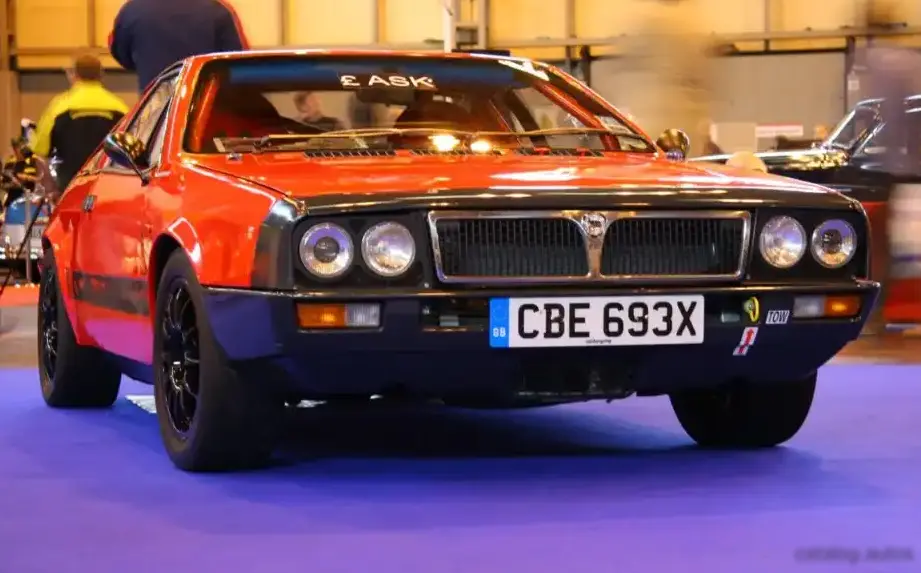
The Lancia Montecarlo (Type 137) 2.0, produced from 1980 to 1981, represents a fascinating chapter in Lancia’s history. This mid-engined, two-seater coupe was a direct successor to the Lancia Stratos, aiming to offer a more accessible and refined sports car experience. Positioned as the flagship of Lancia’s coupe lineup during its brief production run, the 2.0-liter variant with 120 horsepower served as the primary offering, bridging the gap between performance and everyday usability. It was built upon the 1HX0 platform, shared with the Fiat X1/9, but significantly differentiated itself through its more sophisticated engineering and distinctive styling.
Technical Specifications
| Brand | Lancia |
| Model | Montecarlo |
| Generation | Montecarlo (Type 137) |
| Type (Engine) | 2.0 (120 Hp) |
| Start of production | 1980 |
| End of production | 1981 |
| Powertrain Architecture | Internal Combustion engine |
| Body type | Coupe |
| Seats | 2 |
| Doors | 2 |
| Fuel consumption (urban) | 14.5 l/100 km (16.2 US mpg, 19.5 UK mpg, 6.9 km/l) |
| Fuel consumption (extra urban) | 7.2 l/100 km (32.7 US mpg, 39.2 UK mpg, 13.9 km/l) |
| Fuel Type | Petrol (Gasoline) |
| Acceleration 0 – 100 km/h | 9.3 sec |
| Acceleration 0 – 62 mph | 9.3 sec |
| Acceleration 0 – 60 mph | 8.8 sec |
| Maximum speed | 195 km/h (121.17 mph) |
| Weight-to-power ratio | 8.1 kg/Hp, 123.7 Hp/tonne |
| Weight-to-torque ratio | 5.7 kg/Nm, 176.3 Nm/tonne |
| Power | 120 Hp @ 6000 rpm |
| Power per litre | 60.2 Hp/l |
| Torque | 171 Nm @ 3400 rpm (126.12 lb.-ft. @ 3400 rpm) |
| Maximum engine speed | 6200 rpm |
| Engine layout | Middle, Transverse |
| Engine Model/Code | 134AS.000 |
| Engine displacement | 1995 cm3 (121.74 cu. in.) |
| Number of cylinders | 4 |
| Engine configuration | Inline |
| Cylinder Bore | 84 mm (3.31 in.) |
| Piston Stroke | 90 mm (3.54 in.) |
| Compression ratio | 9.35:1 |
| Number of valves per cylinder | 4 |
| Fuel injection system | Multi-port manifold injection |
| Engine aspiration | Naturally aspirated engine |
| Valvetrain | DOHC |
| Engine oil capacity | 6.22 l (6.57 US qt | 5.47 UK qt) |
| Kerb Weight | 970 kg (2138.48 lbs.) |
| Fuel tank capacity | 59 l (15.59 US gal | 12.98 UK gal) |
| Length | 3813 mm (150.12 in.) |
| Width | 1696 mm (66.77 in.) |
| Height | 1190 mm (46.85 in.) |
| Wheelbase | 2300 mm (90.55 in.) |
| Front track | 1422 mm (55.98 in.) |
| Rear track | 1466 mm (57.72 in.) |
| Minimum turning circle | 9.5 m (31.17 ft.) |
| Drivetrain Architecture | Rear wheel drive |
| Number of gears | 5 gears, manual transmission |
| Front suspension | Wishbone |
| Rear suspension | Trailing arm |
| Front brakes | Disc, 251 mm |
| Rear brakes | Disc, 251 mm |
| Steering type | Steering rack and pinion |
| Tires size | 185/65 R14 |
| Wheel rims size | 5.5J x 14 |
Powertrain & Engine Architecture
The heart of the Montecarlo 2.0 is the Lancia-designed, Fiat-built 1995cc inline-four cylinder engine, designated as the 134AS.000. This engine featured a dual overhead camshaft (DOHC) valvetrain operating four valves per cylinder, contributing to its relatively high specific output for the era. Fuel delivery was managed by a Bosch multi-port fuel injection system, a significant advancement over earlier carbureted designs, improving both performance and fuel efficiency. The engine produced 120 horsepower at 6000 rpm and 171 Nm (126 lb-ft) of torque at 3400 rpm. The engine was transversely mounted behind the driver and passenger, driving the rear wheels through a five-speed manual transmission. This mid-engine layout provided excellent balance and handling characteristics.
Driving Characteristics
The Montecarlo 2.0 offered a distinctly engaging driving experience. While not brutally fast, with a 0-60 mph time of around 8.8 seconds and a top speed of 195 km/h (121 mph), it provided ample power for spirited driving on winding roads. The mid-engine layout contributed to neutral handling and predictable cornering behavior. The five-speed manual transmission allowed drivers to keep the engine in its sweet spot, maximizing performance. Compared to potential higher-performance variants (which were never officially produced), the 2.0-liter version prioritized usability and refinement over outright speed. The gear ratios were tuned for a balance of acceleration and cruising comfort, making it a suitable grand tourer for its time.
Equipment & Trim Levels
The Montecarlo 2.0 was relatively well-equipped for a sports car of the early 1980s. Standard features included leather upholstery, power windows, and a comprehensive instrument panel. The interior design was modern and driver-focused, with a wrap-around dashboard and supportive bucket seats. Optional extras included a sunroof, upgraded audio systems, and metallic paint finishes. The trim level was fairly consistent across all Montecarlo 2.0 models, with limited options for customization beyond the available accessories.
Chassis & Braking
The Montecarlo’s chassis was a monocoque construction, providing a rigid and lightweight platform. Suspension consisted of wishbones at the front and a trailing arm setup at the rear. The car featured disc brakes on all four wheels, providing adequate stopping power for its performance level. The braking system was not particularly advanced by modern standards, but it was effective for typical road use. The car’s relatively low weight (970 kg or 2138 lbs) contributed to its agile handling and responsive braking.
Market Reception & Comparison
The Lancia Montecarlo received generally positive reviews from automotive critics. It was praised for its stylish design, engaging driving dynamics, and comfortable interior. However, some critics noted its relatively high price compared to competitors like the Fiat X1/9 and Porsche 924. Fuel economy was reasonable for a sports car of its era, averaging around 14.5 l/100 km (16.2 US mpg) in urban driving and 7.2 l/100 km (32.7 US mpg) on the highway. Reliability was generally good, although the complex engine and electrical systems could require occasional maintenance. Compared to a potential turbocharged or higher-displacement variant, the 2.0-liter Montecarlo offered a more balanced package, appealing to drivers who prioritized refinement and usability over outright performance.
Legacy
The Lancia Montecarlo, despite its short production run, has become a sought-after classic car. The 2.0-liter variant is particularly desirable due to its balance of performance, reliability, and affordability. The engine, while not without its quirks, has proven to be relatively durable when properly maintained. Today, well-preserved examples command a premium in the used car market. The Montecarlo’s mid-engine layout and distinctive styling continue to appeal to enthusiasts, cementing its place as a significant and memorable sports car from the 1980s. Parts availability can be a challenge, but a dedicated community of owners and specialists ensures that these cars can be kept on the road for years to come.
