
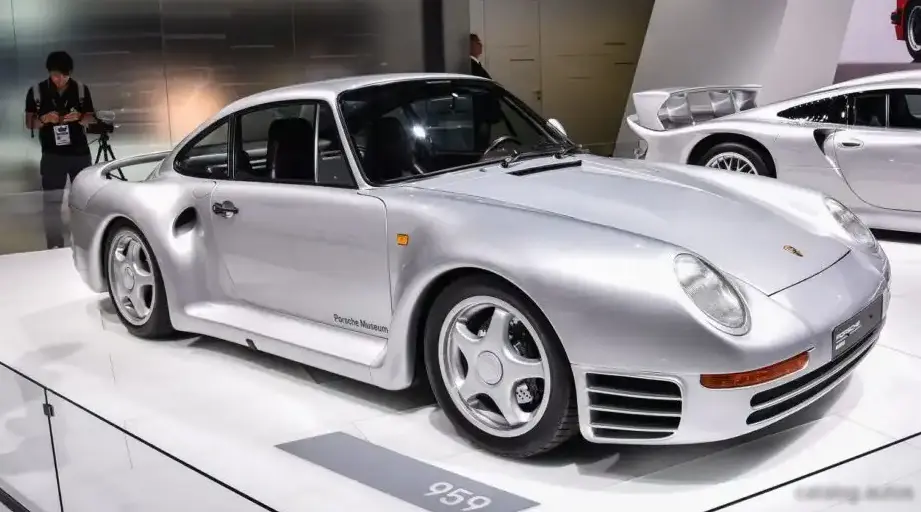
The Porsche 959 2.8, producing 450 horsepower, represented a technological tour de force when it debuted in 1987 and continued through a limited production run until 1988. Designed as a homologation special for Group B rally racing (though the class was cancelled before the 959 could compete extensively), it quickly became renowned as one of the most advanced sports cars of its era. Built around a sophisticated all-wheel-drive system and featuring extensive use of lightweight materials and cutting-edge electronics, the 959 was far more than just a powerful Porsche; it was a statement of engineering ambition. Approximately 337 examples were produced, making it an exceptionally rare and collectible vehicle even today.
Technical Specifications
| Brand | Porsche |
| Model | 959 |
| Generation | 959 |
| Type (Engine) | 2.8 (450 Hp) AWD |
| Start of production | 1987 |
| End of production | 1988 |
| Powertrain Architecture | Internal Combustion engine |
| Body type | Coupe |
| Seats | 4 |
| Doors | 2 |
| Fuel consumption (economy) – urban | 17.5 l/100 km (13.4 US mpg, 16.1 UK mpg, 5.7 km/l) |
| Fuel consumption (economy) – extra urban | 9.3-10.7 l/100 km (25.3 – 22 US mpg, 30.4 – 26.4 UK mpg, 10.8 – 9.3 km/l) |
| Fuel Type | Petrol (Gasoline) |
| Acceleration 0 – 100 km/h | 3.9 sec |
| Acceleration 0 – 62 mph | 3.9 sec |
| Acceleration 0 – 60 mph | 3.7 sec |
| Maximum speed | 315 km/h (195.73 mph) |
| Weight-to-power ratio | 3.2 kg/Hp, 310.3 Hp/tonne |
| Weight-to-torque ratio | 2.9 kg/Nm, 344.8 Nm/tonne |
| Power | 450 Hp @ 6500 rpm |
| Power per litre | 157.9 Hp/l |
| Torque | 500 Nm @ 5000 rpm (368.78 lb.-ft. @ 5000 rpm) |
| Maximum engine speed | 7600 rpm |
| Engine layout | Rear, Longitudinal |
| Engine Model/Code | 959.50 |
| Engine displacement | 2850 cm3 (173.92 cu. in.) |
| Number of cylinders | 6 |
| Engine configuration | Boxer |
| Cylinder Bore | 95 mm (3.74 in.) |
| Piston Stroke | 67 mm (2.64 in.) |
| Compression ratio | 8.3:1 |
| Number of valves per cylinder | 4 |
| Fuel injection system | Multi-port manifold injection |
| Engine aspiration | Twin-Turbo, Intercooler |
| Valvetrain | DOHC |
| Engine oil capacity | 12.5 l (13.21 US qt | 11 UK qt) |
| Coolant | 25 l (26.42 US qt | 22 UK qt) |
| Kerb Weight | 1450 kg (3196.7 lbs.) |
| Max. weight | 1940 kg (4276.97 lbs.) |
| Max load | 490 kg (1080.27 lbs.) |
| Fuel tank capacity | 84 l (22.19 US gal | 18.48 UK gal) |
| Length | 4260 mm (167.72 in.) |
| Width | 1840 mm (72.44 in.) |
| Height | 1280 mm (50.39 in.) |
| Wheelbase | 2300 mm (90.55 in.) |
| Front track | 1504 mm (59.21 in.) |
| Rear (Back) track | 1550 mm (61.02 in.) |
| Front overhang | 900 mm (35.43 in.) |
| Rear overhang | 1060 mm (41.73 in.) |
| Ride height (ground clearance) | 120-180 mm (4.72 – 7.09 in.) |
| Drag coefficient (Cd) | 0.31 |
| Minimum turning circle (turning diameter) | 11.1 m (36.42 ft.) |
| Approach angle | 12° |
| Departure angle | 16° |
| Climb angle | 44.8° |
| Drivetrain Architecture | The Internal combustion engine (ICE) drives permanently the four wheels of the vehicle. |
| Drive wheel | All wheel drive (4×4) |
| Number of gears and type of gearbox | 6 gears, manual transmission |
| Front suspension | Double wishbone |
| Rear suspension | Double wishbone |
| Front brakes | Ventilated discs, 322×32 mm |
| Rear brakes | Ventilated discs, 304×28 mm |
| Assisting systems | ABS (Anti-lock braking system) |
| Power steering | Hydraulic Steering |
| Tires size | Front wheel tires: 215/50 R17; 235/45 R17Rear wheel tires: 235/45 R17; 255/40 R17 |
| Wheel rims size | Front wheel rims: 8J x 17Rear wheel rims: 9J x 17; 10J x 17 |
Powertrain & Engine Architecture
At the heart of the 959 lay a 2.8-liter, flat-six (boxer) engine, designated the 959.50. This wasn’t a simple evolution of existing Porsche engines; it was a completely new design. The engine featured a dry-sump lubrication system, crucial for maintaining oil supply during the high g-forces experienced in performance driving. Twin Kühnle, Kopp & Schwarz (KKS) turbochargers with intercoolers were employed, boosting power output to a remarkable 450 horsepower. The engine utilized Bosch Motronic engine management, a sophisticated system for the time, controlling fuel injection and ignition timing. The 959’s engine also featured four valves per cylinder and a relatively low 8.3:1 compression ratio, designed to manage the stresses of forced induction. Power was delivered to all four wheels through a six-speed manual transmission.
Driving Characteristics
The 959’s driving experience was unlike anything else available in the late 1980s. The all-wheel-drive system, coupled with Porsche’s electronically controlled differential locks, provided exceptional traction and stability. The turbo lag was noticeable, but once the turbos spooled up, the acceleration was breathtaking. The 959 could sprint from 0 to 60 mph in around 3.7 seconds and achieve a top speed of 197 mph. The suspension, featuring adjustable dampers, allowed drivers to tailor the ride to their preferences, from comfortable road cruising to aggressive track driving. The steering was precise and communicative, providing a direct connection to the road. While the 959 was undeniably fast, it was also surprisingly usable as a daily driver, thanks to its relatively comfortable interior and refined ride quality.
Equipment & Trim Levels
The Porsche 959 was offered with a high level of standard equipment, reflecting its status as a flagship model. The interior featured leather upholstery, power windows, power steering, and air conditioning. Optional extras included a custom-fitted luggage set, a premium sound system, and various trim options. The dashboard layout was clean and functional, with easily accessible controls. The 959 also featured a sophisticated instrument cluster, providing information on engine performance, vehicle speed, and system status. Due to the limited production run, customization options were readily available, allowing buyers to personalize their 959 to their exact specifications.
Chassis & Braking
The 959’s chassis was a groundbreaking design, utilizing a combination of steel and aluminum construction to minimize weight while maximizing rigidity. The suspension featured double wishbones at both the front and rear, with adjustable dampers and anti-roll bars. The braking system consisted of ventilated disc brakes at all four corners, with ABS (Anti-lock Braking System) as standard equipment. The tires were specially developed by Michelin, featuring a unique tread pattern designed to optimize grip in both wet and dry conditions. The 959’s suspension geometry and braking system were carefully engineered to provide balanced handling and exceptional stopping power.
Market Reception & Comparison
The Porsche 959 was universally praised by automotive critics for its technological innovation, performance, and driving experience. It was widely regarded as the most advanced sports car of its time. However, its high price tag – around $665,000 in 1989 – limited its appeal to a select few. Compared to other contemporary supercars, such as the Ferrari F40 and Lamborghini Countach, the 959 offered a more refined and technologically sophisticated experience. While the Ferrari and Lamborghini prioritized raw power and visceral thrills, the 959 emphasized precision, control, and usability. Fuel economy, while not a primary concern for buyers of this caliber, was surprisingly reasonable for a turbocharged sports car.
Legacy
The Porsche 959’s legacy extends far beyond its limited production run. It served as a testbed for many of the technologies that would later become commonplace in Porsche’s production models, including all-wheel drive, electronic stability control, and advanced engine management systems. The 959 also demonstrated Porsche’s commitment to pushing the boundaries of automotive engineering. Today, the 959 is highly sought after by collectors, with prices continuing to rise. Its rarity, technological significance, and exceptional driving experience ensure its place as one of the most iconic and influential sports cars of all time. The powertrain, while complex, has proven relatively reliable when properly maintained, though specialized knowledge is required for servicing.
