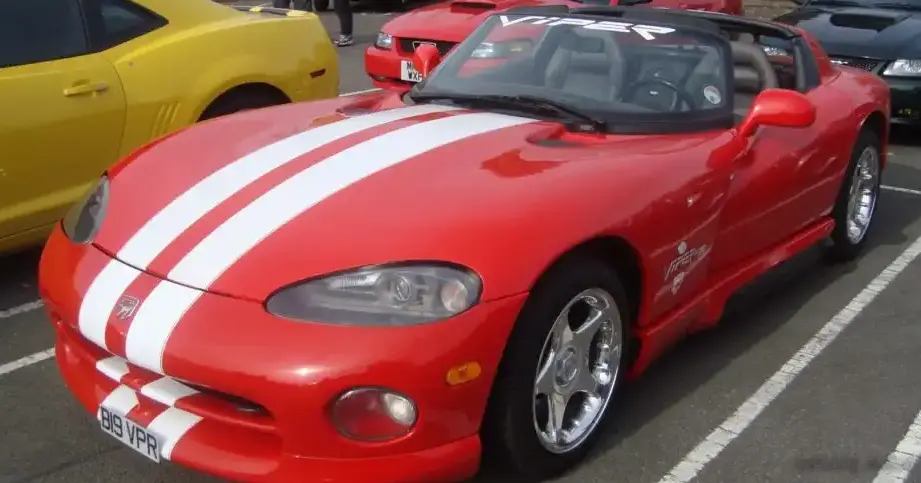
The Chrysler Viper 8.0 V10, produced from 1997 to 2002, represents the first generation of the iconic American sports car. Born from a concept car originally dubbed the “Copperhead,” the Viper was a deliberate return to the raw, visceral sports car experience, eschewing many of the electronic aids and comforts becoming commonplace in the 1990s. It quickly became a symbol of American performance, offering a potent combination of a massive V10 engine and a relatively lightweight chassis. This initial iteration, designated internally as the ZB I, established the Viper’s reputation for uncompromising performance and a driver-focused experience. The Viper filled a unique niche in the American market, offering a direct competitor to European sports cars like the Porsche 911 and Lotus Esprit, but at a significantly lower price point.
Technical Specifications
| Brand | Chrysler |
| Model | Viper |
| Generation | Viper |
| Type (Engine) | 8.0 V10 (455 Hp) |
| Start of production | 1997 year |
| End of production | 2002 year |
| Powertrain Architecture | Internal Combustion engine |
| Body type | Coupe |
| Seats | 2 |
| Doors | 2 |
| Fuel consumption (economy) – urban | 32.7 l/100 km (7.2 US mpg, 8.6 UK mpg, 3.1 km/l) |
| Fuel consumption (economy) – extra urban | 12.2 l/100 km (19.3 US mpg, 23.2 UK mpg, 8.2 km/l) |
| Fuel Type | Petrol (Gasoline) |
| Acceleration 0 – 100 km/h | 4.5 sec |
| Acceleration 0 – 62 mph | 4.5 sec |
| Acceleration 0 – 60 mph | 4.3 sec |
| Maximum speed | 298 km/h (185.17 mph) |
| Weight-to-power ratio | 3.5 kg/Hp, 286.2 Hp/tonne |
| Weight-to-torque ratio | 2.4 kg/Nm, 419.5 Nm/tonne |
| Power | 455 Hp @ 5200 rpm |
| Power per litre | 56.9 Hp/l |
| Torque | 667 Nm @ 3700 rpm (491.95 lb.-ft. @ 3700 rpm) |
| Engine layout | Front, Longitudinal |
| Engine displacement | 7990 cm3 (487.58 cu. in.) |
| Number of cylinders | 10 |
| Engine configuration | V-engine |
| Cylinder Bore | 101.6 mm (4 in.) |
| Piston Stroke | 98.55 mm (3.88 in.) |
| Compression ratio | 9.6:1 |
| Number of valves per cylinder | 2 |
| Fuel injection system | Multi-port manifold injection |
| Engine aspiration | Naturally aspirated engine |
| Engine oil capacity | 8 l (8.45 US qt | 7.04 UK qt) |
| Coolant | 12 l (12.68 US qt | 10.56 UK qt) |
| Kerb Weight | 1590 kg (3505.35 lbs.) |
| Max. weight | 1840 kg (4056.51 lbs.) |
| Max load | 250 kg (551.16 lbs.) |
| Trunk (boot) space – minimum | 565 l (19.95 cu. ft.) |
| Trunk (boot) space – maximum | 1000 l (35.31 cu. ft.) |
| Fuel tank capacity | 72 l (19.02 US gal | 15.84 UK gal) |
| Length | 4490 mm (176.77 in.) |
| Width | 1920 mm (75.59 in.) |
| Height | 1190 mm (46.85 in.) |
| Wheelbase | 2445 mm (96.26 in.) |
| Front track | 1515 mm (59.65 in.) |
| Rear (Back) track | 1540 mm (60.63 in.) |
| Drivetrain Architecture | The Internal combustion engine (ICE) drives the rear wheels of the vehicle. |
| Drive wheel | Rear wheel drive |
| Number of gears and type of gearbox | 6 gears, manual transmission |
| Front suspension | Double wishbone |
| Rear suspension | Double wishbone |
| Front brakes | Ventilated discs |
| Rear brakes | Ventilated discs |
| Assisting systems | ABS (Anti-lock braking system) |
| Steering type | Steering rack and pinion |
| Power steering | Hydraulic Steering |
| Tires size | 275/40 R17 |
Powertrain & Engine Architecture
The heart of the first-generation Viper is its 8.0-liter (487.58 cubic inch) V10 engine. This engine, designated the engine code was not prominently displayed, was a naturally aspirated powerplant designed for maximum power and minimal weight. It featured cast iron block and aluminum cylinder heads, with two valves per cylinder operated by a single overhead camshaft per bank. The engine utilized a multi-port fuel injection system, delivering fuel directly into each intake port. The V10 configuration provided a unique exhaust note and a smooth power delivery, despite its large displacement. The engine produced 455 horsepower at 5,200 rpm and 491.95 lb-ft of torque at 3,700 rpm. The only transmission offered was a robust, six-speed manual gearbox, reinforcing the Viper’s commitment to a pure driving experience. The engine’s design prioritized simplicity and durability, eschewing complex variable valve timing or forced induction systems.
Driving Characteristics
The 1997-2002 Viper offered a driving experience unlike almost anything else on the road at the time. The combination of the powerful V10 engine and the manual transmission resulted in exhilarating acceleration. The 0-60 mph sprint took approximately 4.3 seconds, and the car could reach a top speed of 185.17 mph. However, the Viper was not a refined sports car. The suspension was firm, providing excellent handling but a relatively harsh ride. The lack of electronic stability control and traction control meant that the driver was fully responsible for managing the car’s immense power. The Viper demanded respect and skill, and could be unforgiving to those who underestimated its capabilities. The gear ratios were tuned for acceleration, with a relatively short final drive, contributing to the car’s responsiveness.
Equipment & Trim Levels
The Viper was intentionally minimalist in its equipment levels. The focus was on performance, not luxury. Standard features included air conditioning, power windows, and power locks. The interior was spartan, with simple analog gauges and supportive bucket seats. Upholstery was typically leather, but options were limited. A premium sound system was available, but the Viper’s loud exhaust note often drowned out the music. The Viper was not offered with many of the convenience features found in other sports cars of the era, such as cruise control or a navigation system. This stripped-down approach kept the weight down and reinforced the car’s raw, visceral character.
Chassis & Braking
The Viper’s chassis was a tubular steel space frame, providing a rigid and lightweight foundation. The suspension consisted of double wishbones at all four corners, with coil springs and gas-filled shock absorbers. The braking system featured ventilated discs at all four wheels, with ABS (Anti-lock Braking System) as standard equipment. The rear brakes were notably smaller than the front brakes, a cost-saving measure that contributed to the car’s tendency to oversteer. The steering was a rack-and-pinion system with hydraulic power assistance, providing precise and responsive control. The relatively low curb weight of 3505.35 lbs contributed to the car’s agility and handling.
Market Reception & Comparison
The Chrysler Viper was initially met with both excitement and skepticism. Critics praised its performance and value, but some questioned its lack of refinement and its challenging driving dynamics. Compared to other sports cars in its price range, the Viper offered significantly more power, but less comfort and convenience. Fuel economy was predictably poor, with combined fuel consumption of around 15.7 mpg. Reliability was generally good, but the Viper’s complex engine and demanding driving characteristics meant that it required regular maintenance. The Viper quickly gained a loyal following among enthusiasts who appreciated its raw, uncompromising character.
Legacy
The first-generation Chrysler Viper established the model as a true American icon. Its bold styling, massive V10 engine, and uncompromising performance captivated enthusiasts and cemented its place in automotive history. While early Vipers suffered from some teething issues, the powertrain proved to be remarkably durable when properly maintained. Today, the 1997-2002 Viper is a sought-after collectible, with prices steadily increasing. The car remains a symbol of American performance and a reminder of a time when sports cars were about pure driving enjoyment, not electronic aids and creature comforts. The Viper’s legacy continues to inspire automotive enthusiasts and serves as a benchmark for performance and driver engagement.