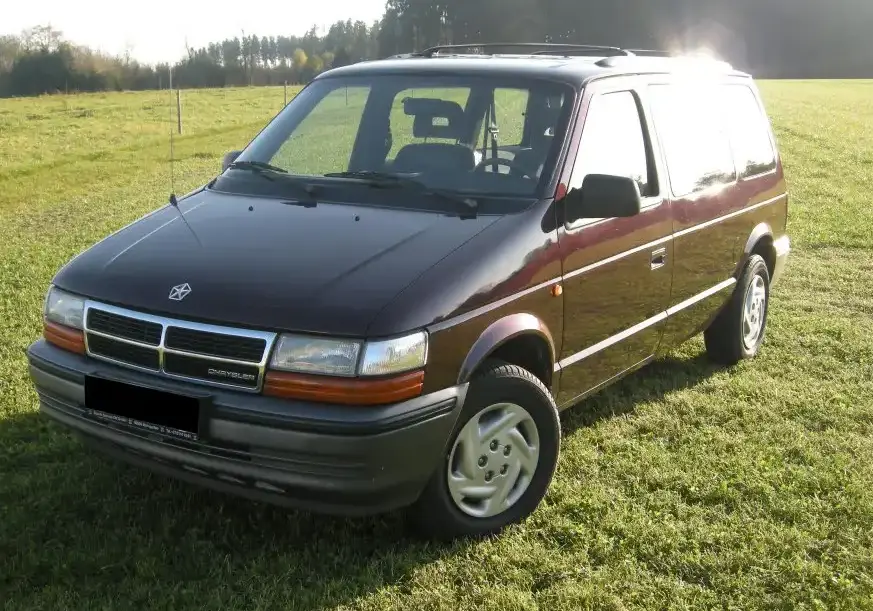
The Chrysler Voyager II 2.5i Automatic, produced between 1990 and 1995, represented a significant entry in the burgeoning minivan market, particularly in Europe and other international markets. Positioned as a more affordable option within the Voyager II range, the 2.5i model with the automatic transmission aimed to provide family transportation with a focus on practicality and ease of use. It was built on the Chrysler’s NS platform, shared with the Dodge Caravan and Plymouth Voyager, and represented the second generation of Chrysler’s minivan offerings. This variant served as a stepping stone for buyers who desired the space and versatility of a minivan but didn’t require the performance of higher-trim models.
Technical Specifications
| Brand | Chrysler |
| Model | Voyager |
| Generation | Voyager II |
| Type (Engine) | 2.5 i (101 Hp) Automatic |
| Start of production | 1990 |
| End of production | 1995 |
| Powertrain Architecture | Internal Combustion engine |
| Body type | Minivan |
| Seats | 7 |
| Doors | 3 |
| Fuel consumption (urban) | 14.2 l/100 km (16.6 US mpg, 19.9 UK mpg, 7 km/l) |
| Fuel consumption (extra urban) | 7.1 l/100 km (33.1 US mpg, 39.8 UK mpg, 14.1 km/l) |
| Fuel consumption (combined) | 9.6 l/100 km (24.5 US mpg, 29.4 UK mpg, 10.4 km/l) |
| Fuel Type | Petrol (Gasoline) |
| Acceleration 0 – 100 km/h | 16 sec |
| Acceleration 0 – 62 mph | 16 sec |
| Acceleration 0 – 60 mph | 15.2 sec |
| Maximum speed | 158 km/h (98.18 mph) |
| Weight-to-power ratio | 14.7 kg/Hp, 68 Hp/tonne |
| Weight-to-torque ratio | 8.1 kg/Nm, 123.2 Nm/tonne |
| Power | 101 Hp @ 4800 rpm |
| Power per litre | 40.4 Hp/l |
| Torque | 183 Nm @ 2800 rpm (134.97 lb.-ft. @ 2800 rpm) |
| Engine layout | Front, Transverse |
| Engine displacement | 2501 cm3 (152.62 cu. in.) |
| Number of cylinders | 4 |
| Engine configuration | Inline |
| Cylinder Bore | 87.5 mm (3.44 in.) |
| Piston Stroke | 104 mm (4.09 in.) |
| Compression ratio | 9:1 |
| Number of valves per cylinder | 2 |
| Fuel injection system | Single-point injection |
| Engine aspiration | Naturally aspirated engine |
| Valvetrain | OHC |
| Engine oil capacity | 3.8 l (4.02 US qt | 3.34 UK qt) |
| Coolant | 9 l (9.51 US qt | 7.92 UK qt) |
| Kerb Weight | 1485 kg (3273.86 lbs.) |
| Max. weight | 2395 kg (5280.07 lbs.) |
| Max load | 910 kg (2006.21 lbs.) |
| Trunk (boot) space – minimum | 671 l (23.7 cu. ft.) |
| Trunk (boot) space – maximum | 3250 l (114.77 cu. ft.) |
| Fuel tank capacity | 76 l (20.08 US gal | 16.72 UK gal) |
| Length | 4525 mm (178.15 in.) |
| Width | 1830 mm (72.05 in.) |
| Height | 1707 mm (67.2 in.) |
| Wheelbase | 2853 mm (112.32 in.) |
| Front track | 1522 mm (59.92 in.) |
| Rear (Back) track | 1578 mm (62.13 in.) |
| Drivetrain Architecture | The Internal combustion engine (ICE) drives the front wheels of the vehicle. |
| Drive wheel | Front wheel drive |
| Number of gears and type of gearbox | 3 gears, automatic transmission |
| Front suspension | Wishbone |
| Rear suspension | Leaf spring |
| Front brakes | Ventilated discs |
| Rear brakes | Drum |
| Assisting systems | ABS (Anti-lock braking system) |
| Steering type | Steering rack and pinion |
| Power steering | Hydraulic Steering |
| Tires size | 195/75 R14 |
| Wheel rims size | 14 |
Powertrain & Engine Architecture
The heart of the Voyager II 2.5i Automatic was the 2.5-liter inline-four cylinder engine. Internally designated with various codes depending on the market, this engine was a relatively simple design, featuring a single overhead camshaft (OHC) and two valves per cylinder. The fuel delivery system utilized single-point fuel injection, a common technology for the time, which offered a balance between cost and efficiency. This system injected fuel into the intake manifold rather than directly into the cylinders. The engine produced 101 horsepower at 4800 rpm and 183 Nm (135 lb-ft) of torque at 2800 rpm. The engine was transversely mounted in the front of the vehicle, driving the front wheels. Paired with the engine was a three-speed automatic transmission, chosen for its ease of use and suitability for family drivers. This transmission wasn’t known for its sporty performance, but it provided smooth shifts and predictable behavior.
Driving Characteristics
The 2.5i Automatic Voyager II offered a comfortable, if not particularly exciting, driving experience. Acceleration was modest, taking around 16 seconds to reach 60 mph. The three-speed automatic transmission, while smooth, lacked the responsiveness of a manual gearbox or a more modern automatic with additional gears. The gear ratios were optimized for fuel economy and relaxed cruising rather than spirited driving. In real-world conditions, the Voyager II 2.5i felt adequate for everyday tasks like commuting and highway driving, but struggled when fully loaded with passengers and luggage, or when attempting to overtake on the highway. Compared to the more powerful V6 options available in the Voyager lineup, the 2.5i felt noticeably slower and less refined.
Equipment & Trim Levels
The Voyager II 2.5i Automatic typically came with a fairly basic level of equipment, reflecting its position as an entry-level model. Standard features generally included power steering, air conditioning, and an AM/FM radio. Interior upholstery was typically cloth, and the dashboard featured a simple, functional design. Optional extras included power windows and locks, upgraded sound systems, and a rear window wiper. The trim level often dictated the color of the interior fabrics and the availability of certain cosmetic enhancements. The focus was on providing a practical and affordable family vehicle, rather than luxury or high-end features.
Chassis & Braking
The Voyager II’s chassis was designed for comfort and practicality. The front suspension utilized a wishbone setup, while the rear suspension employed a leaf spring design. This combination provided a reasonably comfortable ride, although it wasn’t particularly sporty. Braking duties were handled by ventilated discs at the front and drum brakes at the rear. An anti-lock braking system (ABS) was often included as standard equipment, enhancing safety. The steering was rack and pinion, providing adequate precision for everyday driving. The relatively simple suspension setup and drum brakes on the rear were cost-saving measures common in this class of vehicle.
Market Reception & Comparison
The Chrysler Voyager II 2.5i Automatic was generally well-received as an affordable and practical family vehicle. Critics praised its spacious interior and comfortable ride, but noted its lack of performance and somewhat dated technology. Compared to the higher-trim Voyager models with V6 engines, the 2.5i offered significantly less power and refinement. However, it also offered better fuel economy and a lower purchase price. Against competitors like the Ford Windstar and the Chevrolet Venture, the Voyager II 2.5i held its own in terms of space and practicality, but often lagged behind in terms of performance and features.
Legacy
The Chrysler Voyager II 2.5i Automatic, while not a performance icon, remains a relatively reliable and affordable used car option today. The 2.5-liter engine is known for its durability, although regular maintenance is essential to prevent issues. The automatic transmission, while not particularly sophisticated, is generally reliable if properly serviced. Parts availability is generally good, and the relatively simple design of the vehicle makes it relatively easy to repair. Today, these Voyagers are often found as budget-friendly transportation for families or as work vehicles, representing a practical and enduring legacy in the minivan segment.