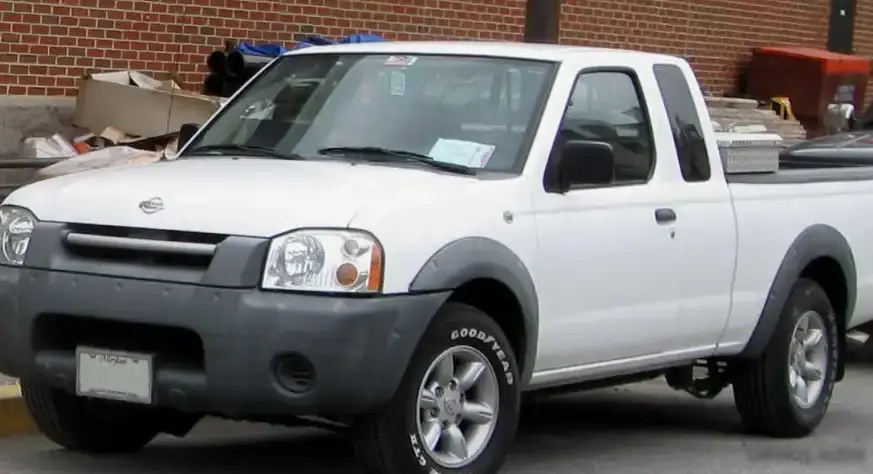
The Nissan Frontier I King Cab (D22), specifically the facelifted version produced from 2000 to 2004, represented Nissan’s entry into the increasingly popular mid-size pickup truck market in North America and other global markets. This generation Frontier, built on the D22 platform, aimed to offer a blend of affordability, practicality, and reliability. The 2.4-liter (143 hp) automatic variant occupied a position as the base engine and transmission option, targeting buyers seeking a functional and economical truck for everyday use and light-duty tasks. It was positioned below the more powerful 3.3-liter V6 options, offering a lower price point but with a trade-off in performance.
Technical Specifications
| Brand | Nissan |
| Model | Frontier |
| Generation | Frontier I King Cab (D22, facelift 2000) |
| Type (Engine) | 2.4 (143 Hp) Automatic |
| Start of production | 2000 |
| End of production | 2004 |
| Powertrain Architecture | Internal Combustion engine |
| Body type | Pick-up |
| Seats | 4 |
| Doors | 2 |
| Fuel Type | Petrol (Gasoline) |
| Power | 143 Hp @ 5200 rpm |
| Power per litre | 59.9 Hp/l |
| Torque | 209 Nm @ 4000 rpm / 154.15 lb.-ft. @ 4000 rpm |
| Engine Model/Code | KA24DE |
| Engine displacement | 2389 cm3 / 145.79 cu. in. |
| Number of cylinders | 4 |
| Engine configuration | Inline |
| Cylinder Bore | 89 mm / 3.5 in. |
| Piston Stroke | 96 mm / 3.78 in. |
| Number of valves per cylinder | 4 |
| Fuel injection system | Multi-port manifold injection |
| Engine aspiration | Naturally aspirated engine |
| Engine oil capacity | 3.5 l / 3.7 US qt | 3.08 UK qt |
| Coolant | 7.1 l / 7.5 US qt | 6.25 UK qt |
| Fuel tank capacity | 60.2 l / 15.9 US gal | 13.24 UK gal |
| Permitted trailer load with brakes (12%) | 907 kg / 1999.59 lbs. |
| Permitted towbar download | 91 kg / 200.62 lbs. |
| Length | 4999 mm / 196.81 in. |
| Width | 1664-1808 mm / 65.51 – 71.18 in. |
| Height | 1605 mm / 63.19 in. |
| Wheelbase | 2950 mm / 116.14 in. |
| Front track | 1395 mm / 54.92 in. |
| Rear (Back) track | 1390 mm / 54.72 in. |
| Drivetrain Architecture | Rear wheel drive |
| Number of gears and type of gearbox | 4 gears, automatic transmission |
| Front suspension | Double wishbone |
| Rear suspension | Leaf spring |
| Front brakes | Ventilated discs |
| Rear brakes | Drum |
| Tires size | 225/70 R15; 265/70 R15; 255/65 R16; 265/55 R17 |
| Wheel rims size | 6.0J x 15; 7.0J x 15; 7.0J x 16; 8.0J x 17 |
Powertrain & Engine Architecture
The heart of this Frontier variant is the KA24DE 2.4-liter inline-four cylinder engine. This engine, a staple in Nissan’s lineup for many years, is known for its relative simplicity and durability. It features a cast iron block and an aluminum cylinder head, employing multi-port fuel injection for efficient fuel delivery. The KA24DE utilizes a single overhead camshaft (SOHC) design with four valves per cylinder, contributing to reasonable power output for its displacement. The engine’s 143 horsepower and 154 lb-ft of torque were delivered through a four-speed automatic transmission. This transmission, while providing ease of use, was not known for its sophistication or fuel efficiency compared to more modern automatic gearboxes. The automatic transmission was geared towards providing smooth, comfortable shifts rather than sporty performance. It was a fairly conventional automatic, lacking features like overdrive or selectable shift modes common in later transmissions.
Driving Characteristics
The 2.4-liter engine and four-speed automatic combination in the Frontier King Cab delivered adequate, but not exhilarating, performance. Acceleration was modest, and passing maneuvers required careful planning. The automatic transmission’s gear ratios were optimized for fuel economy and everyday driving, resulting in a noticeable lack of responsiveness when pushed hard. Compared to the available 3.3-liter V6 versions, the 2.4L felt significantly underpowered, especially when hauling cargo or towing. The four-speed automatic contributed to higher engine speeds at highway cruising, impacting both noise levels and fuel consumption. However, for buyers prioritizing fuel efficiency and a relaxed driving experience, the 2.4L automatic offered a suitable balance. The rear-wheel-drive configuration provided a traditional truck feel, with predictable handling characteristics. The suspension, while adequate, wasn’t particularly refined, resulting in a somewhat firm ride, especially when the bed was empty.
Equipment & Trim Levels
The base 2.4-liter automatic Frontier King Cab typically came with a fairly basic set of standard features. These generally included air conditioning, a basic AM/FM radio, cloth upholstery, and manual windows and locks. Power steering was standard, but power windows and locks were often optional extras. The King Cab configuration offered a small rear seat area, suitable for occasional passengers or extra storage. This rear seating was best suited for children or short trips. Optional equipment could include upgraded audio systems, alloy wheels, and a sliding rear window. The interior was functional and durable, prioritizing practicality over luxury. The dashboard layout was straightforward and easy to use, with large, clearly marked controls.
Chassis & Braking
The Frontier I King Cab utilized a body-on-frame construction, typical of pickup trucks of the era. This construction method provided a robust and durable platform, but also contributed to a higher overall weight. The front suspension consisted of double wishbones, providing a reasonably comfortable ride. The rear suspension employed leaf springs, which were well-suited for carrying loads but could result in a somewhat bumpy ride when unladen. Braking duties were handled by ventilated discs at the front and drum brakes at the rear. This configuration was adequate for the truck’s weight and intended use, but lacked the stopping power of four-wheel disc brakes. The steering was hydraulic power-assisted, providing reasonable maneuverability, although it lacked the precision of more modern steering systems.
Market Reception & Comparison
The 2.4-liter automatic Frontier was generally viewed as a sensible and affordable option in the mid-size pickup truck segment. Critics acknowledged its practicality and reliability, but often noted its lack of power compared to competitors and even its own V6-powered siblings. Fuel economy was a strong point, making it an attractive choice for buyers seeking a cost-effective work truck. Compared to the 3.3-liter V6 models, the 2.4L offered significantly lower purchase price and better gas mileage, but at the expense of performance and towing capacity. The 2.4L was often favored by those who primarily used their trucks for commuting and light-duty tasks. It competed with other base-model mid-size trucks like the Ford Ranger and Chevrolet S-10, often offering a more modern interior and a slightly more refined driving experience.
Legacy
The KA24DE engine, in general, has a reputation for being a durable and reliable powerplant, and the Frontier’s 2.4-liter variant is no exception. While not known for its high performance, it has proven to be capable of racking up high mileage with proper maintenance. In the used car market today, these Frontier King Cabs are often sought after by buyers looking for an affordable and dependable truck. The 2.4-liter automatic models tend to be more affordable than the V6 versions, making them an attractive option for those on a budget. However, potential buyers should be aware of the limitations of the four-speed automatic transmission and the engine’s modest power output. Common issues with these trucks include rust, particularly in areas with harsh winters, and wear and tear on suspension components. Overall, the Nissan Frontier I King Cab 2.4L Automatic remains a viable option for those seeking a simple, reliable, and affordable pickup truck, especially for light-duty applications.