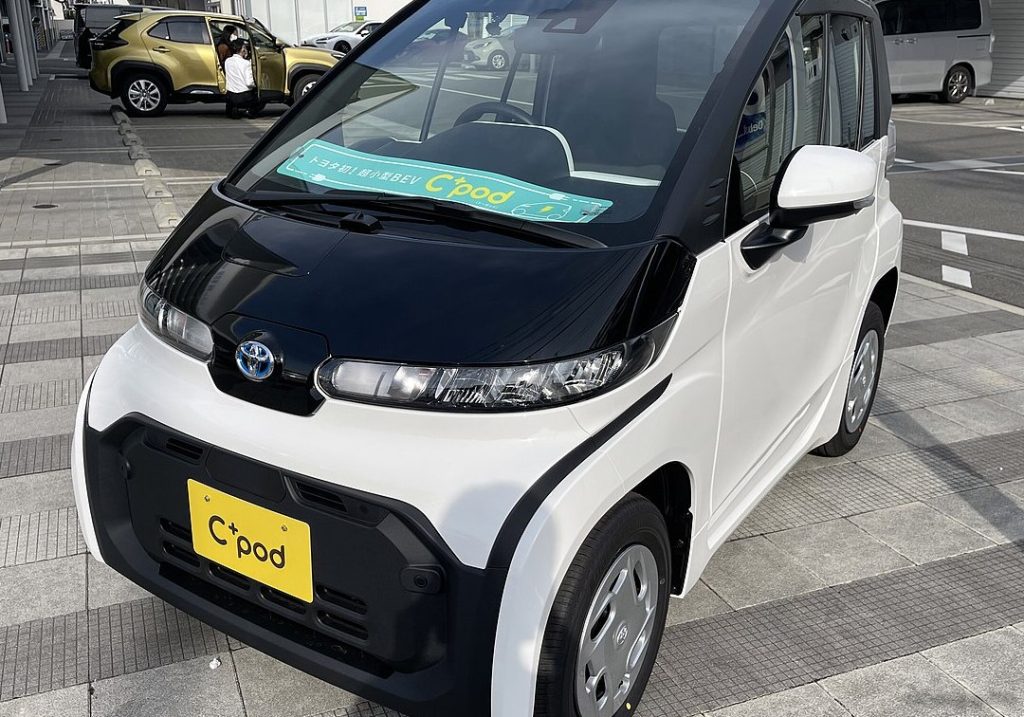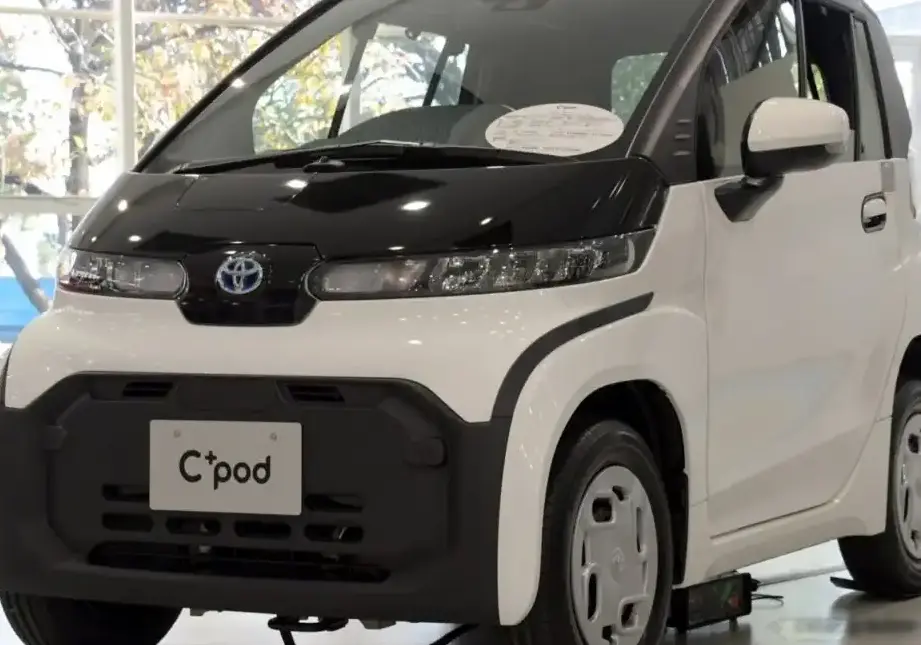
The Toyota C+pod is a two-seater, ultra-compact battery electric vehicle (BEV) designed primarily for short-distance urban commuting. Introduced in December 2020, the C+pod represents Toyota’s commitment to offering a diverse range of electrified vehicles, catering to specific needs within the Japanese market. It’s positioned as an alternative to kei cars, offering electric mobility in a very small package. The C+pod utilizes a rear-wheel-drive layout and a single electric motor, prioritizing efficiency and maneuverability over outright performance. It’s important to note that the C+pod was initially offered exclusively in Japan and has not been widely exported.
Technical Specifications
| Brand | Toyota |
| Model | C+pod |
| Generation | C+pod |
| Type (Engine) | 9.06 kWh (13 Hp) |
| Start of production | December, 2020 |
| Powertrain Architecture | BEV (Electric Vehicle) |
| Body type | Hatchback |
| Seats | 2 |
| Doors | 3 |
| Fuel Type | Electricity |
| Maximum speed | 60 km/h (37.28 mph) |
| Weight-to-power ratio | 51.5 kg/Hp, 19.4 Hp/tonne |
| Weight-to-torque ratio | 12 kg/Nm, 83.6 Nm/tonne |
| Gross battery capacity | 9.06 kWh |
| Battery voltage | 177.6 V |
| Battery technology | Lithium-ion (Li-Ion) |
| Battery location | Below the floor |
| All-electric range | 150 km (93.21 mi) |
| Average Energy consumption | 5.4 kWh/100 km (8.69 kWh/100 mi) |
| MPGe | 388 |
| km/kWh | 18.5 |
| mi/kWh | 11.5 |
| Electric motor power | 13 Hp |
| Electric motor Torque | 56 Nm (41.3 lb.-ft.) |
| Electric motor location | Rear axle, Transverse |
| System power | 13 Hp |
| System torque | 56 Nm (41.3 lb.-ft.) |
| Kerb Weight | 670-690 kg (1477.1 – 1521.19 lbs.) |
| Length | 2490 mm (98.03 in.) |
| Width | 1290 mm (50.79 in.) |
| Height | 1550 mm (61.02 in.) |
| Wheelbase | 1780 mm (70.08 in.) |
| Front track | 1105 mm (43.5 in.) |
| Rear (Back) track | 1095 mm (43.11 in.) |
| Ride height (ground clearance) | 145 mm (5.71 in.) |
| Minimum turning circle (turning diameter) | 7.8 m (25.59 ft.) |
| Drivetrain Architecture | One electric motor drives the rear wheels. |
| Drive wheel | Rear wheel drive |
| Number of gears and type of gearbox | 1 gears, automatic transmission |
| Front suspension | Spring Strut, Transverse stabilizer |
| Rear suspension | Coil spring, Torsion |
| Front brakes | Disc |
| Rear brakes | Drum |
| Steering type | Steering rack and pinion |
| Tires size | 155/70 R13 |
| Wheel rims size | 13 |
Powertrain & Engine Architecture
The C+pod is powered by a single electric motor located on the rear axle, producing 13 horsepower and 56 Nm (41.3 lb.-ft.) of torque. It utilizes a 9.06 kWh lithium-ion battery pack positioned under the floor, contributing to a low center of gravity. The battery operates at 177.6V. The powertrain is a direct-drive system, employing a single-speed automatic transmission. This simplicity is a key factor in the C+pod’s efficiency. The vehicle uses regenerative braking to recapture energy during deceleration, further extending its range. The charging port location is not widely publicized, but it supports standard AC charging.
Driving Characteristics
Given its limited power output, the C+pod is not designed for high-speed driving. Its maximum speed is restricted to 60 km/h (37.28 mph). Acceleration is understandably slow, making it best suited for navigating congested city streets. The rear-wheel-drive configuration provides a surprisingly nimble feel, particularly in tight corners. The single-speed transmission offers smooth, linear power delivery. Compared to potential future higher-performance variants (should Toyota develop them), this base model prioritizes efficiency and ease of use over sporty driving dynamics. The single gear ratio is optimized for maximizing range within its intended operating environment.
Equipment & Trim Levels
The C+pod is relatively sparsely equipped, reflecting its affordability and focus on essential transportation. Standard features include air conditioning, power windows, and a basic audio system. Safety features include airbags and anti-lock brakes. Interior upholstery is simple and durable. Optional extras, available at the time of purchase, included different exterior colors and a navigation system. The interior design is minimalist, prioritizing functionality and space efficiency within the compact dimensions. Trim levels were limited, with most customization options revolving around exterior aesthetics.
Chassis & Braking
The C+pod utilizes a lightweight chassis to maximize efficiency. The front suspension consists of a spring strut setup with a transverse stabilizer bar, while the rear suspension employs a coil spring and torsion beam arrangement. The front brakes are discs, providing adequate stopping power for the vehicle’s weight and speed. The rear brakes are drums, a cost-saving measure typical in this segment. The steering system is a rack and pinion type, offering precise and responsive handling. The vehicle rides on 13-inch wheels with 155/70 R13 tires.
Market Reception & Comparison
The Toyota C+pod was primarily targeted at the Japanese market, where it found a niche among commuters seeking an affordable and eco-friendly transportation solution. Critics praised its compact size, ease of maneuverability, and low running costs. However, its limited range and slow speed were also noted. Compared to other kei cars, the C+pod offered the advantage of zero emissions. Compared to other BEVs, it was significantly more affordable, but also offered a much shorter range and lower performance. Its fuel economy, expressed as 5.4 kWh/100 km (8.69 kWh/100 mi) and 388 MPGe, was competitive within the ultra-compact EV segment.
Legacy
The Toyota C+pod represents an important step in Toyota’s broader electrification strategy. While not a global model, it demonstrated the company’s ability to develop and produce affordable, purpose-built EVs. The C+pod’s powertrain, while modest in terms of power, has proven to be reliable in real-world use. On the used car market in Japan, the C+pod holds its value reasonably well, reflecting the growing demand for electric vehicles. The C+pod’s legacy lies in its contribution to the expansion of electric mobility options, particularly in densely populated urban areas. Its simple design and focus on efficiency may influence future Toyota EV development.