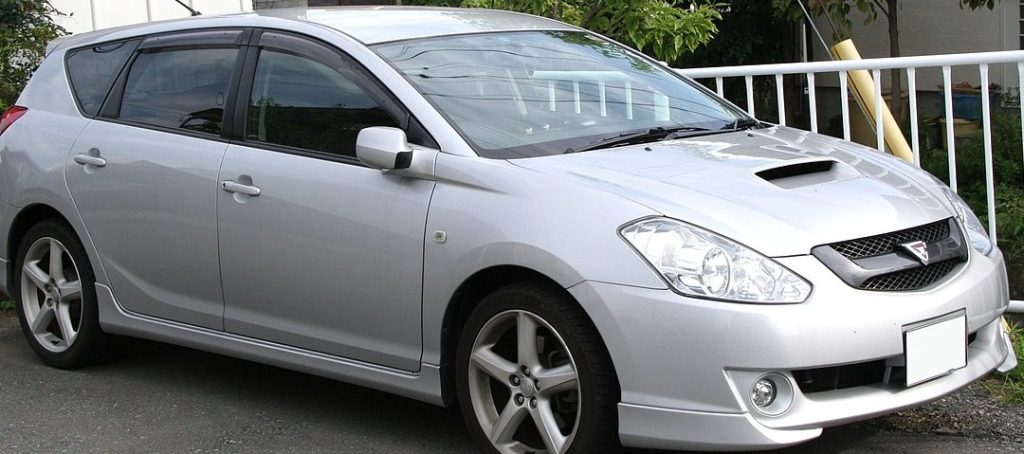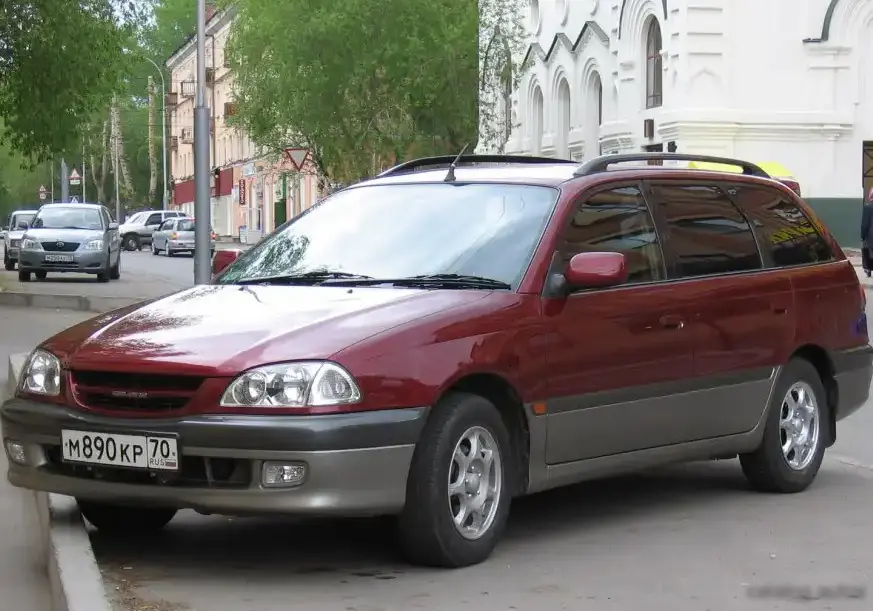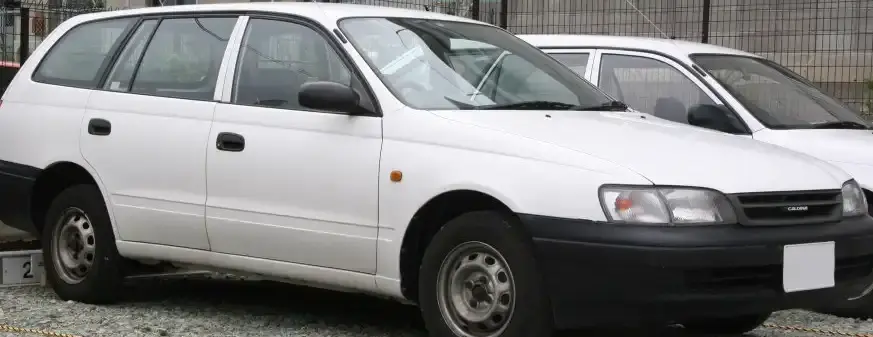
The Toyota Caldina (T19) 1.8i 16V CZ, produced between 1992 and 1997, represents a practical and often overlooked station wagon offering from Toyota. Positioned within the broader Caldina (T19) range – which spanned from 1992 to 1997 and shared its platform (the 1HX0) with the Toyota Corona and Celica – the 1.8i served as the entry-level engine option, appealing to buyers prioritizing fuel efficiency and affordability over outright performance. It was primarily marketed in Japan, where the wagon body style remained popular, offering a blend of family practicality and Toyota’s reputation for reliability. This variant aimed at a broader customer base than the more performance-oriented turbocharged models that would later become associated with the Caldina nameplate.
Technical Specifications
| Brand | Toyota |
| Model | Caldina |
| Generation | Caldina (T19) |
| Type (Engine) | 1.8i 16V CZ (125 Hp) |
| Start of production | 1992 |
| End of production | 1997 |
| Powertrain Architecture | Internal Combustion engine |
| Body type | Station wagon (estate) |
| Seats | 5 |
| Doors | 5 |
| Fuel consumption (combined) | 5.4 l/100 km |
| Fuel consumption (US mpg) | 43.6 US mpg |
| Fuel consumption (UK mpg) | 52.3 UK mpg |
| Fuel consumption (km/l) | 18.5 km/l |
| Fuel Type | Petrol (Gasoline) |
| Weight-to-power ratio | 9.4 kg/Hp |
| Hp/tonne | 105.9 Hp/tonne |
| Weight-to-torque ratio | 7.3 kg/Nm |
| Nm/tonne | 137.3 Nm/tonne |
| Power | 125 Hp @ 6000 rpm |
| Power per litre | 68 Hp/l |
| Torque | 162 Nm @ 4600 rpm (119.49 lb.-ft. @ 4600 rpm) |
| Engine layout | Front, Transverse |
| Engine Model/Code | 4S-FE |
| Engine displacement | 1839 cm3 (112.22 cu. in.) |
| Number of cylinders | 4 |
| Engine configuration | Inline |
| Cylinder Bore | 82.5 mm (3.25 in.) |
| Piston Stroke | 86 mm (3.39 in.) |
| Compression ratio | 9.5:1 |
| Number of valves per cylinder | 4 |
| Fuel injection system | Multi-port manifold injection |
| Engine aspiration | Naturally aspirated engine |
| Valvetrain | DOHC |
| Engine oil capacity | 3.9 l (4.12 US qt | 3.43 UK qt) |
| Coolant capacity | 6.6 l (6.97 US qt | 5.81 UK qt) |
| Kerb Weight | 1180 kg (2601.45 lbs.) |
| Max. weight | 1455 kg (3207.73 lbs.) |
| Max load | 275 kg (606.27 lbs.) |
| Fuel tank capacity | 60 l (15.85 US gal | 13.2 UK gal) |
| Length | 4545 mm (178.94 in.) |
| Width | 1695 mm (66.73 in.) |
| Height | 1450 mm (57.09 in.) |
| Wheelbase | 2580 mm (101.57 in.) |
| Front track | 1465 mm (57.68 in.) |
| Rear track | 1450 mm (57.09 in.) |
| Drivetrain Architecture | Front wheel drive |
| Number of gears | 5 |
| Gearbox type | Manual transmission |
| Front suspension | Spring Strut |
| Rear suspension | Coil spring |
| Front brakes | Ventilated discs |
| Rear brakes | Drum |
| Assisting systems | ABS (Anti-lock braking system) |
| Steering type | Steering rack and pinion |
| Power steering | Hydraulic Steering |
| Tires size | 185/65 R14 S |
Powertrain & Engine Architecture
The heart of the Caldina 1.8i is the 4S-FE engine, a 1.8-liter (1839 cc) inline-four cylinder gasoline engine. This engine, a mainstay in Toyota’s lineup during the 1990s, is known for its durability and relatively simple design. It features a double overhead camshaft (DOHC) valvetrain with four valves per cylinder, contributing to its respectable power output for its displacement. Fuel delivery is handled by a multi-port fuel injection system, optimizing combustion efficiency. The 4S-FE produces 125 horsepower at 6000 rpm and 162 Nm (119.49 lb-ft) of torque at 4600 rpm. The engine’s design prioritized smooth operation and fuel economy over peak performance. The standard transmission for this variant was a 5-speed manual, although a 4-speed automatic transmission was also available, impacting the vehicle’s acceleration and fuel consumption.
Driving Characteristics
The 1.8i Caldina, particularly when equipped with the 5-speed manual transmission, offered a reasonably engaging driving experience. While not a sports car, the engine provided adequate power for everyday driving and highway cruising. The manual gearbox allowed for precise control, and the relatively light weight of the vehicle (1180 kg / 2601.45 lbs) contributed to a feeling of nimbleness. The automatic transmission, while offering convenience, noticeably dulled acceleration and reduced fuel economy. Gear ratios were tuned for fuel efficiency, meaning the engine often needed to be revved to access its full power. Compared to the later, turbocharged Caldina variants (like the 2.0L 280RS), the 1.8i felt significantly less powerful, but it also offered a more predictable and manageable driving experience for less experienced drivers.
Equipment & Trim Levels
The Caldina 1.8i typically came with a modest level of standard equipment. Interior features generally included cloth upholstery, a basic stereo system, and manual air conditioning. Power windows and door locks were often optional extras. Trim levels varied depending on the specific market and package selected, but generally focused on providing essential comfort and convenience features. Higher trim levels might have included features like alloy wheels, upgraded audio systems, and a sunroof. The interior design was functional and straightforward, prioritizing practicality over luxury.
Chassis & Braking
The Caldina 1.8i utilized a front-engine, front-wheel-drive layout. Suspension consisted of a MacPherson strut setup at the front and a coil spring arrangement at the rear. This configuration provided a comfortable ride quality, suitable for everyday use. Braking duties were handled by ventilated discs at the front and drum brakes at the rear. An Anti-lock Braking System (ABS) was often included as standard equipment, enhancing safety. The chassis was designed to provide a balance between ride comfort and handling stability, prioritizing practicality over sporty performance.
Market Reception & Comparison
The Caldina 1.8i was generally well-received in the Japanese market as a practical and reliable family vehicle. Critics praised its fuel efficiency and spacious interior. However, it was often overshadowed by the more powerful and sporty Caldina variants. Compared to the 2.0L models, the 1.8i offered lower running costs but lacked the same level of performance. Its fuel economy of 5.4 l/100 km (43.6 US mpg) was a significant selling point for budget-conscious buyers. Reliability was a key strength, consistent with Toyota’s reputation at the time.
Legacy
The Toyota Caldina 1.8i 16V CZ, while not the most celebrated version of the Caldina, remains a testament to Toyota’s commitment to building durable and practical vehicles. The 4S-FE engine is known for its longevity, and well-maintained examples can still be found on the road today. In the used car market, these Caldinas are often valued for their affordability and reliability, making them a sensible choice for those seeking a practical and economical station wagon. While the turbocharged Caldinas have gained a cult following among enthusiasts, the 1.8i represents the more common and accessible face of the Caldina lineage.