
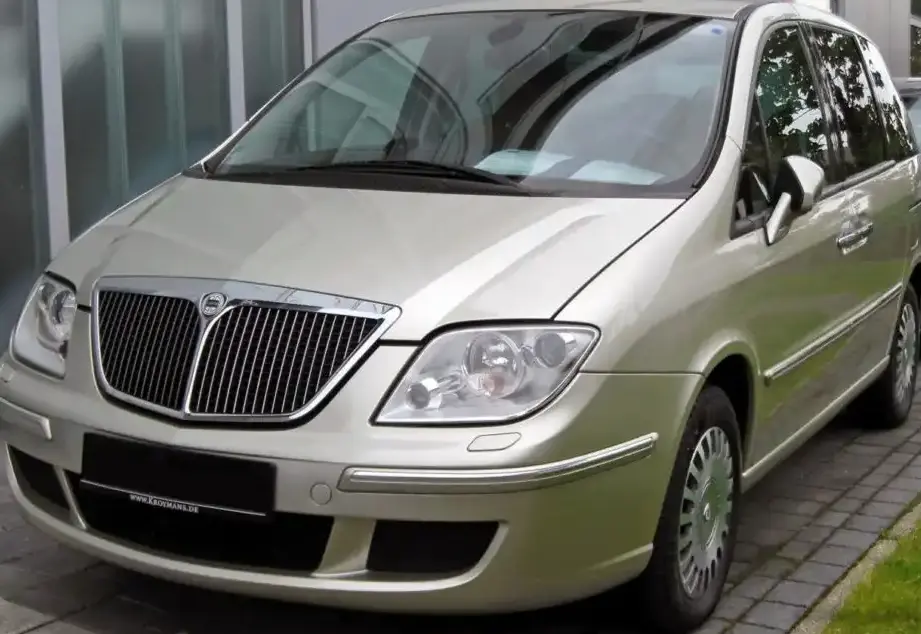
The Lancia Phedra 2.0 JTD, producing 107 horsepower, was a significant offering in the large MPV (Multi-Purpose Vehicle) segment during its production run from 2002 to 2008. Positioned as a more affordable and practical option within the Phedra range, it catered to families and those requiring substantial passenger and cargo space. The Phedra itself was the result of a collaborative effort between Fiat, Peugeot, and Citroën, sharing its underpinnings with the Peugeot 807 and Citroën C8, all built on the shared PSA/Fiat 1HX0 platform. This variant, with its 2.0-liter turbodiesel engine and automatic transmission, aimed to balance fuel efficiency with acceptable performance for everyday use.
Technical Specifications
| Brand | Lancia |
| Model | Phedra |
| Generation | Phedra |
| Type (Engine) | 2.0 JTD (107 Hp) |
| Start of production | 2002 |
| End of production | 2008 |
| Powertrain Architecture | Internal Combustion engine |
| Body type | Minivan |
| Seats | 8 |
| Doors | 5 |
| Fuel consumption (urban) | 9.2 l/100 km (25.6 US mpg) |
| Fuel consumption (extra urban) | 5.9 l/100 km (39.9 US mpg) |
| Fuel consumption (combined) | 7.2 l/100 km (32.7 US mpg) |
| Fuel Type | Diesel |
| Acceleration 0 – 100 km/h | 13.4 sec |
| Acceleration 0 – 62 mph | 13.4 sec |
| Acceleration 0 – 60 mph | 12.7 sec |
| Maximum speed | 174 km/h (108.12 mph) |
| Weight-to-power ratio | 16.2 kg/Hp |
| Weight-to-torque ratio | 6.4 kg/Nm |
| Power | 107 Hp @ 4000 rpm |
| Power per litre | 53.6 Hp/l |
| Torque | 270 Nm @ 1750 rpm (199.14 lb.-ft. @ 1750 rpm) |
| Engine layout | Front, Transverse |
| Engine Model/Code | RHM DW10ATED4 |
| Engine displacement | 1997 cm3 (121.86 cu. in.) |
| Number of cylinders | 4 |
| Engine configuration | Inline |
| Cylinder Bore | 85 mm (3.35 in.) |
| Piston Stroke | 88 mm (3.46 in.) |
| Compression ratio | 18:1 |
| Number of valves per cylinder | 4 |
| Fuel injection system | Diesel Commonrail |
| Engine aspiration | Turbocharger, Intercooler |
| Valvetrain | OHC |
| Engine oil capacity | 4.8 l (5.07 US qt | 4.22 UK qt) |
| Kerb Weight | 1736 kg (3827.22 lbs.) |
| Max. weight | 2505 kg (5522.58 lbs.) |
| Max load | 769 kg (1695.35 lbs.) |
| Trunk (boot) space – minimum | 325 l (11.48 cu. ft.) |
| Trunk (boot) space – maximum | 2950 l (104.18 cu. ft.) |
| Fuel tank capacity | 80 l (21.13 US gal | 17.6 UK gal) |
| Length | 4750 mm (187.01 in.) |
| Width | 1863 mm (73.35 in.) |
| Height | 1760 mm (69.29 in.) |
| Wheelbase | 2823 mm (111.14 in.) |
| Front track | 1570 mm (61.81 in.) |
| Rear (Back) track | 1548 mm (60.94 in.) |
| Drivetrain Architecture | The Internal combustion engine (ICE) drives the front wheels of the vehicle. |
| Drive wheel | Front wheel drive |
| Number of gears and type of gearbox | 5 gears, manual transmission |
| Front suspension | Spring Strut |
| Rear suspension | Coil spring |
| Front brakes | Ventilated discs |
| Rear brakes | Disc |
| Assisting systems | ABS (Anti-lock braking system) |
| Steering type | Steering rack and pinion |
| Power steering | Hydraulic Steering |
| Tires size | 215/65 R15 |
Introduction
The Lancia Phedra 2.0 JTD (107 Hp) was produced between 2002 and 2008 as part of the first generation of the Phedra model line. Sharing its platform with the Peugeot 807 and Citroën C8, the Phedra aimed to provide a luxurious and spacious MPV experience. This particular variant, equipped with the 2.0-liter JTD engine and an automatic transmission, represented a mid-range offering, balancing performance and economy. It was designed to appeal to families and individuals needing a versatile vehicle capable of carrying up to eight passengers and a significant amount of luggage. The Phedra, while not a major sales success for Lancia, offered a unique blend of Italian styling and French engineering.
Powertrain & Engine Architecture
At the heart of the Phedra 2.0 JTD is the DW10ATED4 engine, a 1997cc inline-four cylinder turbodiesel. This engine, developed jointly by PSA and Fiat, utilizes a common rail direct injection system, delivering fuel at extremely high pressure for improved combustion efficiency and reduced emissions. The engine code ‘RHM’ is often associated with this specific output. The engine features an overhead camshaft (OHC) valvetrain with four valves per cylinder, optimizing gas flow for increased power and torque. A turbocharger with an intercooler further enhances performance by forcing more air into the cylinders. The automatic transmission paired with this engine is typically a four-speed unit, designed for smooth and comfortable shifting. While not known for its sportiness, the transmission prioritizes drivability and fuel efficiency.
Driving Characteristics
The 107 horsepower output of the 2.0 JTD engine, coupled with the automatic transmission, resulted in a driving experience focused on comfort and practicality rather than outright performance. Acceleration from 0-60 mph took around 12.7 seconds, and top speed was limited to approximately 108 mph. The automatic transmission, while smooth, could feel somewhat sluggish, particularly during overtaking maneuvers. The gear ratios were optimized for fuel economy, meaning the engine often operated at lower RPMs. Compared to the more powerful 2.2 JTD variants, the 2.0 JTD offered less spirited acceleration. However, it provided a more relaxed driving experience, especially in urban environments. The torque output of 270 Nm (199 lb-ft) at 1750 rpm provided adequate pulling power for fully loaded vehicles.
Equipment & Trim Levels
The Phedra 2.0 JTD typically came equipped with a reasonable level of standard features. These included air conditioning, power windows, central locking, and an audio system. Higher trim levels offered upgrades such as leather upholstery, alloy wheels, a sunroof, and a more advanced audio system with navigation. Interior upholstery was generally cloth on the base models, with leather options available. The dashboard layout was functional and ergonomically designed, with easy-to-read instrumentation. Optional extras included rear parking sensors, a DVD entertainment system for rear passengers, and upgraded climate control systems.
Chassis & Braking
The Phedra’s chassis featured a MacPherson strut front suspension and a coil spring rear suspension. This setup provided a comfortable ride, absorbing bumps and imperfections in the road surface effectively. The braking system consisted of ventilated discs on the front wheels and solid discs on the rear. Anti-lock Braking System (ABS) was standard, enhancing safety by preventing wheel lockup during emergency braking. The Phedra’s weight, exceeding 1700 kg, necessitated a robust braking system to ensure adequate stopping power. Stabilizer bars were fitted to both the front and rear axles to reduce body roll during cornering.
Market Reception & Comparison
The Lancia Phedra 2.0 JTD received mixed reviews from automotive critics. While praised for its spacious interior, comfortable ride, and practical features, it was often criticized for its relatively uninspiring performance and somewhat dated styling. Compared to the more powerful Phedra variants, the 2.0 JTD offered better fuel economy but lacked the same level of performance. Against competitors like the Renault Espace and Volkswagen Sharan, the Phedra offered a unique Italian flair but struggled to match their overall refinement and sales success. Fuel economy was a strong point, averaging around 32.7 US mpg in combined driving conditions.
Legacy
The Lancia Phedra 2.0 JTD, while not a groundbreaking vehicle, remains a practical and affordable MPV option in the used car market. The DW10ATED4 engine is generally considered reliable, although regular maintenance is crucial to prevent issues with the turbocharger and fuel injection system. The automatic transmission, if properly maintained, can provide years of trouble-free service. Today, these vehicles are often sought after by families needing a spacious and versatile vehicle at a reasonable price. Parts availability can be a concern, as the Phedra is no longer in production, but many components are shared with Peugeot and Citroën models, making sourcing replacements easier.
