
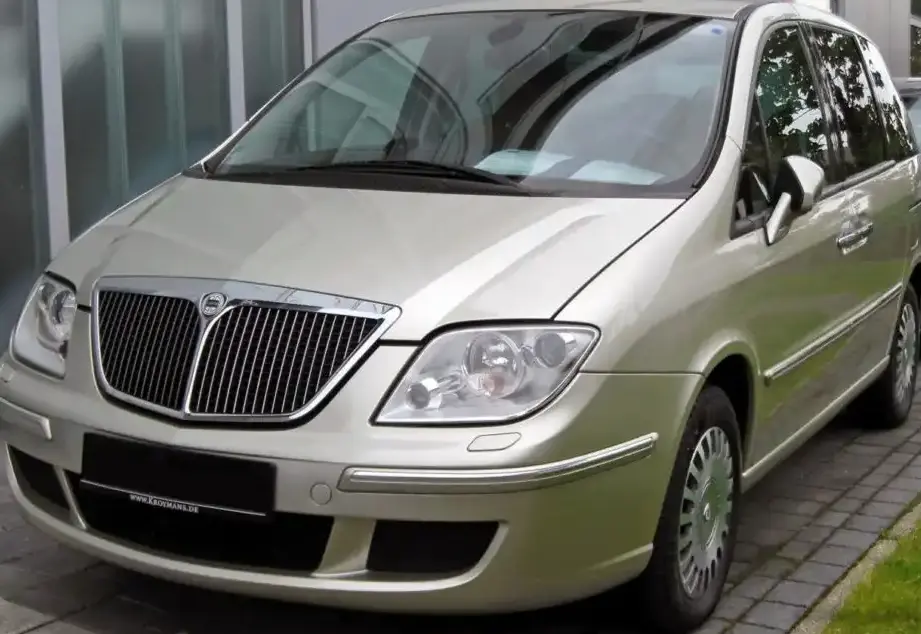
The Lancia Phedra 2.0 Multijet 16v (136 hp) DPF was a front-wheel-drive minivan produced between July 2006 and March 2008. It represented a mid-cycle update within the second generation of the Phedra, a vehicle jointly developed with Peugeot and Citroën (resulting in the Peugeot 807 and Citroën C8 respectively). The Phedra aimed to provide a luxurious and spacious multi-passenger vehicle for the European market, competing with offerings from Renault, Volkswagen, and other manufacturers. This particular variant, equipped with the 2.0 Multijet engine and a diesel particulate filter (DPF), was positioned as a balance between performance, fuel economy, and environmental compliance within the Phedra lineup.
Technical Specifications
| Brand | Lancia |
| Model | Phedra |
| Generation | Phedra |
| Type (Engine) | 2.0 Multijet 16v (136 Hp) DPF |
| Start of production | July, 2006 |
| End of production | March, 2008 |
| Powertrain Architecture | Internal Combustion engine |
| Body type | Minivan |
| Seats | 8 |
| Doors | 5 |
| Fuel consumption (urban) | 9 l/100 km (26.1 US mpg, 31.4 UK mpg, 11.1 km/l) |
| Fuel consumption (extra urban) | 6 l/100 km (39.2 US mpg, 47.1 UK mpg, 16.7 km/l) |
| Fuel consumption (combined) | 7.1 l/100 km (33.1 US mpg, 39.8 UK mpg, 14.1 km/l) |
| CO2 emissions | 188 g/km |
| Fuel Type | Diesel |
| Acceleration 0 – 100 km/h | 11.4 sec |
| Acceleration 0 – 62 mph | 11.4 sec |
| Acceleration 0 – 60 mph | 10.8 sec |
| Maximum speed | 190 km/h (118.06 mph) |
| Emission standard | Euro 4 |
| Weight-to-power ratio | 12.8 kg/Hp, 78.3 Hp/tonne |
| Weight-to-torque ratio | 5.4 kg/Nm, 184.3 Nm/tonne |
| Power | 136 Hp @ 4000 rpm |
| Power per litre | 68.1 Hp/l |
| Torque | 320 Nm @ 2000 rpm (236.02 lb.-ft. @ 2000 rpm) |
| Engine layout | Front, Transverse |
| Engine Model/Code | RHR |
| Engine displacement | 1997 cm3 (121.86 cu. in.) |
| Number of cylinders | 4 |
| Engine configuration | Inline |
| Compression ratio | 17.6:1 |
| Number of valves per cylinder | 4 |
| Fuel injection system | Diesel Commonrail |
| Engine aspiration | Turbocharger, Intercooler |
| Valvetrain | DOHC |
| Engine oil capacity | 5.25 l (5.55 US qt | 4.62 UK qt) |
| Coolant | 9 l (9.51 US qt | 7.92 UK qt) |
| Kerb Weight | 1736-1909 kg (3827.22 – 4208.62 lbs.) |
| Max. weight | 2530 kg (5577.7 lbs.) |
| Max load | 621-794 kg (1369.07 – 1750.47 lbs.) |
| Trunk (boot) space – minimum | 324 l (11.44 cu. ft.) |
| Trunk (boot) space – maximum | 2948 l (104.11 cu. ft.) |
| Fuel tank capacity | 80 l (21.13 US gal | 17.6 UK gal) |
| Max. roof load | 100 kg (220.46 lbs.) |
| Permitted trailer load with brakes (12%) | 1850 kg (4078.55 lbs.) |
| Permitted trailer load without brakes | 650 kg (1433 lbs.) |
| Permitted towbar download | 76 kg (167.55 lbs.) |
| Length | 4750 mm (187.01 in.) |
| Width | 1863 mm (73.35 in.) |
| Height | 1759 mm (69.25 in.) |
| Wheelbase | 2823 mm (111.14 in.) |
| Front track | 1570 mm (61.81 in.) |
| Rear (Back) track | 1548 mm (60.94 in.) |
| Minimum turning circle | 11.6 m (38.06 ft.) |
| Drivetrain Architecture | The Internal combustion engine (ICE) drives the front wheels of the vehicle. |
| Drive wheel | Front wheel drive |
| Number of gears and type of gearbox | 6 gears, manual transmission |
| Front suspension | Independent, type McPherson with coil spring and anti-roll bar |
| Rear suspension | Threaded twist beam |
| Front brakes | Ventilated discs, 285 mm |
| Rear brakes | Disc, 272 mm |
| Assisting systems | ABS (Anti-lock braking system) |
| Steering type | Steering rack and pinion |
| Power steering | Hydraulic Steering |
Powertrain & Engine Architecture
The heart of the Phedra 2.0 Multijet was the RHR engine code, a 1.997-liter inline-four cylinder diesel engine. This engine was part of the Fiat/PSA group’s Multijet family, known for its common-rail direct injection system. The Multijet technology allowed for multiple injections per combustion cycle, resulting in smoother operation, reduced noise, and improved fuel efficiency. The engine featured a turbocharger with an intercooler to boost power output. The 16-valve DOHC (Double Overhead Camshaft) valvetrain further contributed to the engine’s breathing efficiency. The engine’s high 17.6:1 compression ratio was typical for diesel engines, maximizing thermal efficiency. The 6-speed manual transmission was the standard offering for this variant, providing a good balance between fuel economy and drivability.
Driving Characteristics
The 136 hp and 320 Nm (236 lb-ft) of torque delivered by the 2.0 Multijet engine provided adequate, though not exhilarating, performance for the Phedra. Acceleration from 0-60 mph took around 10.8 seconds, and top speed was approximately 118 mph. The engine’s torque peak at 2000 rpm meant that the Phedra offered reasonable pulling power for overtaking and carrying a full load of passengers and luggage. Compared to higher-output versions of the Phedra (which were not commonly available in the US market), this variant felt less responsive. The 6-speed manual transmission allowed drivers to keep the engine in its optimal power band, but the overall driving experience was geared towards comfort and practicality rather than sporty handling. The gear ratios were tuned for fuel efficiency and smooth cruising.
Equipment & Trim Levels
The Phedra 2.0 Multijet 16v DPF typically came with a fairly comprehensive standard equipment list, reflecting its positioning as a premium minivan. Standard features often included air conditioning, power windows and mirrors, central locking, an audio system with CD player, and ABS brakes. Higher trim levels offered options such as leather upholstery, automatic climate control, a sunroof, parking sensors, and a navigation system. Interior upholstery was typically cloth, with options for upgraded materials. The dashboard layout was functional and modern for its time, with a focus on ergonomics and ease of use.
Chassis & Braking
The Phedra utilized a McPherson strut independent suspension setup at the front, providing a comfortable ride and decent handling. The rear suspension employed a threaded twist beam, a cost-effective solution that offered a good compromise between ride comfort and space efficiency. The braking system consisted of ventilated discs at the front and solid discs at the rear. ABS (Anti-lock Braking System) was standard, enhancing safety during emergency braking situations. The steering was rack and pinion with hydraulic power assistance, providing a reasonably direct and responsive feel.
Market Reception & Comparison
The Lancia Phedra, and its Peugeot/Citroën siblings, received mixed reviews. Critics generally praised the spacious interior, comfortable ride, and practical features. However, the Phedra’s styling was often considered less appealing than some of its competitors. The 2.0 Multijet engine was generally well-regarded for its fuel efficiency and refinement, but some reviewers found its performance to be somewhat underwhelming, especially when fully loaded. Compared to the petrol-powered versions, the 2.0 Multijet offered significantly better fuel economy, making it the more popular choice in Europe. Reliability was generally considered average, with some reports of issues with the electronic systems.
Legacy
The Lancia Phedra, while not a massive sales success, remains a relatively common sight on European roads today. The 2.0 Multijet engine has proven to be reasonably durable, with many examples exceeding 200,000 kilometers (124,000 miles) without major issues. However, like all diesel engines, it is susceptible to problems with the DPF system if not properly maintained. In the used car market, the Phedra 2.0 Multijet 16v DPF represents a relatively affordable and practical option for those seeking a spacious and comfortable minivan. Its fuel efficiency and relatively simple mechanical design make it an attractive choice for budget-conscious buyers.
