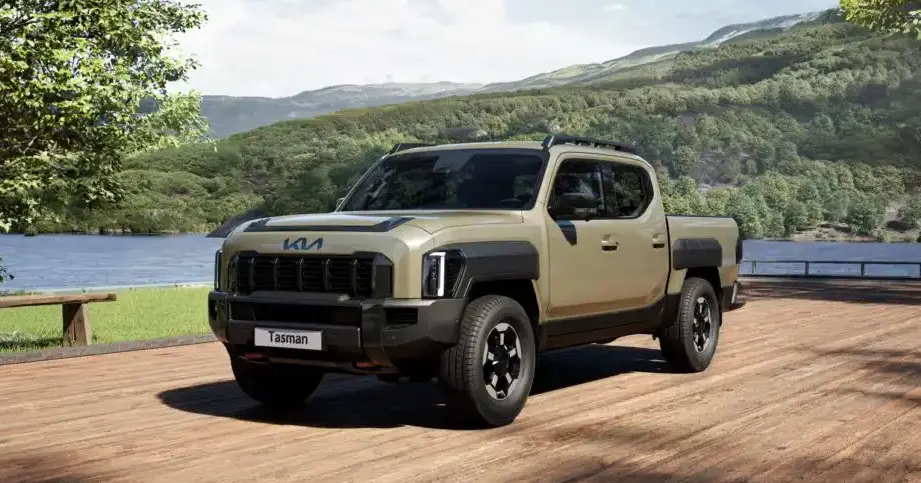
The Kia Tasman Double Cab 2.5 T-GDI Automatic, launched in February 2025, represents Kia’s entry into the mid-size pickup truck segment. Designed primarily for markets outside of North America initially, the Tasman aims to provide a versatile and capable vehicle blending passenger comfort with practical utility. This specific configuration, featuring the 2.5-liter turbocharged gasoline engine paired with an eight-speed automatic transmission, is positioned as a strong all-rounder within the Tasman lineup, offering a balance between performance, fuel efficiency, and towing capacity. It’s built on a dedicated body-on-frame chassis, marking Kia’s first foray into this type of construction for a pickup truck.
Technical Specifications
| Brand | Kia |
| Model | Tasman |
| Generation | Tasman Double Cab |
| Type (Engine) | 2.5 T-GDI (281 Hp) Automatic |
| Start of production | February, 2025 |
| Powertrain Architecture | Internal Combustion engine |
| Body type | Pick-up |
| Seats | 5 |
| Doors | 4 |
| Fuel consumption (urban) | 12.8-13.7 l/100 km (18.4 – 17.2 US mpg, 22.1 – 20.6 UK mpg, 7.8 – 7.3 km/l) |
| Fuel consumption (extra urban) | 10.2-11.2 l/100 km (23.1 – 21 US mpg, 27.7 – 25.2 UK mpg, 9.8 – 8.9 km/l) |
| Fuel consumption (combined) | 11.6-12.5 l/100 km (20.3 – 18.8 US mpg, 24.4 – 22.6 UK mpg, 8.6 – 8 km/l) |
| CO2 emissions | 197-213 g/km |
| Fuel Type | Petrol (Gasoline) |
| Weight-to-power ratio | 7.3 kg/Hp, 136.4 Hp/tonne |
| Weight-to-torque ratio | 4.9 kg/Nm, 204.4 Nm/tonne |
| Power | 281 Hp @ 5800 rpm |
| Power per litre | 112.5 Hp/l |
| Torque | 421 Nm @ 1750-4000 rpm (310.51 lb.-ft. @ 1750-4000 rpm) |
| Engine layout | Front, Longitudinal |
| Engine Model/Code | Theta 3 |
| Engine displacement | 2497 cm3 (152.38 cu. in.) |
| Number of cylinders | 4 |
| Engine configuration | Inline |
| Cylinder Bore | 88.5 mm (3.48 in.) |
| Piston Stroke | 101.5 mm (4 in.) |
| Number of valves per cylinder | 4 |
| Fuel injection system | Direct injection and Multi-port manifold injection |
| Engine aspiration | Turbocharger, Intercooler |
| Valvetrain | DOHC |
| Engine systems | Start & Stop System |
| Kerb Weight | 2060-2240 kg (4541.52 – 4938.35 lbs.) |
| Max. weight | 2760-2940 kg (6084.76 – 6481.59 lbs.) |
| Max load | 700 kg (1543.24 lbs.) |
| Trunk (boot) space – minimum | 1173 l (41.42 cu. ft.) |
| Fuel tank capacity | 80 l (21.13 US gal | 17.6 UK gal) |
| Permitted trailer load with brakes (12%) | 3500 kg (7716.18 lbs.) |
| Length | 5410 mm (212.99 in.) |
| Width | 1930 mm (75.98 in.) |
| Height | 1870 mm (73.62 in.) |
| Wheelbase | 3270 mm (128.74 in.) |
| Front track | 1636 mm (64.41 in.) |
| Rear (Back) track | 1624 mm (63.94 in.) |
| Ride height (ground clearance) | 231 mm (9.09 in.) |
| Wading depth | 800 mm (31.5 in.) |
| Drivetrain Architecture | The Internal combustion engine (ICE) drives the rear wheels of the vehicle. |
| Drive wheel | Rear wheel drive |
| Number of gears and type of gearbox | 8 gears, automatic transmission |
| Front suspension | Coil spring, Double wishbone |
| Rear suspension | Rigid axle suspension, Leaf spring |
| Front brakes | Ventilated discs |
| Rear brakes | Disc |
| Assisting systems | ABS (Anti-lock braking system) |
| Steering type | Steering rack and pinion |
| Power steering | Electric Steering |
| Tires size | 265/65 R17; 265/60 R18 |
| Wheel rims size | 17; 18 |
Powertrain & Engine Architecture
At the heart of the Tasman 2.5 T-GDI Automatic lies the Theta 3 engine, a 2.5-liter inline-four cylinder gasoline engine. This engine utilizes a combination of direct injection and multi-port fuel injection to optimize combustion efficiency and power delivery. The engine is turbocharged and intercooled, allowing it to produce 281 horsepower at 5800 rpm and 421 Nm (310.51 lb.-ft.) of torque between 1750 and 4000 rpm. The eight-speed automatic transmission is a crucial component, designed to efficiently manage the engine’s power and provide smooth shifts. It’s a conventional torque-converter automatic, prioritizing drivability over outright performance. The engine features a DOHC (Double Overhead Camshaft) valvetrain and incorporates a Start & Stop system to improve fuel economy during city driving.
Driving Characteristics
The Tasman 2.5 T-GDI Automatic offers a comfortable and capable driving experience. The eight-speed automatic transmission is well-tuned for everyday driving, providing smooth and predictable gear changes. While not as sporty as a manual transmission, the automatic offers convenience and ease of use, particularly in urban environments. The engine delivers ample torque at low to mid-range RPMs, making it suitable for hauling and towing. The rear-wheel-drive configuration contributes to a more traditional truck-like feel, and while it doesn’t offer the all-weather capability of a four-wheel-drive system, it keeps the vehicle relatively lightweight. The gear ratios are optimized for a balance of acceleration and fuel efficiency, with taller gears for highway cruising and shorter gears for quicker acceleration.
Equipment & Trim Levels
The Tasman Double Cab 2.5 T-GDI Automatic typically comes standard with features such as air conditioning, power windows and locks, a touchscreen infotainment system with smartphone integration (Apple CarPlay and Android Auto), and a suite of safety features including ABS, stability control, and multiple airbags. Higher trim levels offer upgrades like leather upholstery, heated and ventilated front seats, a premium sound system, and advanced driver-assistance systems such as lane departure warning and automatic emergency braking. Exterior features often include alloy wheels, a bed liner, and a rear step bumper.
Chassis & Braking
The Tasman utilizes a body-on-frame construction, providing a robust and durable platform for hauling and off-road driving. The front suspension consists of a coil spring and double wishbone setup, while the rear suspension employs a rigid axle with leaf springs. This configuration is designed to handle heavy loads and provide a comfortable ride. The braking system features ventilated discs at the front and solid discs at the rear, coupled with an ABS (Anti-lock Braking System) to enhance safety. The steering is rack and pinion with electric power assistance, offering precise and responsive handling.
Market Reception & Comparison
Initial reviews of the Kia Tasman have been generally positive, with critics praising its blend of practicality, comfort, and value. The 2.5 T-GDI Automatic variant is seen as a sweet spot in the lineup, offering a good balance between performance and fuel economy. Compared to other trims, the automatic transmission prioritizes ease of use over the more engaging driving experience of a manual. Fuel economy figures of 11.6-12.5 l/100 km (20.3 – 18.8 US mpg) are competitive within the mid-size pickup segment, though not class-leading. Reliability is still being assessed as the vehicle is relatively new to the market, but Kia’s reputation for building durable vehicles suggests a positive outlook.
Legacy
The Kia Tasman represents a significant step for Kia, marking its entry into a highly competitive segment. The 2.5 T-GDI Automatic powertrain is expected to be a popular choice, offering a compelling combination of performance, efficiency, and convenience. As the vehicle matures in the market, its long-term reliability and resale value will become clearer. However, its robust construction, capable engine, and well-rounded features suggest that the Tasman has the potential to become a well-regarded and enduring presence in the mid-size pickup truck landscape.