
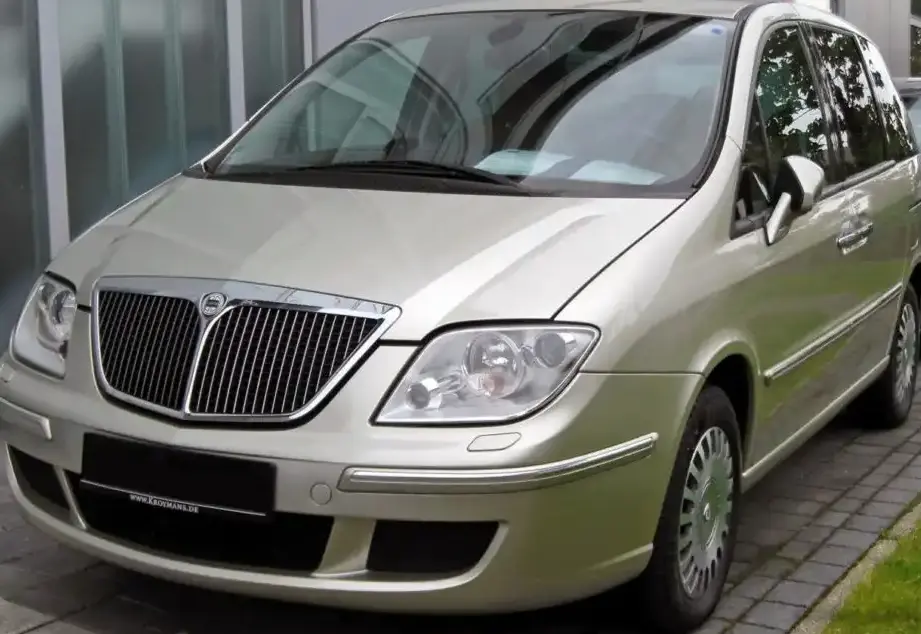
The Lancia Phedra 2.2 JTD, producing 128 horsepower, was a significant offering in the large European minivan segment from 2002 to 2008. Built in collaboration with Peugeot and Citroën – sharing its platform and many components with the Peugeot 807 and Citroën C8 – the Phedra aimed to provide a premium, spacious, and comfortable family vehicle. This particular variant, powered by the 2.2-liter turbodiesel engine, represented a balance between fuel efficiency and acceptable performance for the class, positioned as a mid-range option within the Phedra lineup. It competed directly with other large MPVs like the Renault Espace, Volkswagen Sharan, and Ford Galaxy.
Technical Specifications
| Brand | Lancia |
| Model | Phedra |
| Generation | Phedra |
| Type (Engine) | 2.2 JTD (128 Hp) |
| Start of production | 2002 |
| End of production | 2008 |
| Powertrain Architecture | Internal Combustion engine |
| Body type | Minivan |
| Seats | 8 |
| Doors | 5 |
| Fuel consumption (urban) | 10.1 l/100 km (23.3 US mpg) |
| Fuel consumption (extra urban) | 5.9 l/100 km (39.9 US mpg) |
| Fuel consumption (combined) | 7.4 l/100 km (31.8 US mpg) |
| Fuel Type | Diesel |
| Acceleration 0 – 100 km/h | 12.6 sec |
| Acceleration 0 – 62 mph | 12.6 sec |
| Acceleration 0 – 60 mph | 12 sec |
| Maximum speed | 182 km/h (113.09 mph) |
| Weight-to-power ratio | 13.4 kg/Hp |
| Weight-to-torque ratio | 5.4 kg/Nm |
| Power | 128 Hp @ 4000 rpm |
| Torque | 314 Nm @ 2000 rpm (231.59 lb.-ft. @ 2000 rpm) |
| Engine layout | Front, Transverse |
| Engine Model/Code | 4HW DW12ATED4 |
| Engine displacement | 2179 cm3 (132.97 cu. in.) |
| Number of cylinders | 4 |
| Engine configuration | Inline |
| Cylinder Bore | 85 mm (3.35 in.) |
| Piston Stroke | 96 mm (3.78 in.) |
| Compression ratio | 18:1 |
| Number of valves per cylinder | 4 |
| Fuel injection system | Diesel Commonrail |
| Engine aspiration | Turbocharger, Intercooler |
| Valvetrain | OHC |
| Engine oil capacity | 4.8 l (5.07 US qt | 4.22 UK qt) |
| Kerb Weight | 1710 kg (3769.9 lbs.) |
| Max. weight | 2505 kg (5522.58 lbs.) |
| Max load | 795 kg (1752.67 lbs.) |
| Trunk (boot) space – minimum | 325 l (11.48 cu. ft.) |
| Trunk (boot) space – maximum | 2950 l (104.18 cu. ft.) |
| Fuel tank capacity | 80 l (21.13 US gal | 17.6 UK gal) |
| Length | 4750 mm (187.01 in.) |
| Width | 1863 mm (73.35 in.) |
| Height | 1760 mm (69.29 in.) |
| Wheelbase | 2823 mm (111.14 in.) |
| Front track | 1570 mm (61.81 in.) |
| Rear (Back) track | 1548 mm (60.94 in.) |
| Drivetrain Architecture | Front wheel drive |
| Number of gears | 6 gears, manual transmission |
| Front suspension | Spring Strut |
| Rear suspension | Coil spring |
| Front brakes | Ventilated discs |
| Rear brakes | Disc |
| Assisting systems | ABS (Anti-lock braking system) |
| Steering type | Steering rack and pinion |
| Power steering | Hydraulic Steering |
| Tires size | 215/60 R16 |
Powertrain & Engine Architecture
The heart of the Phedra 2.2 JTD is the DW12ATED4 engine, a 2.2-liter inline-four cylinder diesel engine developed by PSA (Peugeot Société Anonyme) and used across several of their models, as well as in Lancia and Fiat vehicles. This engine utilizes a common rail direct injection system, delivering fuel at extremely high pressure for improved combustion efficiency and reduced emissions. The turbocharger, coupled with an intercooler, provides increased air intake, boosting power output. The engine features an overhead camshaft (OHC) valvetrain with four valves per cylinder, optimizing gas flow. The 6-speed manual transmission was the standard offering for this variant, providing a good balance between fuel economy and driver control. The engine’s design prioritized torque delivery at lower RPMs, typical of diesel engines, making it well-suited for hauling passengers and luggage.
Driving Characteristics
The 128 hp 2.2 JTD engine in the Phedra delivered adequate, but not exhilarating, performance. Acceleration from 0-60 mph took around 12 seconds, and top speed was around 113 mph. While sufficient for everyday driving and highway cruising, it lacked the punch of the more powerful gasoline engines offered in the Phedra range. The manual transmission allowed for greater driver involvement and control compared to the optional automatic, and the gear ratios were tuned to maximize fuel efficiency and provide reasonable acceleration. The Phedra’s weight, exceeding 3700 pounds, was noticeable, particularly when fully loaded. Compared to the higher-output versions, this variant prioritized fuel economy and lower running costs over outright performance.
Equipment & Trim Levels
The 2.2 JTD variant of the Phedra typically came with a respectable level of standard equipment. This included air conditioning, power windows, central locking, and an audio system. Higher trim levels added features such as alloy wheels, rear parking sensors, a multi-function steering wheel, and upgraded interior upholstery. Interior materials were generally of good quality, reflecting Lancia’s focus on comfort and refinement. Optional extras included a navigation system, leather seats, and a panoramic sunroof. The Phedra was designed with practicality in mind, offering a flexible seating arrangement with individual seats that could be folded or removed to maximize cargo space.
Chassis & Braking
The Phedra utilized a front-wheel-drive layout with a MacPherson strut suspension at the front and a coil spring suspension at the rear. This setup provided a comfortable ride, absorbing bumps and imperfections in the road surface effectively. The front brakes were ventilated discs, offering good stopping power, while the rear brakes were solid discs. Anti-lock Braking System (ABS) was standard, enhancing safety during emergency braking situations. The steering was rack and pinion with hydraulic power assistance, providing a responsive and precise feel. Stabilizer bars were fitted to both the front and rear axles to reduce body roll during cornering.
Market Reception & Comparison
The Lancia Phedra 2.2 JTD received mixed reviews. Critics praised its spacious interior, comfortable ride, and practical features. However, the engine was often criticized for being underpowered, especially when the vehicle was fully loaded. Fuel economy was generally considered good for a vehicle of its size. Compared to the petrol-powered Phedra variants, the 2.2 JTD offered significantly better fuel efficiency and lower running costs, making it a popular choice for families who prioritized practicality and economy. The Phedra faced stiff competition from established players in the minivan segment, such as the Renault Espace and Volkswagen Sharan, which often offered more refined engines and a more established brand reputation.
Legacy
The Lancia Phedra, while not a massive sales success, remains a reasonably reliable vehicle in the used car market. The DW12ATED4 engine is known for its durability, provided it has been properly maintained. Common issues include turbocharger wear and potential problems with the fuel injection system. The Phedra’s spacious interior and comfortable ride continue to appeal to buyers looking for a practical and affordable family vehicle. However, finding parts can sometimes be challenging due to the vehicle’s relatively low production numbers and the discontinuation of the Lancia brand in many markets. The Phedra represents a unique collaboration between three European automakers, offering a blend of Italian style, French engineering, and practical functionality.
