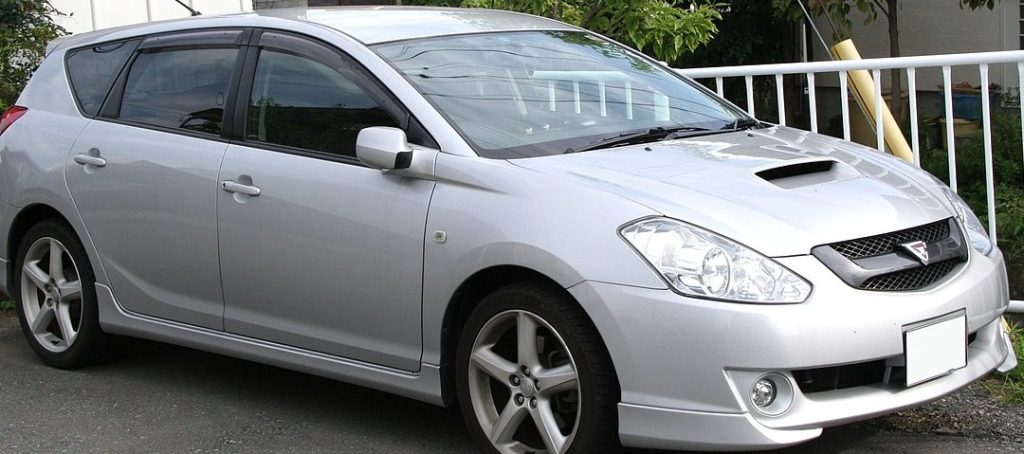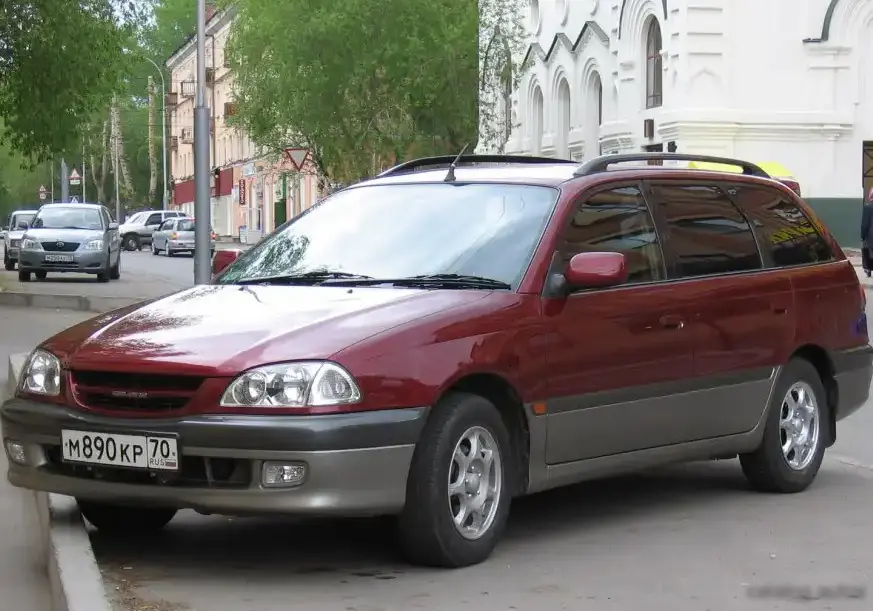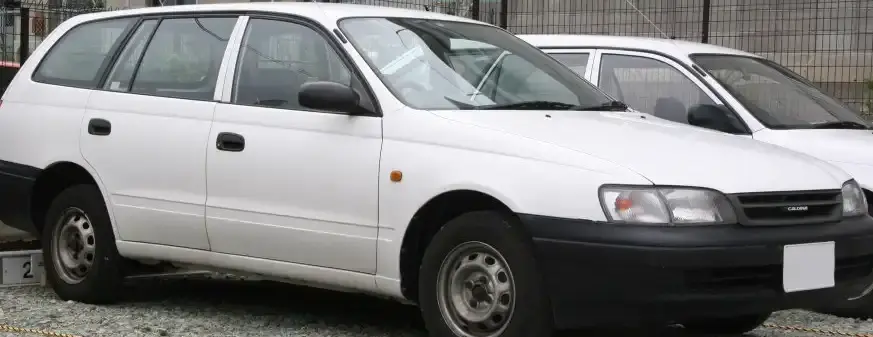
The Toyota Caldina, specifically the T19 generation produced between 1992 and 1997, represented Toyota’s entry into the increasingly popular compact station wagon market, primarily aimed at Japanese domestic buyers. This model sought to blend practicality with a degree of sporting character, offering a more dynamic alternative to traditional family wagons. The 2.0i 16V CZ variant, equipped with the 3S-FE engine and a four-speed automatic transmission, occupied a mid-range position within the Caldina lineup, offering a balance between performance, fuel economy, and affordability. It was positioned below the more powerful 2.2-liter options and above the base 1.8-liter models.
Technical Specifications
| Brand | Toyota |
| Model | Caldina |
| Generation | Caldina (T19) |
| Type | 2.0i 16V CZ (128 Hp) 4WD Automatic |
| Start of production | 1992 |
| End of production | 1997 |
| Powertrain Architecture | Internal Combustion engine |
| Body type | Station wagon (estate) |
| Seats | 5 |
| Doors | 5 |
| Fuel consumption (urban) | 13.5 l/100 km (17.4 US mpg, 20.9 UK mpg) |
| Fuel consumption (extra urban) | 10 l/100 km (23.5 US mpg, 28.2 UK mpg) |
| Fuel Type | Petrol (Gasoline) |
| Weight-to-power ratio | 10.2 kg/Hp |
| Weight-to-torque ratio | 7.3 kg/Nm |
| Power | 128 Hp @ 5600 rpm |
| Power per litre | 64.1 Hp/l |
| Torque | 179 Nm @ 4400 rpm (132.02 lb.-ft. @ 4400 rpm) |
| Engine layout | Front, Transverse |
| Engine Model/Code | 3S-FE |
| Engine displacement | 1998 cm3 (121.93 cu. in.) |
| Number of cylinders | 4 |
| Engine configuration | Inline |
| Cylinder Bore | 86 mm (3.39 in.) |
| Piston Stroke | 86 mm (3.39 in.) |
| Compression ratio | 9.8:1 |
| Number of valves per cylinder | 4 |
| Fuel injection system | Multi-port manifold injection |
| Engine aspiration | Naturally aspirated engine |
| Valvetrain | DOHC |
| Engine oil capacity | 3.9 l (4.12 US qt | 3.43 UK qt) |
| Coolant capacity | 6.5 l (6.87 US qt | 5.72 UK qt) |
| Kerb Weight | 1310 kg (2888.06 lbs.) |
| Max. weight | 1585 kg (3494.33 lbs.) |
| Max load | 275 kg (606.27 lbs.) |
| Fuel tank capacity | 60 l (15.85 US gal | 13.2 UK gal) |
| Length | 4545 mm (178.94 in.) |
| Width | 1695 mm (66.73 in.) |
| Height | 1470 mm (57.87 in.) |
| Wheelbase | 2580 mm (101.57 in.) |
| Front track | 1465 mm (57.68 in.) |
| Rear track | 1435 mm (56.5 in.) |
| Drive wheel | All wheel drive (4×4) |
| Number of gears | 4 |
| Gearbox type | automatic transmission |
| Front suspension | Spring Strut |
| Rear suspension | Coil spring |
| Front brakes | Ventilated discs |
| Rear brakes | Disc |
| Assisting systems | ABS (Anti-lock braking system) |
| Steering type | Steering rack and pinion |
| Power steering | Hydraulic Steering |
| Tires size | 185/65 R14 S |
| Wheel rims size | 14 |
Powertrain & Engine Architecture
The heart of the Caldina 2.0i CZ is the 3S-FE engine, a 2.0-liter, inline-four cylinder gasoline engine. This engine is a member of Toyota’s S-series family, known for its reliability and relatively simple design. The 3S-FE utilizes a multi-port fuel injection system, delivering fuel directly to each intake port for improved combustion efficiency. It features a double overhead camshaft (DOHC) valvetrain, operating 16 valves (four per cylinder) to optimize airflow and enhance performance. The engine produces 128 horsepower at 5600 rpm and 179 Nm (132 lb-ft) of torque at 4400 rpm. This power is then channeled through a four-speed automatic transmission, designed for smooth and convenient operation. The transmission’s gear ratios were tuned for a balance of acceleration and fuel economy, prioritizing usability over outright performance.
Driving Characteristics
The 2.0i Automatic Caldina offered a comfortable and predictable driving experience. While not particularly sporty, the engine provided adequate power for everyday driving and highway cruising. The automatic transmission, while smooth, did contribute to a slight reduction in responsiveness compared to the available manual transmission options. Acceleration was respectable, but the 0-60 mph time was likely in the 10-11 second range. The all-wheel-drive system provided enhanced traction, particularly in inclement weather conditions, making it a practical choice for regions experiencing rain or snow. The suspension was tuned for comfort, absorbing bumps and irregularities in the road surface effectively. However, this did result in some body roll during cornering.
Equipment & Trim Levels
The 2.0i CZ trim level typically included features such as power windows, power door locks, and a basic audio system. Air conditioning was standard equipment. Interior upholstery was typically cloth, with a relatively simple dashboard layout. Optional extras included alloy wheels, a sunroof, and upgraded audio systems. The Caldina aimed for a functional and practical interior, prioritizing durability and ease of use over luxurious appointments. The trim level was considered a step up from the base models, offering a more comprehensive set of features without the added cost of the higher-performance variants.
Chassis & Braking
The Caldina T19 utilized a front strut and rear coil spring suspension setup. The all-wheel-drive system added weight, necessitating a robust chassis and braking system. The front brakes were ventilated discs, providing good stopping power, while the rear brakes were solid discs. Anti-lock braking system (ABS) was standard, enhancing safety by preventing wheel lockup during hard braking. The suspension was tuned to provide a comfortable ride, with stabilizer bars helping to reduce body roll. The all-wheel-drive system employed a viscous coupling to distribute torque between the front and rear axles, providing automatic all-wheel drive engagement when needed.
Market Reception & Comparison
The Caldina 2.0i Automatic was generally well-received in the Japanese market as a practical and reliable family wagon. Critics praised its spacious interior, comfortable ride, and the added security of all-wheel drive. However, some noted that the automatic transmission dulled the engine’s performance compared to the manual versions. Compared to the 2.2-liter models, the 2.0i offered a more affordable price point and slightly better fuel economy, but at the expense of outright power. The 1.8-liter models were even more economical but lacked the performance of the 2.0i. Fuel economy figures were around 13.5 l/100km in urban settings and 10 l/100km on the highway.
Legacy
The Toyota Caldina T19, particularly the 2.0i 16V CZ variant, has developed a reputation for long-term reliability. The 3S-FE engine is known for its durability, and the automatic transmission, while not the most sophisticated, is generally dependable. In the used car market, these Caldinas are often sought after for their practicality, affordability, and the peace of mind offered by Toyota’s reputation for quality. While not a collector’s item, well-maintained examples continue to provide reliable transportation for owners today. Parts availability remains relatively good, contributing to the ongoing viability of these vehicles.