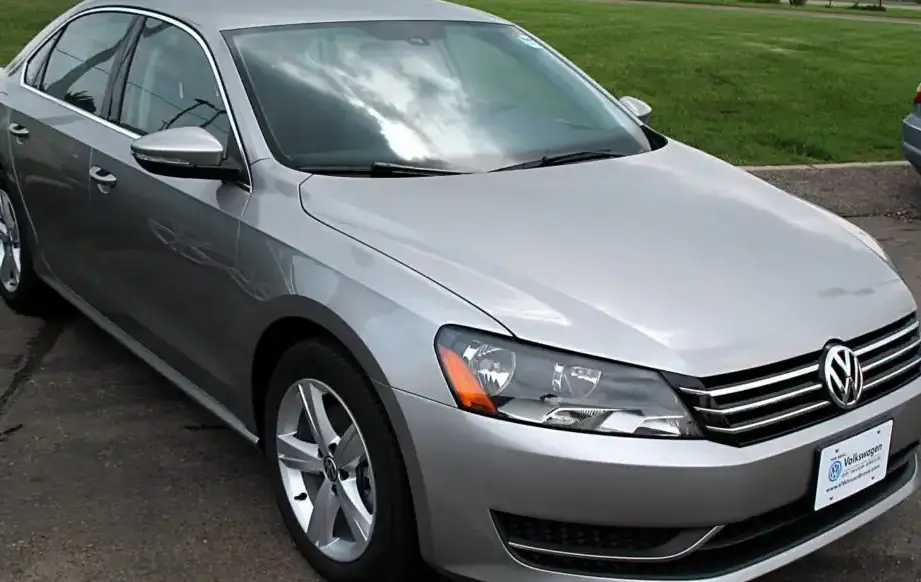
The Volkswagen Passat (North America, A32) 2.5, produced from 2011 to 2014, represented a significant step for Volkswagen in the American mid-size sedan market. This generation, specifically tailored for North American tastes, aimed to offer a more spacious and refined experience than its European counterpart. The 2.5-liter variant occupied a crucial position in the lineup, serving as the entry point to the Passat range while still providing a respectable level of performance and features. It was built on the Volkswagen Group’s PQ46 platform, also known as the A32, and was a key model in Volkswagen’s strategy to gain market share in the United States.
Technical Specifications
| Brand | Volkswagen |
| Model | Passat |
| Generation | Passat (North America, A32) |
| Type (Engine) | 2.5 (170 Hp) |
| Start of production | 2011 |
| End of production | 2014 |
| Powertrain Architecture | Internal Combustion engine |
| Body type | Sedan |
| Seats | 5 |
| Doors | 4 |
| Fuel consumption (economy) – urban | 10.7 l/100 km (22 US mpg, 26.4 UK mpg, 9.3 km/l) |
| Fuel consumption (economy) – extra urban | 7.4 l/100 km (31.8 US mpg, 38.2 UK mpg, 13.5 km/l) |
| Fuel Type | Petrol (Gasoline) |
| Acceleration 0 – 60 mph | 8.2 sec |
| Weight-to-power ratio | 8.4 kg/Hp, 118.4 Hp/tonne |
| Weight-to-torque ratio | 6 kg/Nm, 167.1 Nm/tonne |
| Power | 170 Hp @ 5700 rpm |
| Power per litre | 68.5 Hp/l |
| Torque | 240 Nm @ 4250 rpm (177.01 lb.-ft. @ 4250 rpm) |
| Engine layout | Front, Transverse |
| Engine Model/Code | 07K / CBTA, CBUA |
| Engine displacement | 2480 cm3 (151.34 cu. in.) |
| Number of cylinders | 5 |
| Engine configuration | Inline |
| Cylinder Bore | 82.5 mm (3.25 in.) |
| Piston Stroke | 92.8 mm (3.65 in.) |
| Compression ratio | 9.5:1 |
| Number of valves per cylinder | 4 |
| Fuel injection system | Multi-port manifold injection |
| Engine aspiration | Naturally aspirated engine |
| Valvetrain | DOHC |
| Engine oil capacity | 6 l (6.34 US qt | 5.28 UK qt) |
| Coolant | 7.1 l (7.5 US qt | 6.25 UK qt) |
| Kerb Weight | 1436 kg (3165.84 lbs.) |
| Max. weight | 2010 kg (4431.29 lbs.) |
| Max load | 574 kg (1265.45 lbs.) |
| Trunk (boot) space – minimum | 450 l (15.89 cu. ft.) |
| Fuel tank capacity | 70 l (18.49 US gal | 15.4 UK gal) |
| Permitted trailer load without brakes | 450 kg (992.08 lbs.) |
| Permitted towbar download | 75 kg (165.35 lbs.) |
| Length | 4868 mm (191.65 in.) |
| Width | 1835 mm (72.24 in.) |
| Height | 1487 mm (58.54 in.) |
| Wheelbase | 2803 mm (110.35 in.) |
| Front track | 1577 mm (62.09 in.) |
| Rear (Back) track | 1550 mm (61.02 in.) |
| Ride height (ground clearance) | 138 mm (5.43 in.) |
| Drag coefficient (Cd) | 0.29 |
| Minimum turning circle (turning diameter) | 11.7 m (38.39 ft.) |
| Drivetrain Architecture | The Internal combustion engine (ICE) drives the front wheels of the vehicle. |
| Drive wheel | Front wheel drive |
| Number of gears and type of gearbox | 5 gears, manual transmission |
| Front suspension | Independent, type McPherson with coil spring and anti-roll bar |
| Rear suspension | Independent multi-link spring suspension with stabilizer |
| Front brakes | Ventilated discs, 312×25 mm |
| Rear brakes | Disc, 272×10 mm |
| Assisting systems | ABS (Anti-lock braking system) |
| Steering type | Steering rack and pinion |
| Power steering | Hydraulic Steering |
| Tires size | 215/60 R16; 215/55 R17 |
| Wheel rims size | 6.5J x 16; 7J x 17 |
INTRODUCTION
The 2011-2014 Volkswagen Passat 2.5 was designed specifically for the North American market, representing a departure from the more compact European Passat. Volkswagen aimed to create a mid-size sedan that offered generous interior space, a comfortable ride, and a competitive price point. The 2.5-liter engine, paired with a five-speed manual transmission, served as the base model, providing a balance of affordability and usability. It was positioned as the entry-level option, below the more powerful 3.6-liter V6 and the fuel-efficient TDI diesel variants.
Powertrain & Engine Architecture
The heart of the Passat 2.5 is the 07K/CBTA (and sometimes CBUA) 2.5-liter inline-five cylinder engine. This engine, while not known for its cutting-edge technology, was chosen for its reliability and relatively low cost. It utilizes a multi-port fuel injection system, delivering fuel directly into the intake ports. The engine features a double overhead camshaft (DOHC) valvetrain, operating 16 valves (four per cylinder). The 9.5:1 compression ratio was a standard figure for naturally aspirated engines of the time. The five-speed manual transmission was a conventional design, offering smooth shifts and a direct connection to the engine. The engine’s transverse mounting configuration, common in front-wheel-drive vehicles, helped optimize space utilization within the engine bay.
Driving Characteristics
The 170 horsepower and 177 lb-ft of torque produced by the 2.5-liter engine provided adequate, but not exhilarating, performance. Acceleration from 0 to 60 mph took approximately 8.2 seconds. The five-speed manual transmission allowed drivers to keep the engine in its optimal power band, but the relatively long gear ratios meant that the engine could feel strained during aggressive acceleration. Compared to the V6 model, the 2.5 felt noticeably slower, particularly when fully loaded. However, the 2.5 offered a more fuel-efficient driving experience than the V6, and its lighter weight contributed to a more nimble feel in corners. The manual transmission provided a more engaging driving experience than the optional six-speed automatic.
Equipment & Trim Levels
The base Passat 2.5 came standard with a respectable array of features, including air conditioning, power windows and locks, a basic audio system, and steel wheels with wheel covers. Higher trim levels, such as the SE and SEL, added features like alloy wheels, upgraded audio systems, heated front seats, and a sunroof. Interior upholstery was typically cloth, with leather options available on higher trims. The dashboard layout was straightforward and functional, prioritizing ease of use over stylistic flair. Optional extras included a navigation system, a premium sound system, and various driver assistance features.
Chassis & Braking
The Passat 2.5 utilized an independent McPherson strut suspension in the front and an independent multi-link suspension in the rear. This setup provided a comfortable ride, absorbing bumps and imperfections in the road effectively. The front brakes were ventilated discs, providing ample stopping power, while the rear brakes were solid discs. Anti-lock braking system (ABS) was standard. The steering was hydraulic power-assisted rack and pinion, offering a responsive and predictable feel. The suspension was tuned for comfort rather than sporty handling, prioritizing a smooth and relaxed driving experience.
Market Reception & Comparison
Critics generally praised the 2011-2014 Passat 2.5 for its spacious interior and comfortable ride. However, the engine was often criticized for being underpowered, particularly when compared to competitors like the Honda Accord and Toyota Camry. Fuel economy was considered average for the class. The 2.5-liter model was seen as a good value for buyers prioritizing space and comfort over performance. Compared to the Passat V6, the 2.5 offered a lower price point and better fuel economy, but at the expense of acceleration and refinement. The TDI diesel model offered superior fuel economy but came with a higher initial cost.
Legacy
The Volkswagen Passat 2.5 (2011-2014) remains a relatively affordable and practical used car option. The 2.5-liter engine is generally considered reliable, although regular maintenance is crucial. Common issues include oil leaks and occasional sensor failures. The manual transmission is known for its durability. While not a performance standout, the Passat 2.5 offers a comfortable and spacious interior, making it a suitable choice for families and commuters. Its relatively simple mechanical design makes it easier and less expensive to maintain compared to more complex vehicles. Today, these Passats can be found with reasonable mileage and are often sought after by buyers looking for a dependable and affordable mid-size sedan.