
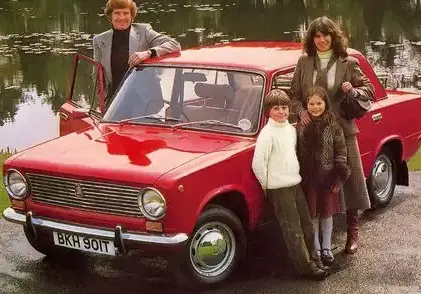
The Lada 21012 1200, producing 64 horsepower, was a variant of the Lada 2101, a Soviet-designed automobile that became a ubiquitous sight on the roads of Eastern Europe and beyond. Produced from 1974 to 1982, the 21012 represented a continuation of the original 2101, itself heavily based on the Fiat 124. This model occupied the entry-level position within the 2101 range, offering a more economical option compared to the later 1.3 and 1.5-liter versions. It was a key vehicle in the Soviet Union’s push for mass motorization, providing affordable transportation to a wide segment of the population.
Technical Specifications
| Brand | Lada |
| Model | 2101 |
| Generation | 21012 |
| Type (Engine) | 1200 (64 Hp) |
| Start of production | 1974 |
| End of production | 1982 |
| Powertrain Architecture | Internal Combustion engine |
| Body type | Sedan |
| Seats | 4 |
| Doors | 4 |
| Fuel consumption (urban) | 11 l/100 km (21.4 US mpg, 25.7 UK mpg, 9.1 km/l) |
| Fuel consumption (extra urban) | 7.5 l/100 km (31.4 US mpg, 37.7 UK mpg, 13.3 km/l) |
| Fuel consumption (combined) | 9 l/100 km (26.1 US mpg, 31.4 UK mpg, 11.1 km/l) |
| Fuel Type | Petrol (Gasoline) |
| Acceleration 0 – 100 km/h | 27 sec |
| Acceleration 0 – 62 mph | 27 sec |
| Acceleration 0 – 60 mph | 25.7 sec |
| Maximum speed | 135 km/h (83.89 mph) |
| Weight-to-power ratio | 14.9 kg/Hp, 67 Hp/tonne |
| Power | 64 Hp |
| Power per litre | 53.4 Hp/l |
| Engine layout | Front, Longitudinal |
| Engine displacement | 1198 cm3 (73.11 cu. in.) |
| Number of cylinders | 4 |
| Engine configuration | Inline |
| Compression ratio | 8:1 |
| Number of valves per cylinder | 2 |
| Fuel injection system | Carburettor |
| Engine aspiration | Naturally aspirated engine |
| Kerb Weight | 955 kg (2105.41 lbs.) |
| Max. weight | 1355 kg (2987.26 lbs.) |
| Max load | 400 kg (881.85 lbs.) |
| Fuel tank capacity | 42 l (11.1 US gal | 9.24 UK gal) |
| Length | 4064 mm (160 in.) |
| Width | 1613 mm (63.5 in.) |
| Height | 1455 mm (57.28 in.) |
| Wheelbase | 2425 mm (95.47 in.) |
| Front track | 1346 mm (52.99 in.) |
| Rear track | 1306 mm (51.42 in.) |
| Drivetrain Architecture | The Internal combustion engine (ICE) drives the rear wheels of the vehicle. |
| Drive wheel | Rear wheel drive |
| Number of gears and type of gearbox | 4 gears, manual transmission |
| Front suspension | Coil spring, Double wishbone |
| Rear suspension | Rigid axle suspension, Coil spring |
| Front brakes | Disc |
| Rear brakes | Drum |
| Steering type | Cone worm with recirculation balls |
| Tires size | 155/80 R13 |
| Wheel rims size | 13 |
Powertrain & Engine Architecture
The heart of the Lada 21012 was its 1.2-liter (1198 cc) inline-four cylinder engine. Designated as a low-output version, it produced 64 horsepower at a relatively low engine speed. This engine utilized a single carburetor for fuel delivery, a common feature for vehicles of this era and price point. The engine featured a relatively low 8:1 compression ratio, contributing to its ability to run on the lower-octane fuel readily available in the Soviet Union and Eastern Bloc countries. The engine’s valvetrain employed two valves per cylinder (SOHC), a simple and reliable design. The 21012 was equipped with a four-speed manual transmission, driving the rear wheels. This configuration was standard for the 2101 series.
Driving Characteristics
The 21012 1200, with its modest 64 horsepower, offered a utilitarian driving experience. Acceleration was slow, taking approximately 27 seconds to reach 62 mph (100 km/h). The car was not designed for speed, but rather for reliable and economical transportation. The four-speed manual transmission had relatively widely spaced gear ratios, requiring frequent shifting to maintain optimal engine speed. Compared to the later 1.3 and 1.5-liter versions of the 2101, the 1200 offered less power and refinement, but it was also more fuel-efficient and arguably more durable due to its simpler design and lower stress levels.
Equipment & Trim Levels
The Lada 21012 1200 was a fairly basic vehicle, reflecting its position as the entry-level model. Standard features included simple cloth upholstery, a basic dashboard with minimal instrumentation, and manually operated windows and door locks. Options were limited, but could include a radio, upgraded seat covers, and sometimes, a heated rear window. The interior was functional and durable, designed to withstand the harsh conditions often encountered in its primary markets. The exterior trim was also minimal, with basic chrome bumpers and simple steel wheels.
Chassis & Braking
The Lada 21012 utilized a body-on-frame construction, a common practice for vehicles of its time. The front suspension consisted of a double wishbone setup with coil springs, while the rear suspension employed a rigid axle with coil springs. This suspension configuration provided a reasonably comfortable ride, although it was not particularly sophisticated. The braking system featured disc brakes on the front wheels and drum brakes on the rear. The steering was a recirculating ball system, which was known for its simplicity and durability, but lacked the precision of more modern steering technologies.
Market Reception & Comparison
The Lada 21012 1200 was generally well-received in its target markets, particularly in the Soviet Union and Eastern Europe. It was praised for its affordability, reliability, and ease of maintenance. Critics noted its lack of power and refinement compared to Western European vehicles, but acknowledged that it offered a practical and economical transportation solution. Compared to the higher-displacement 2101 variants, the 1200 offered better fuel economy and a slightly lower purchase price, making it attractive to budget-conscious buyers. However, it lacked the performance and overall driving experience of its more powerful siblings.
Legacy
The Lada 21012 1200, and the 2101 series as a whole, left a significant mark on the automotive landscape of Eastern Europe and beyond. The car’s simple design and robust construction contributed to its longevity, and many examples remain on the road today, often maintained by dedicated enthusiasts. While not known for its technological innovation, the 21012 played a crucial role in providing affordable transportation to millions of people. In the used car market, the 21012 is valued for its simplicity, affordability, and the availability of spare parts. It represents a nostalgic reminder of a bygone era of automotive history.
