
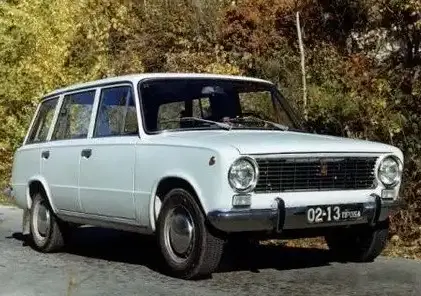
The Lada 21023 1.3, a variant of the popular Lada 2102 station wagon (estate), was produced from 1971 to 1986. It represented a practical and affordable transportation option, particularly within the Soviet Union and its export markets. The 2102, and by extension the 21023, was based on the Fiat 124, a license-built model that formed the foundation of Lada’s early success. The “21023” designation specifically denotes the model equipped with the 1.3-liter engine producing 70 horsepower. This version occupied an entry-level position within the 2102 lineup, offering a balance of fuel economy and usability for everyday transport.
Technical Specifications
| Brand | Lada |
| Model | 2102 |
| Generation | 21023 |
| Type (Engine) | 1.3 (70 Hp) |
| Start of production | 1971 |
| End of production | 1986 |
| Powertrain Architecture | Internal Combustion engine |
| Body type | Station wagon (estate) |
| Seats | 5 |
| Doors | 5 |
| Fuel consumption (urban) | 10.9 l/100 km (21.6 US mpg) |
| Fuel consumption (extra urban) | 8.2 l/100 km (28.7 US mpg) |
| Fuel Type | Petrol (Gasoline) |
| Acceleration 0 – 100 km/h | 20 sec |
| Acceleration 0 – 62 mph | 20 sec |
| Acceleration 0 – 60 mph | 19 sec |
| Maximum speed | 145 km/h (90.1 mph) |
| Weight-to-power ratio | 14.6 kg/Hp |
| Weight-to-torque ratio | 10.6 kg/Nm |
| Power | 70 Hp @ 5600 rpm |
| Power per litre | 53.8 Hp/l |
| Torque | 96 Nm @ 3400 rpm (70.81 lb.-ft. @ 3400 rpm) |
| Engine layout | Front, Longitudinal |
| Engine displacement | 1300 cm3 (79.33 cu. in.) |
| Number of cylinders | 4 |
| Engine configuration | Inline |
| Cylinder Bore | 79 mm (3.11 in.) |
| Piston Stroke | 66.2 mm (2.61 in.) |
| Compression ratio | 8.5:1 |
| Number of valves per cylinder | 2 |
| Fuel injection system | Carburettor |
| Engine aspiration | Naturally aspirated |
| Valvetrain | OHC |
| Kerb Weight | 1020 kg (2248.72 lbs.) |
| Max. weight | 1420 kg (3130.56 lbs.) |
| Max load | 400 kg (881.85 lbs.) |
| Trunk (boot) space – minimum | 345 l (12.18 cu. ft.) |
| Trunk (boot) space – maximum | 1035 l (36.55 cu. ft.) |
| Fuel tank capacity | 45 l (11.89 US gal | 9.9 UK gal) |
| Length | 4059 mm (159.8 in.) |
| Width | 1611 mm (63.43 in.) |
| Height | 1458 mm (57.4 in.) |
| Wheelbase | 2424 mm (95.43 in.) |
| Front track | 1365 mm (53.74 in.) |
| Rear (Back) track | 1321 mm (52.01 in.) |
| Drivetrain Architecture | Rear wheel drive |
| Number of gears | 4 |
| Gearbox type | Manual transmission |
| Front suspension | Double wishbone |
| Rear suspension | Coil spring |
| Front brakes | Disc |
| Rear brakes | Drum |
| Steering type | Worm-reduction unit |
| Tires size | 155/80 SR13 |
Powertrain & Engine Architecture
The heart of the Lada 21023 was the 1.3-liter inline-four cylinder engine, internally designated as a variation of the VAZ-2101 engine family. This engine, while derived from the Fiat 124’s powerplant, underwent modifications for Soviet manufacturing and conditions. It featured a single overhead camshaft (OHC) operating two valves per cylinder. Fuel delivery was managed by a carburetor, a common feature for vehicles of this era, rather than fuel injection. The carburetor provided adequate, though not particularly refined, fuel atomization. The engine produced 70 horsepower at 5600 rpm and 96 Nm (70.81 lb-ft) of torque at 3400 rpm. The engine was mounted longitudinally in the front of the vehicle, driving the rear wheels. The 21023 was exclusively offered with a four-speed manual transmission, chosen for its simplicity and durability. The transmission’s gear ratios were geared towards providing adequate acceleration and cruising ability, but weren’t optimized for high-speed performance.
Driving Characteristics
The 1.3-liter engine in the 21023 provided adequate, but not exhilarating, performance. Acceleration from 0 to 60 mph took approximately 19 seconds, and the top speed was around 90 mph. The car felt somewhat sluggish, especially when fully loaded or climbing hills. The four-speed manual transmission required frequent shifting to maintain optimal engine speed. Compared to the later 1.5-liter and 1.6-liter versions of the 2102, the 1.3 felt noticeably underpowered. The manual transmission offered more driver control than the later automatic options found in some Lada models. The rear-wheel-drive layout provided predictable handling, but the relatively soft suspension and narrow tires limited cornering grip. The steering, utilizing a worm-reduction unit, was known for being somewhat vague and requiring considerable effort at low speeds.
Equipment & Trim Levels
The Lada 21023 1.3 was typically equipped with basic, functional features. Standard equipment included cloth upholstery, a simple dashboard with basic instrumentation (speedometer, fuel gauge, temperature gauge), and manually operated windows and door locks. Heating was standard, but air conditioning was not typically offered. Optional extras were limited, but could include a radio, upgraded seat covers, and sometimes, a sunroof. The interior was designed for practicality and durability, rather than luxury. The trim level was generally consistent across all 21023 models, with minimal variations in interior appointments.
Chassis & Braking
The Lada 21023 utilized a body-on-frame construction, which contributed to its robustness but also added to its weight. The front suspension employed a double wishbone design, while the rear suspension featured a coil spring setup. The braking system consisted of disc brakes on the front wheels and drum brakes on the rear wheels. The brakes were adequate for normal driving conditions, but lacked the stopping power of more modern systems. The car’s relatively high weight and modest braking performance meant that drivers needed to plan ahead when slowing down. Stabilizer bars were not standard equipment on the 1.3-liter models, contributing to a noticeable degree of body roll during cornering.
Market Reception & Comparison
The Lada 21023 1.3 was generally viewed as a reliable and affordable vehicle, particularly in markets where cost was a primary concern. Critics often noted its basic features and modest performance, but acknowledged its practicality and durability. Compared to the higher-displacement 2102 models, the 1.3 offered better fuel economy but significantly less power. The 1.5-liter and 1.6-liter versions were favored by drivers who needed more performance or frequently carried heavy loads. The 21023’s fuel economy was reasonable for its time, achieving around 21.6 US mpg in urban driving and 28.7 US mpg on the highway. Reliability was generally good, although the carburetor required periodic adjustment and maintenance.
Legacy
The Lada 21023 1.3, and the 2102 series as a whole, holds a significant place in automotive history, particularly in Eastern Europe and the Soviet Union. It provided affordable transportation for millions of people. While not known for its technological innovation or performance, the 21023 was valued for its simplicity, durability, and ease of maintenance. Today, the 21023 is a popular choice among classic car enthusiasts and collectors, particularly those interested in Soviet-era automobiles. Parts availability can be challenging, but the car’s relatively simple mechanical design makes it accessible to home mechanics. Well-maintained examples are becoming increasingly rare and are often sought after for their nostalgic appeal and historical significance. The 1.3-liter engine, while the least powerful in the 2102 lineup, is generally considered to be the most reliable and least prone to major mechanical issues.
