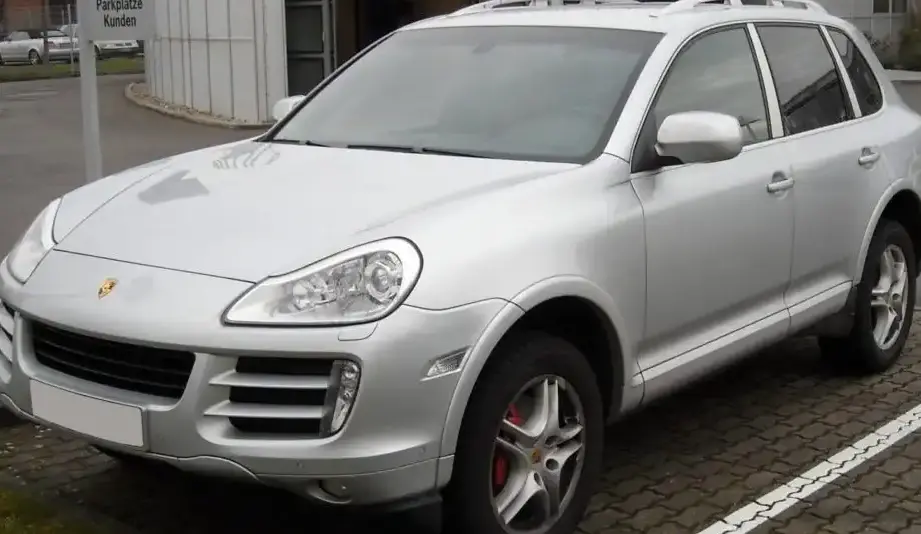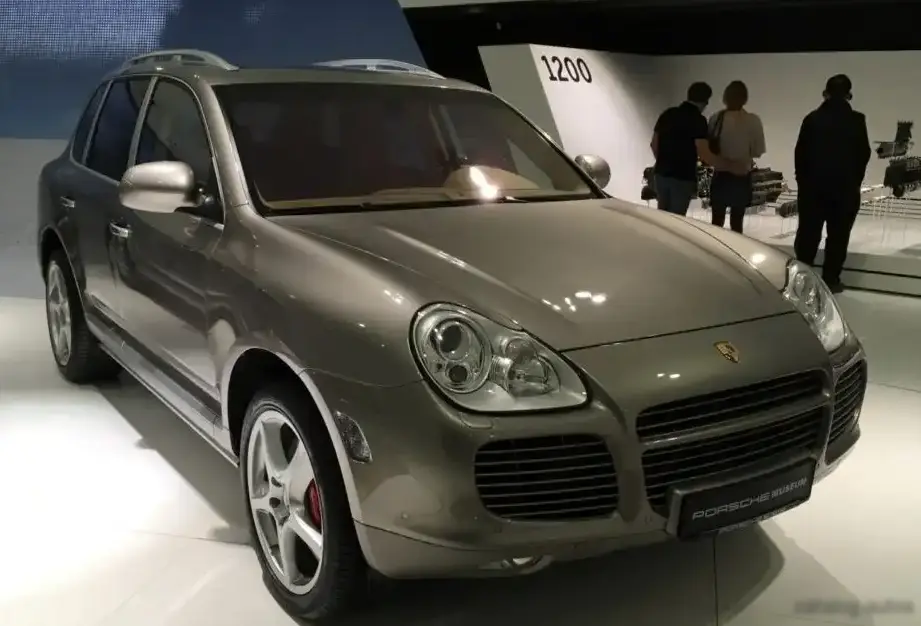
The Porsche Cayenne (955) 3.2i V6, produced from 2003 to 2006, represents Porsche’s initial foray into the luxury SUV market. This variant, powered by a 3.2-liter V6 engine producing 250 horsepower, served as the entry point into the 955 generation Cayenne lineup. Positioned below the more powerful V8 models, the 3.2i aimed to offer a balance of Porsche performance and relative fuel efficiency within the burgeoning SUV segment. It was a crucial model for Porsche, tasked with broadening the brand’s appeal and generating significant sales volume. The 955 generation Cayenne shared its platform with the Volkswagen Touareg and Audi Q7, a collaboration that allowed Porsche to enter the SUV market without incurring the full development costs.
Technical Specifications
| Brand | Porsche |
| Model | Cayenne |
| Generation | Cayenne (955) |
| Type (Engine) | 3.2i V6 (250 Hp) |
| Start of production | 2003 |
| End of production | 2006 |
| Powertrain Architecture | Internal Combustion engine |
| Body type | SUV |
| Seats | 5 |
| Doors | 5 |
| Fuel consumption (economy) – urban | 17.8 l/100 km (13.2 US mpg, 15.9 UK mpg, 5.6 km/l) |
| Fuel consumption (economy) – extra urban | 10.6 l/100 km (22.2 US mpg, 26.6 UK mpg, 9.4 km/l) |
| Fuel consumption (economy) – combined | 13.2 l/100 km (17.8 US mpg, 21.4 UK mpg, 7.6 km/l) |
| CO2 emissions | 320 g/km |
| Fuel Type | Petrol (Gasoline) |
| Acceleration 0 – 100 km/h | 9.1 sec |
| Acceleration 0 – 62 mph | 9.1 sec |
| Acceleration 0 – 60 mph | 8.6 sec |
| Maximum speed | 214 km/h (132.97 mph) |
| Weight-to-power ratio | 8.6 kg/Hp, 115.7 Hp/tonne |
| Weight-to-torque ratio | 7 kg/Nm, 143.5 Nm/tonne |
| Power | 250 Hp @ 6000 rpm |
| Power per litre | 78.4 Hp/l |
| Torque | 310 Nm @ 2500-5500 rpm (228.64 lb.-ft. @ 2500-5500 rpm) |
| Engine layout | Front, Longitudinal |
| Engine Model/Code | M02.2Y |
| Engine displacement | 3189 cm3 (194.6 cu. in.) |
| Number of cylinders | 6 |
| Engine configuration | VR-engine |
| Compression ratio | 11.5:1 |
| Number of valves per cylinder | 4 |
| Fuel injection system | Multi-port manifold injection |
| Engine aspiration | Naturally aspirated engine |
| Valvetrain | DOHC |
| Engine oil capacity | 6.3 l (6.66 US qt | 5.54 UK qt) |
| Coolant | 13 l (13.74 US qt | 11.44 UK qt) |
| Kerb Weight | 2160 kg (4761.98 lbs.) |
| Max. weight | 2945 kg (6492.61 lbs.) |
| Max load | 785 kg (1730.63 lbs.) |
| Trunk (boot) space – minimum | 540 l (19.07 cu. ft.) |
| Trunk (boot) space – maximum | 1770 l (62.51 cu. ft.) |
| Fuel tank capacity | 100 l (26.42 US gal | 22 UK gal) |
| Length | 4782 mm (188.27 in.) |
| Width | 1928 mm (75.91 in.) |
| Height | 1699 mm (66.89 in.) |
| Wheelbase | 2855 mm (112.4 in.) |
| Front track | 1647 mm (64.84 in.) |
| Rear (Back) track | 1662 mm (65.43 in.) |
| Drag coefficient (Cd) | 0.38 |
| Drive wheel | All wheel drive (4×4) |
| Number of gears and type of gearbox | 6 gears, manual transmission |
| Front suspension | Double wishbone |
| Rear suspension | Independent multi-link suspension |
| Front brakes | Ventilated discs, 330 mm |
| Rear brakes | Ventilated discs |
| Assisting systems | ABS (Anti-lock braking system) |
| Steering type | Steering rack and pinion |
| Power steering | Hydraulic Steering |
| Tires size | 255/55 R18 |
| Wheel rims size | 8J x 18 |
Powertrain & Engine Architecture
The heart of the Cayenne 3.2i is the M02.2Y engine, a 3.2-liter naturally aspirated V6. This engine is a member of Porsche’s VR6 family, characterized by its narrow V-angle (15 degrees) which allows for a more compact engine design. The engine utilizes a multi-port fuel injection system and a double overhead camshaft (DOHC) valvetrain with four valves per cylinder. This configuration contributes to a relatively high specific output for a naturally aspirated engine of its time. The engine produces 250 horsepower at 6000 rpm and 310 Nm (228.64 lb-ft) of torque between 2500 and 5500 rpm. The standard transmission for this variant was a six-speed manual, although a five-speed Tiptronic automatic transmission was also available, and quite popular in the US market. The engine is longitudinally mounted at the front of the vehicle, driving all four wheels through Porsche’s all-wheel-drive system.
Driving Characteristics
The Cayenne 3.2i, particularly with the manual transmission, offered a surprisingly engaging driving experience for an SUV. While not as overtly powerful as the V8 models, the 3.2-liter V6 provided adequate acceleration, achieving 0-60 mph in around 8.6 seconds. The automatic transmission, while offering convenience, did slightly diminish performance and responsiveness. The gear ratios were tuned for a balance between fuel economy and usability, rather than outright speed. The all-wheel-drive system provided excellent traction in various conditions, enhancing stability and confidence. Compared to the higher-output Cayenne S and Turbo models, the 3.2i felt less urgent in its acceleration, but it also offered a more manageable and less intimidating driving experience.
Equipment & Trim Levels
The base Cayenne 3.2i came standard with a respectable level of equipment, including automatic climate control, power-adjustable front seats, a CD stereo system, and alloy wheels. Leather upholstery was standard, reflecting Porsche’s luxury positioning. Optional extras were plentiful, including a navigation system, heated seats, a sunroof, and upgraded audio systems. The interior design was generally functional and well-built, although it lacked some of the more opulent touches found in higher-end luxury SUVs. Trim levels were relatively simple, with most customization occurring through the selection of individual options.
Chassis & Braking
The Cayenne 955 utilized a robust chassis with a double wishbone front suspension and an independent multi-link rear suspension. This setup provided a comfortable ride quality while maintaining good handling characteristics. The standard brakes consisted of ventilated discs all around, providing adequate stopping power for the vehicle’s weight. Anti-lock braking system (ABS) was standard. The suspension was tuned to prioritize comfort and stability, rather than outright sportiness, although it still offered a reasonably controlled driving experience. The steering was a hydraulic rack and pinion system, providing precise and responsive steering feel.
Market Reception & Comparison
The Cayenne 3.2i was generally well-received by critics as a competent and capable luxury SUV. However, some reviewers noted that its fuel economy was relatively poor for its class, and that the base engine lacked the punch of the V8 options. Compared to the Cayenne S, the 3.2i offered a more affordable entry point into the Cayenne range, but at the expense of performance. Against competitors like the BMW X5 and Mercedes-Benz ML-Class, the Cayenne 3.2i held its own in terms of handling and build quality, but its fuel economy was often a disadvantage.
Legacy
The Cayenne 3.2i, while superseded by later models, remains a relatively popular choice in the used car market. The M02.2Y engine is generally considered to be reliable, although regular maintenance is essential. Common issues include oil leaks and occasional sensor failures. The availability of parts is generally good, thanks to the Cayenne’s widespread popularity. The 3.2i represents a unique entry point into Porsche ownership, offering a taste of the brand’s performance and luxury at a more accessible price point. Its role in establishing the Cayenne as a successful model for Porsche cannot be overstated, paving the way for the continued development and refinement of Porsche’s SUV lineup.