
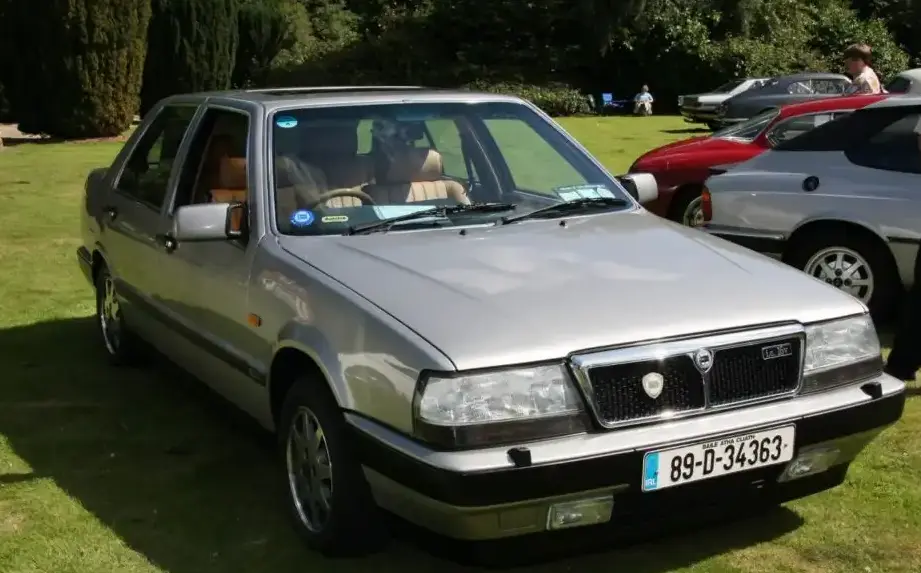
The Lancia Thema (834) 2000 16V, produced between 1992 and 1993, represented a significant evolution of Lancia’s flagship sedan. Positioned as a more performance-oriented variant within the 834 series – which itself was a rebadged version of the Fiat Croma, Alfa Romeo 164, and Saab 9000 sharing the Type Four platform – the 2000 16V aimed to offer a blend of Italian style, comfort, and respectable power. It occupied a mid-range position in the Thema lineup, slotting above the lower-powered 1.8L and 2.0L 8V models, but below the more exclusive 2.8L V6 versions. This model was primarily sold within the European market, representing Lancia’s attempt to appeal to buyers seeking a sophisticated and capable grand tourer.
Technical Specifications
| Brand | Lancia |
| Model | Thema |
| Generation | Thema (834) |
| Type (Engine) | 2000 16V (152 Hp) |
| Start of production | 1992 |
| End of production | 1993 |
| Powertrain Architecture | Internal Combustion engine |
| Body type | Sedan |
| Seats | 5 |
| Doors | 4 |
| Fuel consumption (urban) | 10.4 l/100 km (22.6 US mpg, 27.2 UK mpg, 9.6 km/l) |
| Fuel consumption (extra urban) | 6.4 l/100 km (36.8 US mpg, 44.1 UK mpg, 15.6 km/l) |
| Fuel consumption (combined) | 8.2 l/100 km (28.7 US mpg, 34.4 UK mpg, 12.2 km/l) |
| Fuel Type | Petrol (Gasoline) |
| Acceleration 0 – 100 km/h | 9.5 sec |
| Acceleration 0 – 62 mph | 9.5 sec |
| Acceleration 0 – 60 mph | 9 sec |
| Maximum speed | 205 km/h (127.38 mph) |
| Weight-to-power ratio | 8.2 kg/Hp, 121.6 Hp/tonne |
| Weight-to-torque ratio | 6.8 kg/Nm, 147.2 Nm/tonne |
| Power | 152 Hp @ 6000 rpm |
| Power per litre | 76.2 Hp/l |
| Torque | 184 Nm @ 4000 rpm (135.71 lb.-ft. @ 4000 rpm) |
| Engine layout | Front, Transverse |
| Engine Model/Code | 834 F1.000 |
| Engine displacement | 1995 cm3 (121.74 cu. in.) |
| Number of cylinders | 4 |
| Engine configuration | Inline |
| Cylinder Bore | 84 mm (3.31 in.) |
| Piston Stroke | 90 mm (3.54 in.) |
| Compression ratio | 9.85:1 |
| Number of valves per cylinder | 4 |
| Fuel injection system | Multi-port manifold injection |
| Engine aspiration | Naturally aspirated engine |
| Engine oil capacity | 5.5 l (5.81 US qt | 4.84 UK qt) |
| Coolant capacity | 8.2 l (8.66 US qt | 7.21 UK qt) |
| Kerb Weight | 1250 kg (2755.78 lbs.) |
| Max. weight | 1750 kg (3858.09 lbs.) |
| Max load | 500 kg (1102.31 lbs.) |
| Trunk (boot) space – minimum | 440 l (15.54 cu. ft.) |
| Trunk (boot) space – maximum | 1000 l (35.31 cu. ft.) |
| Fuel tank capacity | 70 l (18.49 US gal | 15.4 UK gal) |
| Length | 4590 mm (180.71 in.) |
| Width | 1750 mm (68.9 in.) |
| Height | 1435 mm (56.5 in.) |
| Wheelbase | 2660 mm (104.72 in.) |
| Front track | 1480 mm (58.27 in.) |
| Rear track | 1470 mm (57.87 in.) |
| Drivetrain Architecture | Front wheel drive |
| Number of gears | 5 |
| Gearbox type | Manual transmission |
| Front suspension | Coil spring |
| Rear suspension | Coil spring |
| Front brakes | Disc |
| Rear brakes | Disc |
| Assisting systems | ABS (Anti-lock braking system) |
| Steering type | Steering rack and pinion |
| Power steering | Hydraulic Steering |
| Tires size | 185/70 R14 |
| Wheel rims size | 14 |
Powertrain & Engine Architecture
The heart of the Thema 2000 16V is the 834 F1.000 engine, a 1995cc inline-four cylinder powerplant. This engine is closely related to those found in other Type Four platform vehicles, but the “16V” designation signifies its key upgrade: a dual overhead camshaft (DOHC) cylinder head with four valves per cylinder. This configuration, compared to the two-valve heads of the base 1.8L and 2.0L engines, significantly improved breathing and allowed for higher engine speeds. The engine utilized Bosch Motronic fuel injection and a distributorless ignition system. The engine’s 9.85:1 compression ratio was a compromise between performance and the fuel quality available in European markets. The Thema 2000 16V was exclusively offered with a five-speed manual transmission, providing drivers with greater control over the engine’s power delivery.
Driving Characteristics
The 2000 16V offered a noticeable improvement in performance over the lower-spec Thema models. The 152 horsepower and 135.71 lb-ft of torque allowed for a 0-60 mph time of around 9 seconds and a top speed of 127.38 mph. While not a sports car, the 16V provided ample power for comfortable highway cruising and confident overtaking. The five-speed manual transmission allowed drivers to keep the engine in its optimal power band. Compared to the V6 models, the 2000 16V felt more nimble and responsive due to its lighter weight. However, it lacked the effortless surge of power provided by the larger engine. The gear ratios were fairly well-spaced, offering a balance between acceleration and fuel efficiency.
Equipment & Trim Levels
The Thema 2000 16V typically came equipped with a respectable level of standard features. Interior appointments included cloth upholstery, power windows, central locking, and a basic stereo system. Air conditioning was often standard, though its presence could vary depending on the specific market. Optional extras included leather upholstery, a sunroof, upgraded audio systems, and alloy wheels. The dashboard layout was typical of early 1990s Italian design, featuring a combination of analog gauges and a central information display. The overall interior ambiance was one of understated elegance and comfort.
Chassis & Braking
The Thema 834 utilized a relatively conventional chassis design, featuring independent coil spring suspension at all four wheels. The front suspension employed MacPherson struts, while the rear utilized a semi-trailing arm setup. Braking duties were handled by disc brakes on all four wheels, supplemented by an ABS anti-lock braking system. The ABS system was a significant safety feature for the time. Stabilizer bars were fitted to both the front and rear axles to reduce body roll during cornering. The suspension tuning was geared towards providing a comfortable ride, rather than outright sporty handling.
Market Reception & Comparison
The Lancia Thema 2000 16V was generally well-received by automotive critics. It was praised for its stylish design, comfortable interior, and improved performance compared to the base models. However, some critics noted that it lacked the prestige and refinement of more established luxury sedans. Compared to the Thema 2.8 V6, the 2000 16V offered a more affordable entry point into the Thema range, but at the expense of outright performance. Fuel economy was respectable for its class, averaging around 28.7 US mpg in combined driving. Reliability was generally considered to be average, with some owners reporting issues with electrical components and the fuel injection system.
Legacy
The Lancia Thema 2000 16V, while not a groundbreaking vehicle, represents an interesting chapter in Lancia’s history. It showcased the brand’s commitment to combining Italian style with respectable performance. Today, the Thema 834 is a relatively rare sight on the roads, and well-maintained examples are becoming increasingly sought after by collectors and enthusiasts. The 834 F1.000 engine, while not known for exceptional durability, is generally considered to be reasonably reliable if properly maintained. Parts availability can be a challenge, but many components are shared with other Type Four platform vehicles, making sourcing replacements somewhat easier. The Thema 2000 16V remains a testament to a time when Lancia was a significant player in the European automotive market.
