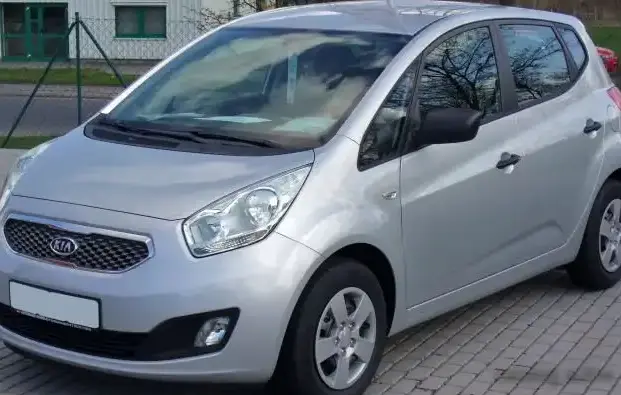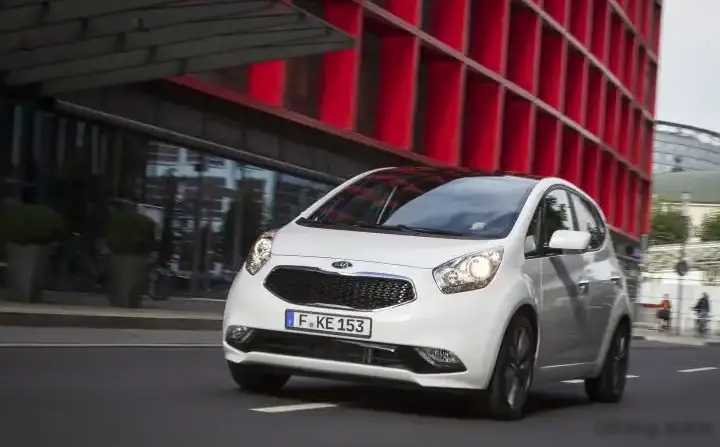
The Kia Venga (YN) facelift, specifically the 1.4-liter (90 horsepower) variant, represents an entry-level offering within the second generation of Kia’s B-segment multi-purpose vehicle (MPV). Introduced in 2014, this facelift brought styling updates and minor mechanical revisions to the original Venga launched in 2009. Positioned as a practical and affordable family car, the Venga aimed to compete with established European rivals like the Renault Modus, Opel Meriva, and Ford Fusion (Fiesta in North America). The 1.4L engine paired with a five-speed manual transmission was designed to prioritize fuel efficiency and ease of driving, making it a popular choice for urban commuters and families seeking a versatile, yet economical vehicle. This model was primarily sold within the European market, where the demand for compact MPVs remained strong.
Technical Specifications
| Brand | Kia |
| Model | Venga |
| Generation | Venga (YN, facelift 2014) |
| Type (Engine) | 1.4 (90 Hp) |
| Start of production | 2014 |
| Powertrain Architecture | Internal Combustion engine |
| Body type | Hatchback |
| Seats | 5 |
| Doors | 5 |
| Fuel consumption (urban) | 7.2 l/100 km (32.7 US mpg) |
| Fuel consumption (extra urban) | 5.3 l/100 km (44.4 US mpg) |
| Fuel consumption (combined) | 6 l/100 km (39.2 US mpg) |
| CO2 emissions | 140 g/km |
| Fuel Type | Petrol (Gasoline) |
| Acceleration 0 – 100 km/h | 12.8 sec |
| Acceleration 0 – 62 mph | 12.8 sec |
| Acceleration 0 – 60 mph | 12.2 sec |
| Maximum speed | 169 km/h (105.01 mph) |
| Emission standard | Euro 6 |
| Weight-to-power ratio | 13.1 kg/Hp |
| Weight-to-torque ratio | 8.6 kg/Nm |
| Power | 90 Hp @ 6000 rpm |
| Torque | 137 Nm @ 4000 rpm (101.05 lb.-ft. @ 4000 rpm) |
| Engine layout | Front, Transverse |
| Engine Model/Code | G4FA |
| Engine displacement | 1396 cm3 (85.19 cu. in.) |
| Number of cylinders | 4 |
| Engine configuration | Inline |
| Cylinder Bore | 77 mm (3.03 in.) |
| Piston Stroke | 74.99 mm (2.95 in.) |
| Compression ratio | 10.5:1 |
| Number of valves per cylinder | 4 |
| Fuel injection system | Multi-port manifold injection |
| Engine aspiration | Naturally aspirated engine |
| Engine oil capacity | 3.3 l (3.49 US qt | 2.9 UK qt) |
| Coolant capacity | 5.3 l (5.6 US qt | 4.66 UK qt) |
| Kerb Weight | 1178-1268 kg (2597.05 – 2795.46 lbs.) |
| Max. weight | 1710 kg (3769.9 lbs.) |
| Max load | 442-532 kg (974.44 – 1172.86 lbs.) |
| Trunk (boot) space – minimum | 314 l (11.09 cu. ft.) |
| Trunk (boot) space – maximum | 1486 l (52.48 cu. ft.) |
| Fuel tank capacity | 50 l (13.21 US gal | 11 UK gal) |
| Max. roof load | 70 kg (154.32 lbs.) |
| Permitted trailer load with brakes (12%) | 1300 kg (2866.01 lbs.) |
| Permitted trailer load without brakes | 550 kg (1212.54 lbs.) |
| Permitted towbar download | 75 kg (165.35 lbs.) |
| Length | 4075 mm (160.43 in.) |
| Width | 1765 mm (69.49 in.) |
| Width including mirrors | 2020 mm (79.53 in.) |
| Height | 1600 mm (62.99 in.) |
| Wheelbase | 2615 mm (102.95 in.) |
| Front track | 1541-1553 mm (60.67 – 61.14 in.) |
| Rear (Back) track | 1545-1557 mm (60.83 – 61.3 in.) |
| Front overhang | 792 mm (31.18 in.) |
| Rear overhang | 668 mm (26.3 in.) |
| Minimum turning circle | 10.42 m (34.19 ft.) |
| Drivetrain Architecture | Front wheel drive |
| Number of gears and type of gearbox | 5 gears, manual transmission |
| Front suspension | Independent, type McPherson with coil spring and anti-roll bar |
| Rear suspension | Semi-independent, coil spring |
| Front brakes | Ventilated discs |
| Rear brakes | Disc |
| Assisting systems | ABS (Anti-lock braking system) |
| Steering type | Steering rack and pinion |
| Power steering | Electric Steering |
| Tires size | 195/65 R15; 205/55 R16; 205/50 R17 |
| Wheel rims size | 6.0J X 15; 6.0J X 16; 6.5J X 17 |
Powertrain & Engine Architecture
The Kia Venga 1.4 utilizes the G4FA engine, a 1.4-liter inline-four cylinder gasoline engine. This engine is a naturally aspirated design, meaning it doesn’t employ turbocharging or supercharging. It features multi-point fuel injection, delivering fuel directly into the intake ports. The engine’s 16-valve configuration (four valves per cylinder) contributes to its breathing efficiency. The G4FA engine is known for its relatively simple design, contributing to its reliability. The five-speed manual transmission paired with this engine was a standard offering, providing a direct connection between the engine and the front wheels. Gear ratios were tuned for fuel economy and everyday drivability rather than outright performance.
Driving Characteristics
The 90 horsepower output of the 1.4L engine, combined with the five-speed manual transmission, resulted in a driving experience focused on practicality rather than sportiness. Acceleration from 0 to 60 mph took approximately 12.2 seconds, and top speed was limited to around 105 mph. The engine delivered adequate power for urban driving and highway cruising, but overtaking maneuvers required careful planning. The gear ratios were spaced to maximize fuel efficiency, meaning the engine often needed to be revved to access its peak power. Compared to higher-output versions of the Venga (like those equipped with a 1.6L engine), the 1.4L felt noticeably less responsive. However, the lighter engine weight contributed to slightly improved handling and fuel economy.
Equipment & Trim Levels
The 1.4-liter Venga typically came with a base level of equipment, designed to offer good value for money. Standard features generally included air conditioning, power steering, electric front windows, a basic audio system with USB connectivity, and ABS brakes. Higher trim levels, available as optional upgrades, added features like alloy wheels, a more sophisticated audio system, rear electric windows, and a trip computer. Interior upholstery was typically cloth, with a focus on durability rather than luxury. Safety features included dual front airbags, side airbags, and curtain airbags.
Chassis & Braking
The Venga’s chassis featured a McPherson strut front suspension and a semi-independent coil spring rear suspension. This setup provided a comfortable ride quality, well-suited for everyday driving. The front brakes were ventilated discs, offering good stopping power, while the rear brakes were solid discs. ABS (Anti-lock Braking System) was standard, enhancing safety during emergency braking situations. The Venga’s suspension was tuned for comfort and stability, prioritizing ride quality over sporty handling. Stabilizer bars were included to reduce body roll during cornering.
Market Reception & Comparison
The Kia Venga 1.4 was generally well-received by automotive critics as a practical and affordable MPV. Its fuel economy was a key selling point, and its spacious interior was praised for its versatility. However, some critics noted that the 1.4L engine felt underpowered, particularly when the vehicle was fully loaded. Compared to other trims in the Venga lineup, the 1.4L offered the lowest price point but also the least amount of performance. It was often seen as a sensible choice for budget-conscious buyers who prioritized fuel efficiency and practicality over driving excitement.
Legacy
The Kia Venga 1.4, while not a performance standout, has proven to be a reliable and durable vehicle. The G4FA engine is known for its longevity, and the simple mechanical design contributes to relatively low maintenance costs. In the used car market, these models are often sought after by buyers looking for an affordable and practical family vehicle. While not particularly collectible, the Venga 1.4 represents a solid and dependable option for those seeking a no-frills, economical MPV.