
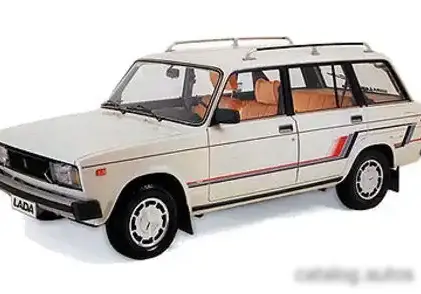
The Lada 21044 1.7, producing 79 horsepower, was a station wagon variant of the Lada 2104 family, manufactured between 1997 and 2003. Positioned as a practical and affordable vehicle, it represented a continuation of the classic Lada design, offering a spacious interior and a robust build. The 21044 was a key model for Lada, particularly in Eastern European markets, where station wagons were highly valued for their versatility. It was built on the 2104 platform, a derivative of the original Fiat 124, and served as a workhorse for families and businesses alike. This specific 1.7-liter engine and five-speed manual transmission combination represented a mid-range offering within the 2104 lineup, slotting between the lower-powered 1.5-liter versions and the rarer, more performance-oriented options.
Technical Specifications
| Brand | Lada |
| Model | 2104 |
| Generation | 21044 |
| Type (Engine) | 1.7 (79 Hp) |
| Start of production | 1997 |
| End of production | 2003 |
| Powertrain Architecture | Internal Combustion engine |
| Body type | Station wagon (estate) |
| Seats | 5 |
| Doors | 5 |
| Fuel consumption (urban) | 9.5 l/100 km (24.8 US mpg) |
| Fuel Type | Petrol (Gasoline) |
| Acceleration 0 – 100 km/h | 17 sec |
| Acceleration 0 – 62 mph | 17 sec |
| Acceleration 0 – 60 mph | 16.2 sec |
| Maximum speed | 153 km/h (95.07 mph) |
| Weight-to-power ratio | 13.3 kg/Hp |
| Weight-to-torque ratio | 8.3 kg/Nm |
| Power | 79 Hp @ 5200 rpm |
| Power per litre | 46.7 Hp/l |
| Torque | 127 Nm @ 3200 rpm (93.67 lb.-ft. @ 3200 rpm) |
| Engine layout | Front, Longitudinal |
| Engine displacement | 1690 cm3 (103.13 cu. in.) |
| Number of cylinders | 4 |
| Engine configuration | Inline |
| Cylinder Bore | 82 mm (3.23 in.) |
| Piston Stroke | 80 mm (3.15 in.) |
| Compression ratio | 9.3:1 |
| Number of valves per cylinder | 2 |
| Fuel injection system | Carburettor |
| Engine aspiration | Naturally aspirated engine |
| Valvetrain | OHC |
| Kerb Weight | 1050 kg (2314.85 lbs.) |
| Max. weight | 1475 kg (3251.82 lbs.) |
| Max load | 425 kg (936.96 lbs.) |
| Trunk (boot) space – minimum | 345 l (12.18 cu. ft.) |
| Trunk (boot) space – maximum | 1035 l (36.55 cu. ft.) |
| Fuel tank capacity | 45 l (11.89 US gal | 9.9 UK gal) |
| Length | 4115 mm (162.01 in.) |
| Width | 1620 mm (63.78 in.) |
| Height | 1443 mm (56.81 in.) |
| Wheelbase | 2424 mm (95.43 in.) |
| Front track | 1365 mm (53.74 in.) |
| Rear (Back) track | 1321 mm (52.01 in.) |
| Drivetrain Architecture | Rear wheel drive |
| Number of gears and type of gearbox | 5 gears, manual transmission |
| Front suspension | Double wishbone |
| Rear suspension | Rigid axle suspension |
| Front brakes | Disc |
| Rear brakes | Drum |
| Steering type | Worm-reduction unit |
| Tires size | 175/70 SR13 |
Powertrain & Engine Architecture
The heart of the Lada 21044 1.7 was the 1690cc inline-four cylinder engine. This engine, often referred to by its internal codes, was a relatively simple design, utilizing a single overhead camshaft (OHC) and two valves per cylinder. Crucially, it employed a carburetor for fuel delivery, a technology increasingly outdated in the late 1990s and early 2000s, but one that contributed to the car’s affordability and ease of maintenance. The carburetor, while less efficient than fuel injection, was well-understood by mechanics in the regions where the 21044 was sold. The engine produced 79 horsepower at 5200 rpm and 127 Nm (93.67 lb-ft) of torque at 3200 rpm. The five-speed manual transmission was a standard feature, providing a reasonable spread of gears for both city driving and highway cruising. The transmission was rear-wheel drive, a characteristic inherited from the original Fiat 124 design.
Driving Characteristics
The 1.7-liter engine in the 21044 provided adequate, but not exhilarating, performance. Acceleration from 0 to 60 mph took around 16.2 seconds, and the top speed was approximately 95 mph. The car felt most comfortable at moderate speeds, with the engine providing sufficient torque for everyday driving. The five-speed manual transmission allowed drivers to keep the engine in its optimal power band, but the carburetor sometimes resulted in a slight lag in throttle response. Compared to the lower-powered 1.5-liter versions, the 1.7 offered a noticeable improvement in acceleration and hill-climbing ability. However, it lacked the punch of any potential higher-performance variants that might have been available in limited numbers. The rear-wheel-drive configuration provided a traditional driving feel, but also required careful handling in slippery conditions.
Equipment & Trim Levels
The Lada 21044 1.7 was generally sparsely equipped, reflecting its budget-oriented positioning. Standard features typically included basic cloth upholstery, a simple dashboard layout, and manual windows and door locks. Heating was standard, but air conditioning was rarely fitted, even as an option. The interior was functional and durable, designed to withstand heavy use. Optional extras were limited, but could include upgraded seat covers, a radio, and sometimes, a more sophisticated instrument cluster. The trim level was largely consistent across the 21044 1.7 models, with variations primarily stemming from dealer-installed accessories.
Chassis & Braking
The Lada 21044 utilized a robust, if somewhat outdated, chassis design. The front suspension featured a double wishbone setup, while the rear suspension employed a rigid axle. This configuration provided a comfortable ride, but handling was not particularly precise. The braking system consisted of disc brakes at the front and drum brakes at the rear. While adequate for normal driving, the brakes lacked the stopping power and modulation of more modern systems. The steering was a worm-reduction unit, which provided a heavy, but direct feel.
Market Reception & Comparison
The Lada 21044 1.7 was well-received in its target markets, primarily due to its affordability, practicality, and durability. Critics acknowledged its simple design and ease of maintenance, but also noted its lack of refinement and outdated technology. Compared to other station wagons available at the time, the 21044 offered a compelling value proposition, particularly for buyers who prioritized functionality over luxury. Fuel economy was reasonable for the era, but not exceptional. Reliability was generally good, although the carburetor required periodic adjustment and maintenance. Compared to the 1.5-liter versions, the 1.7 offered a worthwhile performance upgrade, while remaining within a similar price bracket.
Legacy
The Lada 21044 1.7, and the 2104 series as a whole, holds a significant place in automotive history as a symbol of Soviet-era engineering and post-Soviet adaptation. While not known for its technological innovation, the 21044 proved to be a reliable and durable vehicle, capable of withstanding harsh conditions. Today, the 21044 is gaining a following among classic car enthusiasts, particularly those who appreciate its simplicity and affordability. The 1.7-liter engine, while not particularly powerful, is considered relatively robust and easy to maintain. Parts availability can be a challenge, but a dedicated community of Lada enthusiasts continues to support the preservation of these vehicles. The 21044 remains a testament to a bygone era of automotive design, offering a unique and nostalgic driving experience.
