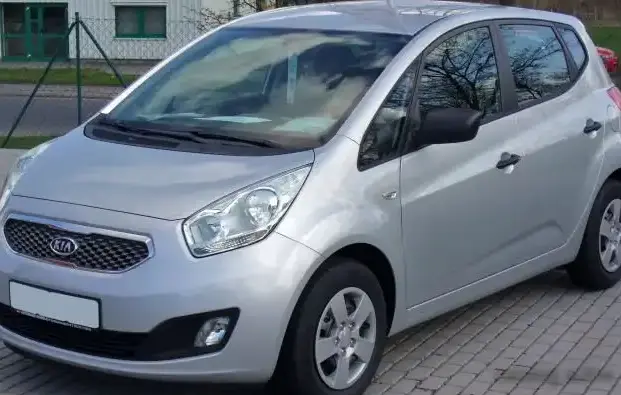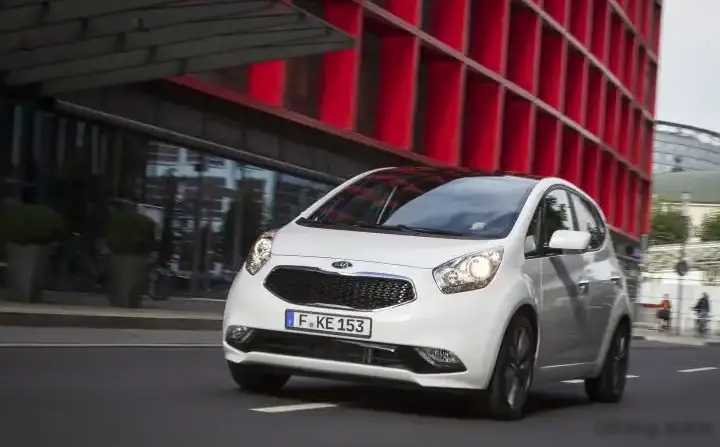
The Kia Venga (YN) facelift, specifically the 1.6-liter (125 horsepower) variant, was a key offering in Kia’s European small MPV lineup from 2014 onwards. Positioned as a mid-range trim, it aimed to balance affordability with a reasonable level of equipment and performance. The Venga, never officially sold in the United States, was designed to appeal to European buyers seeking a practical and spacious vehicle in a compact package. This facelift brought styling updates and minor mechanical revisions to the original YN Venga, launched in 2009. It competed with vehicles like the Renault Modus, Opel Meriva, and Ford Fusion (Europe), offering a distinctive blend of functionality and value.
Technical Specifications
| Brand | Kia |
| Model | Venga |
| Generation | Venga (YN, facelift 2014) |
| Type (Engine) | 1.6 (125 Hp) |
| Start of production | 2014 |
| Powertrain Architecture | Internal Combustion engine |
| Body type | Hatchback |
| Seats | 5 |
| Doors | 5 |
| Fuel consumption (urban) | 7.4 l/100 km (31.8 US mpg) |
| Fuel consumption (extra urban) | 5.7 l/100 km (41.3 US mpg) |
| Fuel consumption (combined) | 6.4 l/100 km (36.8 US mpg) |
| CO2 emissions | 148 g/km |
| Fuel Type | Petrol (Gasoline) |
| Acceleration 0 – 100 km/h | 10.9 sec |
| Acceleration 0 – 62 mph | 10.9 sec |
| Acceleration 0 – 60 mph | 10.4 sec |
| Maximum speed | 185 km/h (114.95 mph) |
| Emission standard | Euro 6 |
| Weight-to-power ratio | 9.4 kg/Hp |
| Weight-to-torque ratio | 7.6 kg/Nm |
| Power | 125 Hp @ 6300 rpm |
| Torque | 156 Nm @ 4200 rpm (115.06 lb.-ft. @ 4200 rpm) |
| Engine layout | Front, Transverse |
| Engine Model/Code | G4FC |
| Engine displacement | 1591 cm3 (97.09 cu. in.) |
| Number of cylinders | 4 |
| Engine configuration | Inline |
| Cylinder Bore | 77 mm (3.03 in.) |
| Piston Stroke | 85.44 mm (3.36 in.) |
| Compression ratio | 10.5:1 |
| Number of valves per cylinder | 4 |
| Fuel injection system | Multi-port manifold injection |
| Engine aspiration | Naturally aspirated engine |
| Engine oil capacity | 3.3 l (3.49 US qt | 2.9 UK qt) |
| Coolant | 5.3 l (5.6 US qt | 4.66 UK qt) |
| Kerb Weight | 1180-1280 kg (2601.45 – 2821.92 lbs.) |
| Max. weight | 1710 kg (3769.9 lbs.) |
| Max load | 430-530 kg (947.99 – 1168.45 lbs.) |
| Trunk (boot) space – minimum | 314 l (11.09 cu. ft.) |
| Trunk (boot) space – maximum | 1486 l (52.48 cu. ft.) |
| Fuel tank capacity | 50 l (13.21 US gal | 11 UK gal) |
| Max. roof load | 70 kg (154.32 lbs.) |
| Permitted trailer load with brakes (12%) | 1300 kg (2866.01 lbs.) |
| Permitted trailer load without brakes | 550 kg (1212.54 lbs.) |
| Permitted towbar download | 75 kg (165.35 lbs.) |
| Length | 4075 mm (160.43 in.) |
| Width | 1765 mm (69.49 in.) |
| Width including mirrors | 2020 mm (79.53 in.) |
| Height | 1600 mm (62.99 in.) |
| Wheelbase | 2615 mm (102.95 in.) |
| Front track | 1541-1553 mm (60.67 – 61.14 in.) |
| Rear (Back) track | 1545-1557 mm (60.83 – 61.3 in.) |
| Front overhang | 792 mm (31.18 in.) |
| Rear overhang | 668 mm (26.3 in.) |
| Minimum turning circle | 10.42 m (34.19 ft.) |
| Drivetrain Architecture | Front wheel drive |
| Drive wheel | Front wheel drive |
| Number of gears and type of gearbox | 6 gears, manual transmission |
| Front suspension | Independent, type McPherson with coil spring and anti-roll bar |
| Rear suspension | Semi-independent, coil spring |
| Front brakes | Ventilated discs |
| Rear brakes | Disc |
| Assisting systems | ABS (Anti-lock braking system) |
| Steering type | Steering rack and pinion |
| Power steering | Electric Steering |
| Tires size | 195/65 R15; 205/55 R16; 205/50 R17 |
| Wheel rims size | 6.0J X 15; 6.0J X 16; 6.5J X 17 |
INTRODUCTION
The Kia Venga 1.6, as introduced with the 2014 facelift, represented a significant step forward for Kia in the European B-segment MPV market. Built on the YN platform, this iteration of the Venga aimed to provide a more refined and appealing package than its predecessor. The 1.6-liter engine, producing 125 horsepower, was a popular choice, offering a balance between fuel efficiency and adequate performance for everyday driving. It slotted into the middle of the Venga range, above the lower-powered 1.4-liter engine and below the more expensive diesel options. The Venga was designed with practicality in mind, offering a surprisingly spacious interior for its compact exterior dimensions.
Powertrain & Engine Architecture
The heart of the Venga 1.6 is the Kia G4FC engine, a 1.6-liter inline-four cylinder gasoline engine. This engine utilizes multi-point fuel injection and a dual overhead camshaft (DOHC) valvetrain with four valves per cylinder. The G4FC is a naturally aspirated engine, meaning it doesn’t employ turbocharging or supercharging. This design prioritizes reliability and simplicity. The engine’s 125 horsepower output is achieved at 6,300 rpm, while its 156 Nm (115 lb-ft) of torque peaks at 4,200 rpm. The engine is transversely mounted in the front of the vehicle. The Venga 1.6 was typically paired with a six-speed manual transmission, although a four-speed automatic transmission was also available, albeit less common. The automatic transmission, while offering convenience, resulted in slightly reduced fuel economy and acceleration compared to the manual version.
Driving Characteristics
The Venga 1.6 with the manual transmission offered a reasonably engaging driving experience for its class. Acceleration from 0 to 100 km/h (0-62 mph) took around 10.9 seconds, which was competitive with other naturally aspirated 1.6-liter engines of the time. The automatic transmission version was slightly slower. The engine felt responsive enough for everyday driving, with adequate power for overtaking and merging onto highways. However, it wasn’t particularly sporty. The Venga’s suspension provided a comfortable ride, absorbing bumps and imperfections in the road well. The steering was light and easy to use, making it well-suited for urban environments. The six-speed manual transmission had well-spaced gear ratios, allowing the driver to keep the engine in its optimal power band. The automatic transmission, while smooth, could sometimes feel hesitant during quick acceleration.
Equipment & Trim Levels
The Venga 1.6 typically came equipped with a decent level of standard features. Base models included air conditioning, electric front windows, central locking, and a basic audio system. Higher trim levels added features such as alloy wheels, a touchscreen infotainment system with Bluetooth connectivity, rear parking sensors, and cruise control. Interior upholstery was typically cloth, with options for upgraded materials on higher trims. Safety features included ABS brakes, electronic stability control (ESC), and multiple airbags. Optional extras included a panoramic sunroof, leather upholstery, and a navigation system.
Chassis & Braking
The Venga utilized a McPherson strut front suspension and a semi-independent torsion beam rear suspension. This setup provided a good balance between ride comfort and handling. The front brakes were ventilated discs, while the rear brakes were solid discs. ABS (Anti-lock Braking System) was standard, providing enhanced braking performance and stability. The Venga’s chassis was designed to maximize interior space while maintaining a relatively lightweight structure. Stabilizer bars were fitted to both the front and rear axles to reduce body roll during cornering.
Market Reception & Comparison
The Kia Venga 1.6 was generally well-received by automotive critics. It was praised for its spacious interior, practical design, and competitive price. However, some critics noted that the engine could feel underpowered when fully loaded or driving uphill. Compared to the lower-powered 1.4-liter Venga, the 1.6 offered a noticeable improvement in performance. Compared to the diesel versions, the 1.6 was less fuel-efficient but offered a lower purchase price and potentially lower maintenance costs. Fuel economy figures were respectable, averaging around 6.4 l/100 km (36.8 US mpg) in combined driving.
Legacy
The Kia Venga, while not a mainstream success in all markets, established Kia as a credible player in the European small MPV segment. The 1.6-liter engine proved to be relatively reliable, with few reported major issues. Today, used Venga 1.6 models represent a good value proposition for buyers seeking a practical and affordable family car. Maintenance costs are generally reasonable, and parts availability is good. The Venga’s simple engine design and robust construction contribute to its long-term durability. While it may not offer the latest technology or the most exciting driving experience, the Venga 1.6 remains a sensible and dependable choice for those prioritizing practicality and value.