
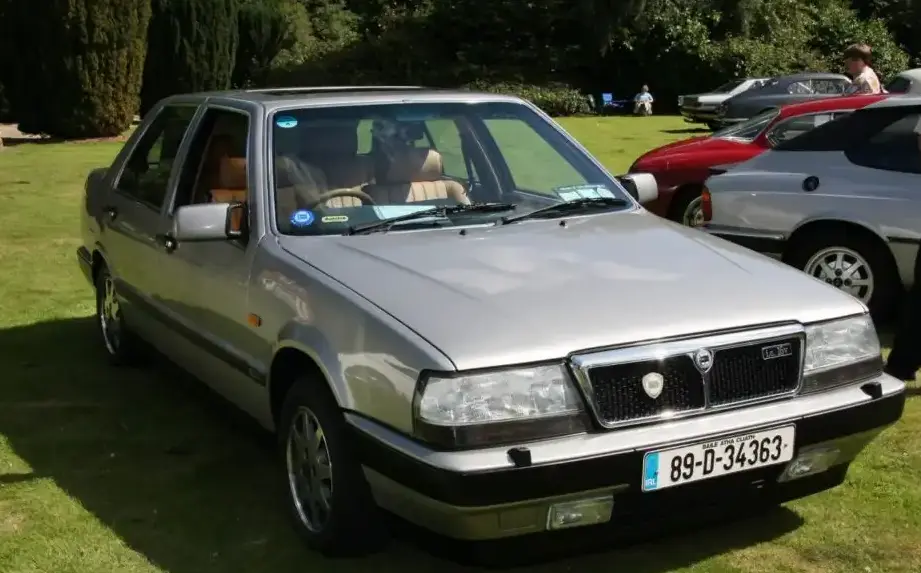
The Lancia Thema (834) 2000 16V Turbo, produced between 1988 and 1990, represented a high-performance variant within the second generation of the Thema family. Positioned as a premium offering, it aimed to blend Italian styling with robust turbocharged power. The Thema 834 series, launched in 1988, was a significant update to the original Thema, sharing its underpinnings with the Saab 9000, Fiat Croma, and Alfa Romeo 164 – all built on the Type Four platform. This 2000 16V Turbo model specifically targeted drivers seeking a more engaging and powerful experience than the base engine options offered.
Technical Specifications
| Brand | Lancia |
| Model | Thema |
| Generation | Thema (834) |
| Type (Engine) | 2000 16V Turbo (181 Hp) |
| Start of production | 1988 |
| End of production | 1990 |
| Powertrain Architecture | Internal Combustion engine |
| Body type | Sedan |
| Seats | 5 |
| Doors | 4 |
| Fuel consumption (urban) | 11.1 l/100 km (21.2 US mpg) |
| Fuel consumption (extra urban) | 7.1 l/100 km (33.1 US mpg) |
| Fuel consumption (combined) | 9 l/100 km (26.1 US mpg) |
| Fuel Type | Petrol (Gasoline) |
| Acceleration 0 – 100 km/h | 8 sec |
| Acceleration 0 – 62 mph | 8 sec |
| Acceleration 0 – 60 mph | 7.6 sec |
| Maximum speed | 222 km/h (137.94 mph) |
| Weight-to-power ratio | 7.1 kg/Hp |
| Weight-to-torque ratio | 4.3 kg/Nm |
| Power | 181 Hp @ 5500 rpm |
| Torque | 299 Nm @ 2500 rpm (220.53 lb.-ft. @ 2500 rpm) |
| Engine layout | Front, Transverse |
| Engine Model/Code | 834 C1.000 |
| Engine displacement | 1995 cm3 (121.74 cu. in.) |
| Number of cylinders | 4 |
| Engine configuration | Inline |
| Cylinder Bore | 84 mm (3.31 in.) |
| Piston Stroke | 90 mm (3.54 in.) |
| Number of valves per cylinder | 4 |
| Fuel injection system | Multi-port manifold injection |
| Engine aspiration | Turbocharger |
| Engine oil capacity | 5.5 l (5.81 US qt | 4.84 UK qt) |
| Coolant capacity | 8.2 l (8.66 US qt | 7.21 UK qt) |
| Kerb Weight | 1285 kg (2832.94 lbs.) |
| Max. weight | 1785 kg (3935.25 lbs.) |
| Max load | 500 kg (1102.31 lbs.) |
| Trunk (boot) space – minimum | 440 l (15.54 cu. ft.) |
| Trunk (boot) space – maximum | 1000 l (35.31 cu. ft.) |
| Fuel tank capacity | 70 l (18.49 US gal | 15.4 UK gal) |
| Length | 4590 mm (180.71 in.) |
| Width | 1750 mm (68.9 in.) |
| Height | 1435 mm (56.5 in.) |
| Wheelbase | 2660 mm (104.72 in.) |
| Front track | 1480 mm (58.27 in.) |
| Rear track | 1470 mm (57.87 in.) |
| Drivetrain Architecture | Front wheel drive |
| Number of gears | 5 |
| Gearbox type | Manual transmission |
| Front suspension | Coil spring |
| Rear suspension | Coil spring |
| Front brakes | Disc |
| Rear brakes | Disc |
| Assisting systems | ABS (Anti-lock braking system) |
| Steering type | Steering rack and pinion |
| Power steering | Hydraulic |
| Tires size | 195/60 R15 |
Powertrain & Engine Architecture
The heart of the Thema 2000 16V Turbo was the 834 C1.000 engine, a 1995cc inline-four cylinder powerplant. This engine featured a sophisticated 16-valve cylinder head and, crucially, a Garrett turbocharger with an intercooler. The turbocharger significantly boosted power output compared to the naturally aspirated 2.0-liter engines available in other Thema trims. Fuel delivery was managed by Bosch multi-port fuel injection, ensuring precise fuel metering for optimal performance and efficiency. The engine’s design prioritized a broad torque curve, making it responsive in a variety of driving situations. The five-speed manual transmission was the only gearbox option offered with this engine, chosen to handle the increased power and provide a more engaging driving experience.
Driving Characteristics
The 2000 16V Turbo offered a noticeable performance upgrade over the standard Thema models. Acceleration to 60 mph was achieved in around 7.6 seconds, and it could reach a top speed of 138 mph. The turbocharger provided a surge of power in the mid-range, making overtaking maneuvers effortless. While not a sports car, the Thema Turbo offered a compelling blend of comfort and performance. The front-wheel-drive configuration, while common for its time, could exhibit some torque steer under hard acceleration. The five-speed manual transmission allowed for precise control over the engine’s power band, and the gear ratios were well-matched to the engine’s characteristics. Compared to the naturally aspirated versions, the turbo model felt significantly more powerful and responsive, though it did require more attentive driving.
Equipment & Trim Levels
The Thema 2000 16V Turbo was generally well-equipped, reflecting its position as a premium variant. Standard features typically included power windows, central locking, power steering, and an anti-lock braking system (ABS). Interior appointments featured comfortable cloth or optional leather upholstery. Dashboard design was modern for the late 1980s, with a clear instrument cluster and logically arranged controls. Optional extras could include a sunroof, upgraded audio system, and metallic paint finishes. The overall interior ambiance aimed for a luxurious feel, consistent with Lancia’s reputation for refined interiors.
Chassis & Braking
The Thema 834 utilized a MacPherson strut front suspension and a semi-independent coil spring rear suspension. This setup provided a comfortable ride while maintaining reasonable handling characteristics. The front and rear disc brakes, coupled with the ABS system, offered effective stopping power. Stabilizer bars were fitted to both the front and rear axles to reduce body roll during cornering. The chassis was designed to balance comfort and handling, prioritizing a smooth ride over outright sporty performance. The weight distribution, while not ideal due to the front-wheel-drive layout, was managed effectively by the suspension tuning.
Market Reception & Comparison
The Lancia Thema 2000 16V Turbo was generally well-received by automotive critics, who praised its performance and comfortable ride. However, it faced competition from other premium sedans, such as the BMW 5 Series and Mercedes-Benz E-Class. Compared to the naturally aspirated Thema models, the Turbo offered a significant performance advantage but came at a higher price point. Fuel economy was reasonable for a turbocharged engine of its era, but it was still less efficient than the base engine options. Reliability was generally good, although turbocharger maintenance could be a concern for some owners.
Legacy
The Lancia Thema 2000 16V Turbo remains a sought-after model among Lancia enthusiasts. The 834 C1.000 engine, while not without its quirks, is considered a robust and capable powerplant. Finding well-maintained examples can be challenging, as many have succumbed to age or neglect. However, those that remain offer a unique blend of Italian style, turbocharged performance, and relative comfort. The Thema’s innovative use of the Type Four platform and its sophisticated engineering continue to be appreciated by those familiar with the model. In the used car market, prices for well-preserved examples have been steadily increasing, reflecting their growing collectibility.
