
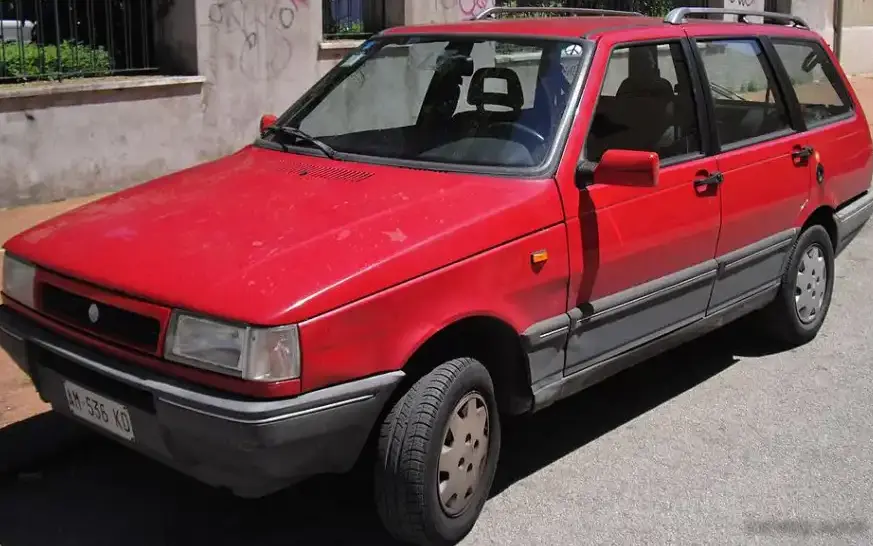
The Innocenti Elba 1.4 i, producing 68 horsepower, was a mainstay of the Italian automaker’s lineup from 1986 to 1996. Positioned as the entry-level variant of the Elba station wagon, it offered affordable family transportation within the European market. The Elba itself was a rebadged and significantly updated version of the original Fiat Duna, born from the collaboration between Innocenti and Fiat following Innocenti’s acquisition by the Leyland Motor Corporation. This model played a crucial role in keeping the Innocenti brand relevant during a period of transition and economic challenges. The 1.4 i represented a balance between economy and practicality, appealing to buyers seeking a spacious and versatile vehicle without the higher costs associated with more powerful engine options.
Technical Specifications
| Brand | Innocenti |
| Model | Elba |
| Generation | Elba |
| Type (Engine) | 1.4 i (68 Hp) |
| Start of production | 1986 |
| End of production | 1996 |
| Powertrain Architecture | Internal Combustion engine |
| Body type | Station wagon (estate) |
| Seats | 5 |
| Doors | 3 |
| Fuel consumption (combined) | 7.3 l/100 km |
| Fuel consumption (US mpg) | 32.2 |
| Fuel consumption (UK mpg) | 38.7 |
| Fuel consumption (km/l) | 13.7 |
| Fuel Type | Petrol (Gasoline) |
| Acceleration 0 – 100 km/h | 14 sec |
| Acceleration 0 – 62 mph | 14 sec |
| Acceleration 0 – 60 mph | 13.3 sec |
| Maximum speed | 160 km/h (99.42 mph) |
| Weight-to-power ratio | 13.7 kg/Hp |
| Weight-to-torque ratio | 8.6 kg/Nm |
| Power | 68 Hp @ 5500 rpm |
| Power per litre | 49.6 Hp/l |
| Torque | 108 Nm @ 3000 rpm (79.66 lb.-ft. @ 3000 rpm) |
| Engine layout | Front, Transverse |
| Engine displacement | 1372 cm3 (83.72 cu. in.) |
| Number of cylinders | 4 |
| Engine configuration | Inline |
| Cylinder Bore | 80.5 mm (3.17 in.) |
| Piston Stroke | 67.4 mm (2.65 in.) |
| Compression ratio | 9.2:1 |
| Number of valves per cylinder | 2 |
| Fuel injection system | Single-point injection |
| Engine aspiration | Naturally aspirated engine |
| Valvetrain | OHC |
| Kerb Weight | 930 kg (2050.3 lbs.) |
| Max. weight | 1390 kg (3064.43 lbs.) |
| Max load | 460 kg (1014.13 lbs.) |
| Trunk (boot) space – minimum | 490 l (17.3 cu. ft.) |
| Trunk (boot) space – maximum | 1430 l (50.5 cu. ft.) |
| Fuel tank capacity | 54 l (14.27 US gal | 11.88 UK gal) |
| Length | 4037 mm (158.94 in.) |
| Width | 1555 mm (61.22 in.) |
| Height | 1450 mm (57.09 in.) |
| Wheelbase | 2362 mm (92.99 in.) |
| Front track | 1321 mm (52.01 in.) |
| Rear (Back) track | 1344 mm (52.91 in.) |
| Drivetrain Architecture | The Internal combustion engine (ICE) drives the front wheels of the vehicle. |
| Drive wheel | Front wheel drive |
| Number of gears and type of gearbox | 5 gears, manual transmission |
| Front suspension | Spring-loaded rack |
| Rear suspension | Leaf spring |
| Front brakes | Disc |
| Rear brakes | Drum |
| Assisting systems | ABS (Anti-lock braking system) |
| Tires size | 165/70 R13S |
Powertrain & Engine Architecture
The Innocenti Elba 1.4 i was powered by a 1372cc inline-four cylinder engine. This engine, often identified by its internal codes (though specific codes varied slightly depending on the year and market), was a relatively simple and robust design. It featured a single overhead camshaft (OHC) valvetrain with two valves per cylinder. Fuel delivery was handled by a single-point fuel injection system, a common technology for the time, which offered improved efficiency and emissions compared to carbureted engines. The engine produced 68 horsepower at 5500 rpm and 108 Nm (79.66 lb-ft) of torque at 3000 rpm. The engine was transversely mounted, driving the front wheels. The standard transmission was a five-speed manual gearbox, designed for durability and ease of maintenance. While an automatic transmission was offered on some Elba models, it was not typically paired with the 1.4-liter engine due to the limited power output.
Driving Characteristics
The 1.4 i Elba offered modest performance. Acceleration from 0 to 60 mph took around 13.3 seconds, and the top speed was approximately 99 mph. The engine felt somewhat underpowered, especially when fully loaded or tackling inclines. The five-speed manual transmission helped to keep the engine in its optimal power band, but drivers often needed to downshift to maintain momentum. Compared to the more powerful 1.6-liter versions of the Elba, the 1.4 i prioritized fuel economy and ease of driving over outright performance. The suspension, while adequate, was tuned for comfort rather than sporty handling. The leaf spring rear suspension, while cost-effective, could result in a somewhat bumpy ride, particularly on uneven surfaces.
Equipment & Trim Levels
The 1.4 i Elba typically came with a basic level of equipment. Standard features included cloth upholstery, a simple dashboard layout, and manual windows and door locks. Power steering was often an optional extra. The interior was functional and durable, designed to withstand the rigors of family use. Higher trim levels, available at an additional cost, offered features such as upgraded upholstery, a more comprehensive instrument cluster, and potentially air conditioning. The Elba’s interior space was a key selling point, offering ample room for passengers and cargo. The rear seats could be folded down to create a larger cargo area, enhancing the vehicle’s versatility.
Chassis & Braking
The Elba’s chassis was a monocoque construction, providing a reasonable level of rigidity. The front suspension utilized a spring-loaded rack system, while the rear suspension employed leaf springs. This combination offered a compromise between comfort and handling. The braking system consisted of disc brakes on the front wheels and drum brakes on the rear wheels. Anti-lock braking system (ABS) was available as an option, improving braking performance and safety. The tires were typically 165/70 R13S, chosen for their balance of grip and fuel efficiency.
Market Reception & Comparison
The Innocenti Elba 1.4 i was generally well-received as an affordable and practical family car. Critics praised its spacious interior, versatility, and fuel economy. However, the engine’s lack of power was a common criticism. Compared to other station wagons in its class, such as the Fiat Regata Weekend or the Renault 19 Estate, the Elba offered a competitive price point and a relatively simple, reliable powertrain. The 1.6-liter Elba offered significantly better performance but came at a higher cost. The 1.4 i appealed to buyers who prioritized economy and practicality over outright speed.
Legacy
The Innocenti Elba, including the 1.4 i variant, has developed a modest following among classic car enthusiasts. The 1.4-liter engine is known for its reliability and relatively simple maintenance requirements. Parts availability can be a challenge, but many components are interchangeable with those from other Fiat and Innocenti models. Today, the Elba 1.4 i represents a piece of Italian automotive history, offering a glimpse into a bygone era of affordable and practical family transportation. While not a performance icon, it remains a testament to the ingenuity and resilience of the Innocenti brand.
