
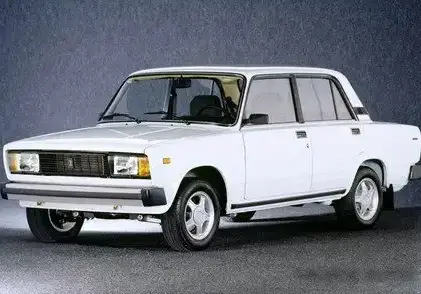
The Lada 2105 1.3, producing 64 horsepower, was a mainstay of the Soviet automotive industry and remained in production from 1980 to 1992. Positioned as the entry-level variant of the 2105 series, it represented an affordable and practical transportation option for a broad segment of the population. The 2105 itself was a significant evolution of the earlier Lada 2103, incorporating numerous refinements and updates while retaining the fundamental rear-wheel-drive layout and robust mechanicals that characterized the brand. It was primarily sold within the Eastern Bloc countries and also found a niche market in Western Europe as a budget-friendly vehicle.
Technical Specifications
| Brand | Lada |
| Model | 2105 |
| Generation | 2105 |
| Type (Engine) | 1.3 (64 Hp) |
| Start of production | 1980 |
| End of production | 1992 |
| Powertrain Architecture | Internal Combustion engine |
| Body type | Sedan |
| Seats | 5 |
| Doors | 4 |
| Fuel consumption (urban) | 10.2 l/100 km (23.1 US mpg, 27.7 UK mpg, 9.8 km/l) |
| Fuel consumption (extra urban) | 7.6 l/100 km (30.9 US mpg, 37.2 UK mpg, 13.2 km/l) |
| Fuel consumption (combined) | 9 l/100 km (26.1 US mpg, 31.4 UK mpg, 11.1 km/l) |
| Fuel Type | Petrol (Gasoline) |
| Acceleration 0 – 100 km/h | 18 sec |
| Acceleration 0 – 62 mph | 18 sec |
| Acceleration 0 – 60 mph | 17.1 sec |
| Maximum speed | 145 km/h (90.1 mph) |
| Weight-to-power ratio | 15.5 kg/Hp, 64.3 Hp/tonne |
| Weight-to-torque ratio | 10.8 kg/Nm, 92.5 Nm/tonne |
| Power | 64 Hp @ 5600 rpm |
| Power per litre | 49.5 Hp/l |
| Torque | 92 Nm @ 3400 rpm (67.86 lb.-ft. @ 3400 rpm) |
| Engine layout | Front, Longitudinal |
| Engine displacement | 1294 cm3 (78.96 cu. in.) |
| Number of cylinders | 4 |
| Engine configuration | Inline |
| Cylinder Bore | 79 mm (3.11 in.) |
| Piston Stroke | 66 mm (2.6 in.) |
| Compression ratio | 8.5:1 |
| Number of valves per cylinder | 2 |
| Fuel injection system | Carburettor |
| Engine aspiration | Naturally aspirated |
| Valvetrain | OHC |
| Kerb Weight | 995 kg (2193.6 lbs.) |
| Trunk (boot) space – maximum | 385 l (13.6 cu. ft.) |
| Fuel tank capacity | 39 l (10.3 US gal | 8.58 UK gal) |
| Length | 4130 mm (162.6 in.) |
| Width | 1620 mm (63.78 in.) |
| Height | 1446 mm (56.93 in.) |
| Wheelbase | 2424 mm (95.43 in.) |
| Front track | 1365 mm (53.74 in.) |
| Rear (Back) track | 1321 mm (52.01 in.) |
| Drivetrain Architecture | Rear wheel drive |
| Drive wheel | Rear wheel drive |
| Number of gears and type of gearbox | 4 gears, manual transmission |
| Front suspension | Double wishbone |
| Rear suspension | Coil spring |
| Front brakes | Disc |
| Rear brakes | Drum |
| Steering type | Worm-reduction unit |
| Tires size | 175/70 SR13 |
Powertrain & Engine Architecture
The heart of the Lada 2105 1.3 was the VAZ-21058 engine, a 1.3-liter inline-four cylinder unit. This engine was a derivative of the earlier VAZ-2101 engine, but with minor modifications to improve reliability and efficiency. It featured a single overhead camshaft (OHC) operating two valves per cylinder. Fuel delivery was handled by a K-126PM carburetor, a relatively simple and robust system common for the era. The engine’s 8.5:1 compression ratio was a compromise between performance and the availability of lower-octane fuel. The four-speed manual transmission was a standard unit, known for its durability but not its refinement. The engine was mounted longitudinally in the front of the vehicle, driving the rear wheels.
Driving Characteristics
The 1.3-liter engine in the 2105 provided modest performance. Acceleration was leisurely, taking approximately 18 seconds to reach 60 mph. The car’s top speed was around 90 mph, but sustained high-speed driving was not its forte. The four-speed gearbox had relatively widely spaced ratios, meaning that the engine often felt strained during acceleration or lacked punch on highway inclines. Compared to the more powerful 1.5 and 1.6-liter versions of the 2105, the 1.3 offered significantly less power, but it also provided better fuel economy. The rear-wheel-drive configuration offered predictable handling, but the car was prone to oversteer if pushed hard. The steering, utilizing a worm-reduction unit, was heavy and lacked precision.
Equipment & Trim Levels
The Lada 2105 1.3 was typically offered with a basic level of equipment. Standard features included cloth upholstery, vinyl floor covering, and a simple dashboard layout. Heating and ventilation were standard, but air conditioning was not typically available on this base model. Optional extras included a radio, upgraded seat upholstery, and sometimes, a more sophisticated instrument cluster. The interior was functional and durable, prioritizing practicality over luxury. The exterior trim was minimal, with basic chrome bumpers and steel wheels.
Chassis & Braking
The 2105 utilized a body-on-frame construction, contributing to its robustness. The front suspension employed a double wishbone design, while the rear suspension featured a coil spring setup. Braking was accomplished via disc brakes on the front wheels and drum brakes on the rear. The braking system was adequate for normal driving conditions, but lacked the stopping power of more modern vehicles. The steering system, as mentioned, was a worm-reduction unit, providing a direct but somewhat cumbersome feel. Tire size was typically 175/70 SR13.
Market Reception & Comparison
The Lada 2105 1.3 was primarily viewed as a utilitarian vehicle. Critics acknowledged its affordability and durability, but often criticized its lack of refinement and modest performance. Compared to the 1.5 and 1.6-liter versions, the 1.3 offered better fuel economy – around 26 mpg combined – but at the expense of performance. The 1.5-liter version, while slightly more expensive, provided a noticeable improvement in acceleration and overall drivability. The 1.3 was often favored by drivers who prioritized fuel efficiency and low running costs over outright performance. Reliability was generally good, although the carburetor required periodic adjustment and maintenance.
Legacy
The Lada 2105 1.3, and the 2105 series as a whole, holds a significant place in automotive history, particularly within the former Eastern Bloc. Its simple design and robust construction made it a reliable workhorse for many years. Today, the 2105 is a popular choice among classic car enthusiasts and those seeking an affordable and easily maintainable vehicle. While the 1.3-liter engine is not known for its power, its simplicity and relative reliability make it a relatively straightforward engine to maintain. Parts availability can be a challenge in some regions, but a dedicated community of enthusiasts continues to support the preservation and restoration of these vehicles. The 2105 remains a testament to a bygone era of automotive engineering, representing a time when practicality and durability were prioritized over luxury and performance.
