
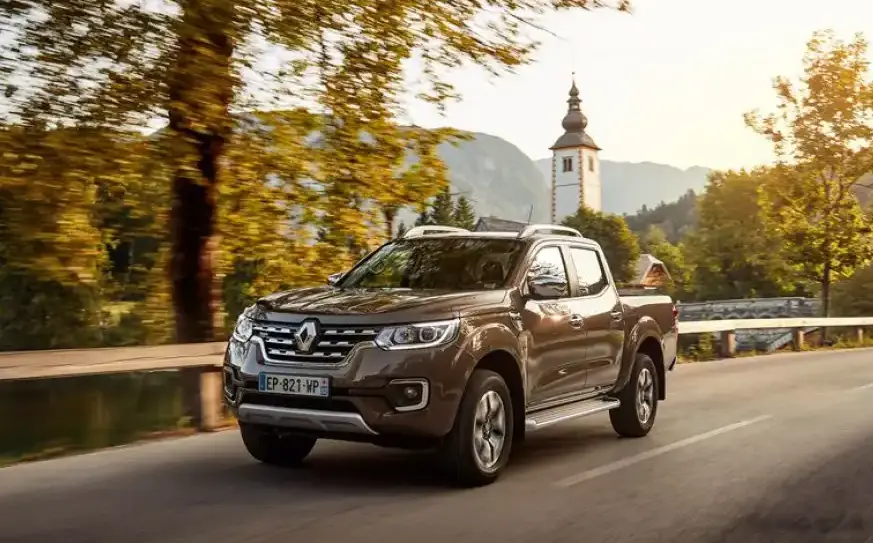
The Renault Alaskan 2.5 dCi (190 Hp) 4×4 Automatic is a mid-size pickup truck produced by Renault from October 2016 until 2025. Developed in collaboration with Nissan, the Alaskan is based on the Nissan Navara/Frontier (D23) platform. Positioned as Renault’s entry into the competitive global pickup market, it aimed to provide a robust and versatile vehicle for both commercial and personal use, particularly in markets outside of North America. This specific 190 horsepower, four-wheel drive, automatic transmission variant represented a significant offering within the Alaskan lineup, balancing performance with accessibility.
Technical Specifications
| Brand | Renault |
| Model | Alaskan |
| Generation | Alaskan |
| Type (Engine) | 2.5 dCi (190 Hp) 4×4 Automatic |
| Start of production | October, 2016 |
| End of production | 2025 |
| Powertrain Architecture | Internal Combustion engine |
| Body type | Pick-up |
| Seats | 5 |
| Doors | 4 |
| Fuel Type | Diesel |
| Weight-to-power ratio | 10.6 kg/Hp, 94.7 Hp/tonne |
| Weight-to-torque ratio | 4.5 kg/Nm, 224.3 Nm/tonne |
| Power | 190 Hp @ 3600 rpm |
| Power per litre | 76.4 Hp/l |
| Torque | 450 Nm @ 2000 rpm, 331.9 lb.-ft. @ 2000 rpm |
| Engine layout | Front, Longitudinal |
| Engine Model/Code | YD25DDTi |
| Engine displacement | 2488 cm3, 151.83 cu. in. |
| Number of cylinders | 4 |
| Engine configuration | Inline |
| Cylinder Bore | 89 mm, 3.5 in. |
| Piston Stroke | 100 mm, 3.94 in. |
| Compression ratio | 15:1 |
| Number of valves per cylinder | 4 |
| Fuel injection system | Diesel Commonrail |
| Engine aspiration | Turbocharger, Intercooler |
| Valvetrain | DOHC |
| Kerb Weight | 2006 kg, 4422.47 lbs |
| Max. weight | 2910 kg, 6415.45 lbs |
| Max load | 904 kg, 1992.98 lbs |
| Fuel tank capacity | 80 l, 21.13 US gal | 17.6 UK gal |
| Permitted trailer load with brakes (12%) | 3000 kg, 6613.87 lbs |
| Length | 5318 mm, 209.37 in |
| Width | 1850 mm, 72.83 in |
| Width including mirrors | 2075 mm, 81.69 in |
| Height | 1860 mm, 73.23 in |
| Wheelbase | 3150 mm, 124.02 in |
| Front track | 1570 mm, 61.81 in |
| Rear (Back) track | 1570 mm, 61.81 in |
| Ride height (ground clearance) | 229 mm, 9.02 in |
| Approach angle | 31° |
| Departure angle | 27.9° |
| Ramp-over (brakeover) angle | 25.4° |
| Drivetrain Architecture | The Internal combustion engine (ICE) drives the rear wheels permanently, and the front wheels are driven through an electrically or mechanically operated clutch if necessary. |
| Drive wheel | All wheel drive (4×4) |
| Number of gears and type of gearbox | 7 gears, automatic transmission |
| Front suspension | Coil spring, Double wishbone, Transverse stabilizer |
| Rear suspension | Rigid axle suspension, Transverse stabilizer, Trailing arm, Coil spring |
| Front brakes | Ventilated discs |
| Rear brakes | Drum |
| Assisting systems | ABS (Anti-lock braking system) |
| Steering type | Steering rack and pinion |
| Power steering | Hydraulic Steering |
| Tires size | 255/60 R18 |
| Wheel rims size | 7J x 18 |
INTRODUCTION
The Renault Alaskan 2.5 dCi 4×4 Automatic, launched in 2016, was Renault’s attempt to establish a foothold in the highly competitive mid-size pickup truck segment. Sharing its underpinnings with the Nissan Navara/Frontier, the Alaskan offered a blend of European styling and Nissan’s proven pickup truck technology. This variant, equipped with the 2.5-liter turbocharged diesel engine producing 190 horsepower and a seven-speed automatic transmission, was aimed at buyers seeking a capable and comfortable vehicle for work and leisure. It was primarily marketed in regions where pickup trucks are popular, including Latin America, Europe, and parts of Asia and Africa.
Powertrain & Engine Architecture
At the heart of the Alaskan 2.5 dCi Automatic lies the YD25DDTi engine, a 2.5-liter inline-four cylinder diesel. This engine is a well-established unit within the Renault-Nissan Alliance, known for its durability and relatively good fuel economy. The YD25DDTi utilizes a common rail direct injection system, delivering fuel at extremely high pressure for optimized combustion. A turbocharger with an intercooler further enhances performance by forcing more air into the cylinders. The engine features a double overhead camshaft (DOHC) valvetrain with four valves per cylinder, contributing to efficient gas exchange. The seven-speed automatic transmission, sourced from Jatco (a Nissan subsidiary), provides smooth and responsive gear changes. This transmission is designed to handle the engine’s torque output and provide adequate performance in various driving conditions. The transmission’s gear ratios are tuned for a balance between acceleration and fuel efficiency.
Driving Characteristics
The 190 horsepower and 450 Nm (331.9 lb-ft) of torque offered by the 2.5 dCi engine, coupled with the seven-speed automatic, provided the Alaskan with adequate, though not exceptional, performance. Acceleration was respectable, but the vehicle’s weight (over 2000 kg) meant it wasn’t particularly quick. The automatic transmission generally shifted smoothly, but could sometimes feel hesitant during quick overtaking maneuvers. Compared to the manual transmission versions of the Alaskan, the automatic offered greater convenience, especially in urban driving. However, the manual versions generally provided slightly better fuel economy and a more engaging driving experience. Compared to higher-output versions available in some markets, the 190 hp variant prioritized fuel efficiency and affordability over outright performance.
Equipment & Trim Levels
The Alaskan 2.5 dCi 4×4 Automatic typically came equipped with a range of standard features, including air conditioning, power windows and locks, a basic audio system with USB connectivity, and steel wheels. Higher trim levels offered upgrades such as alloy wheels, a touchscreen infotainment system with navigation, leather upholstery, and a rearview camera. Safety features generally included ABS brakes, driver and passenger airbags, and electronic stability control. Optional extras could include a limited-slip differential, a tow hitch, and various styling accessories.
Chassis & Braking
The Alaskan’s chassis comprised a robust ladder frame construction, providing a solid foundation for both on-road and off-road driving. The front suspension utilized a double wishbone setup with coil springs and a transverse stabilizer bar, while the rear suspension employed a rigid axle configuration with coil springs and a transverse stabilizer bar. This suspension setup aimed to provide a comfortable ride while maintaining good load-carrying capacity. The braking system featured ventilated discs at the front and drum brakes at the rear. While adequate for most driving situations, the rear drum brakes were a cost-saving measure and didn’t offer the same stopping power as disc brakes.
Market Reception & Comparison
The Renault Alaskan received mixed reviews from automotive critics. It was generally praised for its robust construction, comfortable ride, and competitive pricing. However, some critics noted that its performance was not as refined as some of its rivals, such as the Toyota Hilux or Ford Ranger. Fuel economy was generally considered to be good for a pickup truck of its size. Compared to other trims in the Alaskan lineup, the 2.5 dCi Automatic offered a good balance between price, performance, and fuel efficiency, making it a popular choice for buyers who didn’t require the extra power of the higher-output engines.
Legacy
The Renault Alaskan, while not a massive sales success globally, established Renault as a player in the competitive pickup truck market. The 2.5 dCi engine, in particular, proved to be a reliable and durable unit, and examples continue to be found in the used car market today. While some maintenance issues, such as turbocharger failures, have been reported, the engine is generally considered to be relatively trouble-free if properly maintained. The Alaskan’s legacy lies in its contribution to Renault’s expansion into new vehicle segments and its demonstration of the company’s ability to collaborate effectively with other manufacturers, like Nissan, to develop competitive products.
