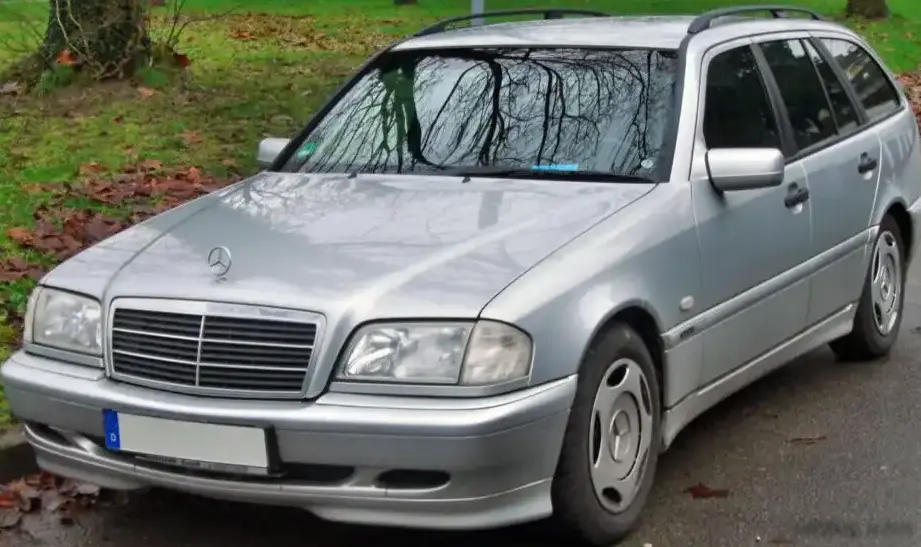
The Mercedes-Benz C-Class T-modell C 200 CDI, produced from June 1998 to January 2001, represents a compelling blend of practicality and efficiency within the S202 facelifted generation of the C-Class estate. Positioned as an entry-level diesel option, it offered a more economical alternative to the gasoline-powered variants and the more potent C 250 CDI. This model catered to buyers prioritizing fuel economy and load-carrying capacity, particularly in European markets where diesel estates were highly popular. The C 200 CDI utilized the advanced common-rail diesel injection technology of the time, aiming to deliver a refined driving experience alongside respectable performance for its class.
| Brand | Mercedes-Benz |
| Model | C-Class |
| Generation | C-Class T-modell (S202, facelift 1997) |
| Type (Engine) | C 200 CDI (102 Hp) |
| Start of production | June, 1998 |
| End of production | January, 2001 |
| Powertrain Architecture | Internal Combustion engine |
| Body type | Station wagon (estate) |
| Seats | 5 |
| Doors | 5 |
| Fuel consumption (urban) | 8.2 l/100 km (28.7 US mpg, 34.4 UK mpg, 12.2 km/l) |
| Fuel consumption (extra urban) | 5.1 l/100 km (46.1 US mpg, 55.4 UK mpg, 19.6 km/l) |
| Fuel consumption (combined) | 6.2 l/100 km (37.9 US mpg, 45.6 UK mpg, 16.1 km/l) |
| Fuel Type | Diesel |
| Acceleration 0 – 100 km/h | 13.6 sec |
| Acceleration 0 – 62 mph | 13.6 sec |
| Acceleration 0 – 60 mph | 12.9 sec |
| Maximum speed | 182 km/h (113.09 mph) |
| Weight-to-power ratio | 14.3 kg/Hp, 69.9 Hp/tonne |
| Weight-to-torque ratio | 6.2 kg/Nm, 161 Nm/tonne |
| Power | 102 Hp @ 4200 rpm |
| Power per litre | 47.5 Hp/l |
| Torque | 235 Nm @ 1500-2600 rpm (173.33 lb.-ft. @ 1500-2600 rpm) |
| Engine layout | Front, Longitudinal |
| Engine Model/Code | OM 611 DE 22 LA red./ 611.960 red. |
| Engine displacement | 2148 cm3 (131.08 cu. in.) |
| Number of cylinders | 4 |
| Engine configuration | Inline |
| Cylinder Bore | 88 mm (3.46 in.) |
| Piston Stroke | 88.4 mm (3.48 in.) |
| Compression ratio | 19:1 |
| Number of valves per cylinder | 4 |
| Fuel injection system | Diesel Commonrail |
| Engine aspiration | Turbocharger, Intercooler |
| Valvetrain | DOHC |
| Engine oil capacity | 6 l (6.34 US qt | 5.28 UK qt) |
| Coolant | 8 l (8.45 US qt | 7.04 UK qt) |
| Kerb Weight | 1460 kg (3218.75 lbs.) |
| Max. weight | 1970 kg (4343.11 lbs.) |
| Max load | 510 kg (1124.36 lbs.) |
| Trunk (boot) space – minimum | 465 l (16.42 cu. ft.) |
| Trunk (boot) space – maximum | 1510 l (53.33 cu. ft.) |
| Fuel tank capacity | 62 l (16.38 US gal | 13.64 UK gal) |
| Length | 4516 mm (177.8 in.) |
| Width | 1723 mm (67.83 in.) |
| Height | 1460 mm (57.48 in.) |
| Wheelbase | 2690 mm (105.91 in.) |
| Front track | 1499 mm (59.02 in.) |
| Rear (Back) track | 1464 mm (57.64 in.) |
| Drag coefficient (Cd) | 0.33 |
| Drivetrain Architecture | The Internal combustion engine (ICE) drives the rear wheels of the vehicle. |
| Drive wheel | Rear wheel drive |
| Number of gears and type of gearbox | 5 gears, manual transmission |
| Front suspension | Double wishbone |
| Rear suspension | Independent multi-link spring suspension with stabilizer |
| Front brakes | Ventilated discs |
| Rear brakes | Disc |
| Assisting systems | ABS (Anti-lock braking system) |
| Steering type | Cone worm with recirculation balls |
| Power steering | Hydraulic Steering |
| Tires size | 195/65 R15 |
| Wheel rims size | 6.5J x 15 |
Powertrain & Engine Architecture
The C 200 CDI was powered by the OM 611 DE 22 LA engine, a 2.2-liter inline-four cylinder diesel. This engine was a key component of Mercedes-Benz’s efforts to modernize its diesel offerings. The ‘DE’ designation indicated a direct-injection diesel engine, while the ‘LA’ suffix denoted a specific variant with reduced emissions. The engine featured a turbocharger with an intercooler, boosting power output to 102 horsepower at 4200 rpm and 235 Nm (173 lb-ft) of torque between 1500 and 2600 rpm. Crucially, the C 200 CDI utilized common-rail direct injection, a relatively new technology at the time. This system allowed for more precise fuel delivery, resulting in improved combustion efficiency, reduced noise, and lower emissions compared to older diesel injection systems. The engine also employed a double overhead camshaft (DOHC) valvetrain with four valves per cylinder, further enhancing its breathing and performance. The standard transmission was a 5-speed manual, although an optional 5-speed automatic transmission was available.
Driving Characteristics
The C 200 CDI, with its 102 hp and 235 Nm of torque, offered a respectable, though not exhilarating, driving experience. Acceleration from 0 to 100 km/h (0-62 mph) took approximately 13.6 seconds, and top speed was limited to 182 km/h (113 mph). The engine’s torque delivery was its strong suit, providing adequate pulling power for everyday driving and load-carrying. Compared to the more powerful C 250 CDI, the C 200 CDI felt noticeably slower, particularly during overtaking maneuvers. However, the 5-speed manual transmission allowed drivers to make the most of the available power, while the optional automatic, while convenient, did slightly diminish performance. The rear-wheel drive configuration provided a balanced feel, but traction could be limited on slippery surfaces. The focus was clearly on fuel efficiency and relaxed cruising rather than sporty handling.
Equipment & Trim Levels
The C 200 CDI T-modell typically came equipped with a reasonable level of standard features. These included power windows, central locking, and an adjustable steering column. Interior upholstery was generally cloth, although leather options were available. The dashboard layout was typical of the S202 C-Class, with a functional and straightforward design. Optional extras included air conditioning, a sunroof, alloy wheels, and an upgraded audio system. The C 200 CDI was often seen as a base model, so many examples were equipped with relatively few options. However, it provided a solid foundation for those seeking a practical and economical estate car.
Chassis & Braking
The C 200 CDI T-modell utilized a double wishbone suspension at the front and an independent multi-link suspension at the rear, providing a comfortable ride quality. A stabilizer bar was included on both axles to reduce body roll during cornering. The braking system consisted of ventilated discs at the front and solid discs at the rear. Anti-lock braking system (ABS) was standard, enhancing safety and control. The suspension setup was tuned for comfort rather than outright sportiness, prioritizing a smooth ride over sharp handling. The tires were typically 195/65 R15, providing a good balance of grip and fuel efficiency.
Market Reception & Comparison
The C 200 CDI T-modell was generally well-received by critics as a practical and economical estate car. Its fuel efficiency was a major selling point, particularly in Europe where diesel fuel was often cheaper than gasoline. Compared to the C 250 CDI, the C 200 CDI offered a lower purchase price and slightly better fuel economy, but at the expense of performance. Against competitors like the Audi A4 Avant and BMW 3 Series Touring, the C 200 CDI offered a competitive package, with a reputation for reliability and a comfortable ride. However, some critics noted that the interior design was somewhat dated compared to its rivals.
Legacy
The OM 611 engine family, including the DE 22 LA variant found in the C 200 CDI, proved to be a durable and reliable powerplant. While not without its potential issues (such as injector wear and occasional turbocharger problems), the engine is generally considered to be robust when properly maintained. Today, the C 200 CDI T-modell is a relatively affordable used car, appealing to buyers seeking a practical and economical estate. Its simple mechanicals and readily available parts make it a relatively easy vehicle to maintain. While it may not offer the performance or luxury of more expensive models, the C 200 CDI T-modell remains a capable and dependable vehicle for those prioritizing practicality and fuel efficiency.