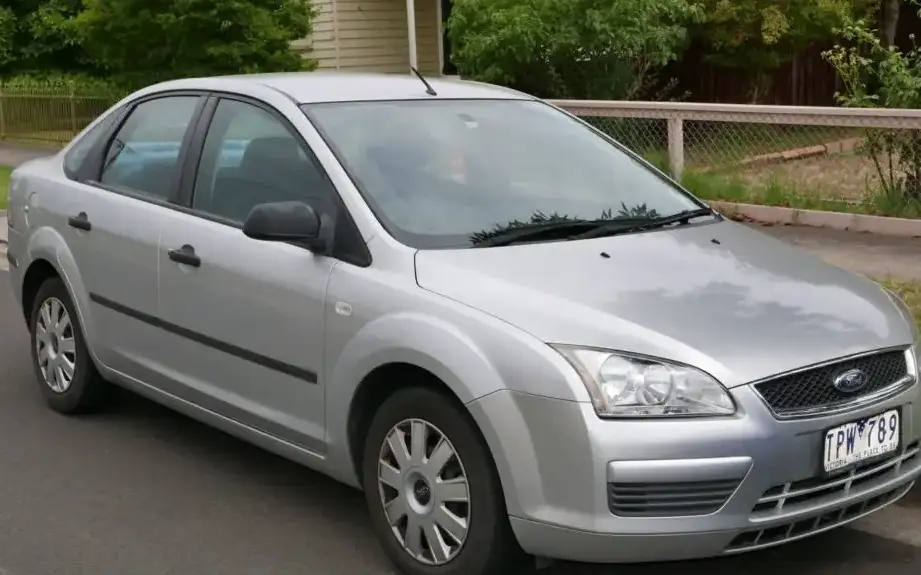
The Ford Focus II Sedan 1.8 TDCi, produced between 2005 and 2006, represented a key offering in Ford’s European lineup during that period. Positioned as a fuel-efficient and practical option, this variant utilized a common-rail diesel engine paired with a five-speed manual transmission. It was part of the second generation Focus (internally designated as the 2HX0/A3 platform), which aimed to improve upon the original Focus’s already strong reputation for handling and build quality. The 1.8 TDCi model served as a mid-range offering, slotting between the lower-powered 1.6-liter petrol and diesel engines and the more potent 2.0-liter options.
Technical Specifications
| Brand | Ford |
| Model | Focus |
| Generation | Focus II Sedan |
| Type (Engine) | 1.8 TDCi (116 Hp) |
| Start of production | 2005 |
| End of production | 2006 |
| Powertrain Architecture | Internal Combustion engine |
| Body type | Sedan |
| Seats | 5 |
| Doors | 4 |
| Fuel consumption (urban) | 6.8 l/100 km (34.6 US mpg) |
| Fuel consumption (extra urban) | 4.4 l/100 km (53.5 US mpg) |
| Fuel Type | Diesel |
| Acceleration 0 – 100 km/h | 10.9 sec |
| Acceleration 0 – 62 mph | 10.9 sec |
| Acceleration 0 – 60 mph | 10.4 sec |
| Maximum speed | 193 km/h (119.92 mph) |
| Weight-to-power ratio | 11.9 kg/Hp |
| Weight-to-torque ratio | 5.5 kg/Nm |
| Power | 116 Hp @ 3800 rpm |
| Power per litre | 66.2 Hp/l |
| Torque | 250 Nm @ 2000 rpm (184.39 lb.-ft. @ 2000 rpm) |
| Engine layout | Front, Transverse |
| Engine Model/Code | BHPA |
| Engine displacement | 1753 cm3 (106.97 cu. in.) |
| Number of cylinders | 4 |
| Engine configuration | Inline |
| Cylinder Bore | 82.5 mm (3.25 in.) |
| Piston Stroke | 82 mm (3.23 in.) |
| Compression ratio | 18.5:1 |
| Number of valves per cylinder | 2 |
| Fuel injection system | Diesel Commonrail |
| Engine aspiration | Turbocharger, Intercooler |
| Valvetrain | OHC |
| Engine oil capacity | 5.6 l (5.92 US qt | 4.93 UK qt) |
| Coolant capacity | 8.1 l (8.56 US qt | 7.13 UK qt) |
| Kerb Weight | 1380 kg (3042.38 lbs.) |
| Max. weight | 1905 kg (4199.81 lbs.) |
| Max load | 525 kg (1157.43 lbs.) |
| Trunk (boot) space – minimum | 526 l (18.58 cu. ft.) |
| Trunk (boot) space – maximum | 931 l (32.88 cu. ft.) |
| Fuel tank capacity | 53 l (14 US gal | 11.66 UK gal) |
| Length | 4488 mm (176.69 in.) |
| Width | 1840 mm (72.44 in.) |
| Height | 1497 mm (58.94 in.) |
| Wheelbase | 2640 mm (103.94 in.) |
| Front track | 1535 mm (60.43 in.) |
| Rear track | 1531 mm (60.28 in.) |
| Drivetrain Architecture | Front wheel drive |
| Number of gears | 5 |
| Gearbox type | Manual transmission |
| Front suspension | Independent, McPherson with coil spring and anti-roll bar |
| Rear suspension | Independent multi-link with stabilizer |
| Front brakes | Disc |
| Rear brakes | Disc |
| Assisting systems | ABS |
| Steering type | Steering rack and pinion |
| Tires size | 195/65R15 |
INTRODUCTION
The Ford Focus II Sedan 1.8 TDCi, launched in 2005, was a significant model for Ford in Europe. It built upon the success of the first-generation Focus, offering a more refined and spacious package. The sedan body style, while less popular than the hatchback in Europe, was specifically targeted at markets where traditional three-box designs were preferred. This 1.8-liter turbodiesel variant aimed to provide a balance between fuel economy, reasonable performance, and affordability, making it a popular choice for fleet buyers and private customers alike. The engine, designated BHPA, was a key component of Ford’s diesel strategy at the time, offering a modern common-rail injection system for improved efficiency and reduced emissions.
Powertrain & Engine Architecture
The heart of the Focus II Sedan 1.8 TDCi is the BHPA engine, a 1753cc inline-four cylinder diesel. This engine utilizes a common-rail direct injection system, delivering fuel at extremely high pressure for optimized combustion. The common-rail system, supplied by Bosch, allowed for precise control over injection timing and quantity, contributing to both improved fuel economy and reduced noise. The engine features an overhead camshaft (OHC) valvetrain with two valves per cylinder. A turbocharger with an intercooler is employed to increase power output by forcing more air into the cylinders. The five-speed manual transmission was the standard offering for this variant, providing a good balance between fuel efficiency and drivability. The gearbox ratios were tuned to maximize the engine’s torque output, providing adequate acceleration in everyday driving situations.
Driving Characteristics
The 1.8 TDCi engine, producing 116 horsepower and 250 Nm (184 lb-ft) of torque, provided adequate, though not exhilarating, performance. Acceleration from 0 to 60 mph took around 10.4 seconds, and the top speed was approximately 119.92 mph. Compared to the higher-output 2.0-liter TDCi versions, the 1.8 felt noticeably less powerful, particularly when fully loaded or tackling steep inclines. However, the 1.8’s strength lay in its fuel efficiency and relaxed cruising ability. The five-speed manual transmission allowed drivers to keep the engine in its optimal torque band, providing good responsiveness in most situations. The gear ratios were relatively long, prioritizing fuel economy over outright acceleration. Compared to petrol-powered Focus models, the 1.8 TDCi offered significantly better fuel economy, making it a more economical choice for high-mileage drivers.
Equipment & Trim Levels
The 1.8 TDCi variant of the Focus II Sedan typically came with a reasonable level of standard equipment. This included power steering, central locking, electric front windows, and an adjustable steering column. Interior upholstery was typically cloth, with a functional and durable design. Optional extras included air conditioning, alloy wheels, a CD player, and rear electric windows. Trim levels varied depending on the market, but generally, the 1.8 TDCi was positioned as a mid-range offering, providing a good balance of features and affordability. Higher trim levels added features such as climate control, upgraded audio systems, and more luxurious interior materials.
Chassis & Braking
The Focus II Sedan featured independent suspension on all four wheels. The front suspension utilized a McPherson strut design with a coil spring and anti-roll bar, while the rear suspension employed a multi-link setup, also with a stabilizer bar. This suspension configuration provided a good balance between ride comfort and handling precision. Brakes were disc brakes on all four wheels, providing adequate stopping power for the vehicle’s weight and performance. Anti-lock Braking System (ABS) was standard, enhancing safety by preventing wheel lockup during hard braking. The chassis was designed to be relatively lightweight, contributing to the car’s overall agility and fuel efficiency.
Market Reception & Comparison
The Ford Focus II Sedan 1.8 TDCi was generally well-received by automotive critics. It was praised for its fuel efficiency, comfortable ride, and spacious interior. However, some critics noted that the engine lacked the outright performance of its larger counterparts. Compared to other diesel-powered sedans in its class, such as the Volkswagen Bora TDI and the Opel Astra CDTi, the Focus offered a competitive package in terms of price, fuel economy, and features. The 1.8 TDCi was often seen as a more sensible and economical choice than the higher-powered variants, appealing to drivers who prioritized fuel efficiency and practicality over outright performance.
Legacy
The BHPA 1.8 TDCi engine proved to be a relatively reliable unit, although, like all diesel engines, it was susceptible to issues related to the fuel injection system and turbocharger. Regular maintenance, including oil changes and fuel filter replacements, was crucial for ensuring long-term reliability. In the used car market today, the Focus II Sedan 1.8 TDCi remains a popular choice for budget-conscious buyers seeking a fuel-efficient and practical vehicle. Its relatively simple mechanical design and readily available parts make it a relatively affordable car to maintain. While it may not offer the performance or refinement of more modern vehicles, it continues to provide a dependable and economical transportation option.