
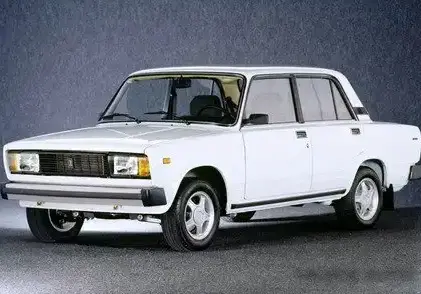
The Lada 21054 1.6i, produced from 2005 to 2010, represents a late iteration of the classic Lada 2105 model. This variant, equipped with a 1.6-liter inline-four engine producing 74 horsepower, served as a relatively affordable and accessible option within the Lada lineup during its production run. It was primarily aimed at the domestic Russian market and other Eastern European countries, offering a basic, reliable, and inexpensive mode of transportation. The 21054 represents a continuation of the original 2105 design, which itself was based on the Fiat 124, but with incremental updates to meet evolving (though modest) emissions and safety standards.
Technical Specifications
| Brand | Lada |
| Model | 2105 |
| Generation | 21054 |
| Type (Engine) | 1.6i (74 Hp) |
| Start of production | 2005 |
| End of production | 2010 |
| Powertrain Architecture | Internal Combustion engine |
| Body type | Sedan |
| Fuel Type | Petrol (Gasoline) |
| Power | 74 Hp @ 5400 rpm |
| Power per litre | 47.2 Hp/l |
| Torque | 114 Nm @ 3400 rpm |
| Torque (lb.-ft.) | 84.08 lb.-ft. @ 3400 rpm |
| Engine layout | Front, Longitudinal |
| Engine displacement | 1569 cm3 |
| Engine displacement (cu. in.) | 95.75 cu. in. |
| Number of cylinders | 4 |
| Engine configuration | Inline |
| Cylinder Bore | 79 mm |
| Cylinder Bore (in.) | 3.11 in. |
| Piston Stroke | 80 mm |
| Piston Stroke (in.) | 3.15 in. |
| Compression ratio | 8.5:1 |
| Number of valves per cylinder | 2 |
| Fuel injection system | Single-point injection |
| Engine aspiration | Naturally aspirated engine |
| Drivetrain | Rear wheel drive |
Powertrain & Engine Architecture
The heart of the 21054 1.6i is the Lada 16V engine, a four-cylinder, inline configuration. While sharing its basic architecture with earlier Lada engines, the 21054 utilizes a single-point fuel injection system, a significant upgrade from the carburetors found in older models. This system, though relatively basic by modern standards, improved fuel efficiency and reduced emissions compared to its predecessors. The engine features a two-valve per cylinder setup, operated by a single overhead camshaft. The engine code is often associated with variations like VK8, though specific sub-variants existed. The 1.6-liter displacement (1569 cc) provides a reasonable balance between power and fuel economy for its intended purpose. The engine is longitudinally mounted in the front of the vehicle, driving the rear wheels. The transmission is a four-speed manual, or a five-speed manual, or a four-speed automatic transmission, the latter being relatively uncommon. The automatic transmission was sourced from external suppliers and was known for its simplicity rather than performance.
Driving Characteristics
The 21054 1.6i, particularly in automatic transmission guise, offers modest performance. With 74 horsepower and 84 lb-ft of torque, acceleration is leisurely, and overtaking requires careful planning. The four-speed automatic transmission contributes to this, with relatively wide gear ratios. The automatic transmission, while providing convenience, noticeably diminishes the car’s responsiveness compared to the manual versions. The rear-wheel-drive layout provides a traditional driving feel, but the relatively soft suspension and basic steering system don’t offer a particularly engaging experience. The car is best suited for city driving and shorter journeys, where its simplicity and affordability outweigh its performance limitations. The automatic transmission, while offering ease of use, further reduces fuel economy compared to the manual options.
Equipment & Trim Levels
The Lada 21054 1.6i was typically offered with a fairly basic level of equipment. Standard features generally included cloth upholstery, a simple dashboard layout with analog gauges, and manual windows and door locks. Power steering was not standard, and air conditioning was a rare option. The trim level was relatively consistent across the 21054 range, with limited options for customization. Some models might have included upgraded seat fabrics or a basic audio system, but these were often dealer-installed accessories rather than factory options. The focus was on providing a functional and affordable vehicle, rather than luxury or advanced features.
Chassis & Braking
The 21054 utilizes a traditional body-on-frame construction, contributing to its robustness but also its relatively heavy weight. The suspension consists of independent front suspension with wishbones and coil springs, and a live rear axle with leaf springs. This setup provides a comfortable ride on smooth surfaces, but can feel somewhat crude on uneven roads. The braking system features disc brakes on the front wheels and drum brakes on the rear wheels. The braking performance is adequate for its intended use, but lacks the stopping power and modulation of more modern systems. Steering is a recirculating ball system, providing a somewhat vague and indirect feel.
Market Reception & Comparison
The Lada 21054 1.6i was primarily targeted at budget-conscious buyers in Russia and surrounding countries. It was often seen as a practical and reliable, if unsophisticated, option. Critics generally acknowledged its affordability and ease of maintenance, but also pointed to its outdated design, limited performance, and basic features. Compared to other trims in the 2105 lineup, the 1.6i automatic offered a compromise between performance and convenience. The manual transmission versions provided better fuel economy and acceleration, while higher-displacement engines (though not commonly available in the 21054) offered more power. The 21054 competed with other low-cost sedans from manufacturers like Dacia and occasionally older models from Western European brands.
Legacy
The Lada 21054, and the 2105 series as a whole, holds a significant place in automotive history as a symbol of Soviet and post-Soviet automotive engineering. While not known for innovation or refinement, the 2105 was incredibly durable and easy to repair, making it a popular choice for decades. The 1.6i engine, while not particularly powerful, proved to be relatively reliable. Today, the 21054 is becoming increasingly sought after by classic car enthusiasts and collectors, particularly those interested in Eastern European automotive history. Parts availability remains relatively good, and the car’s simple mechanical design makes it accessible to home mechanics. The automatic transmission variants are less common and may command a premium among collectors due to their rarity.
