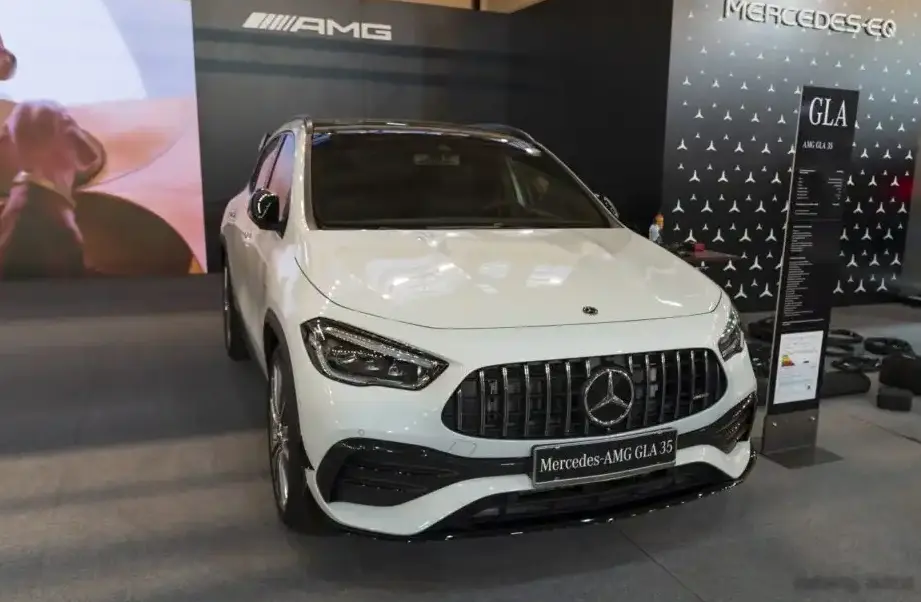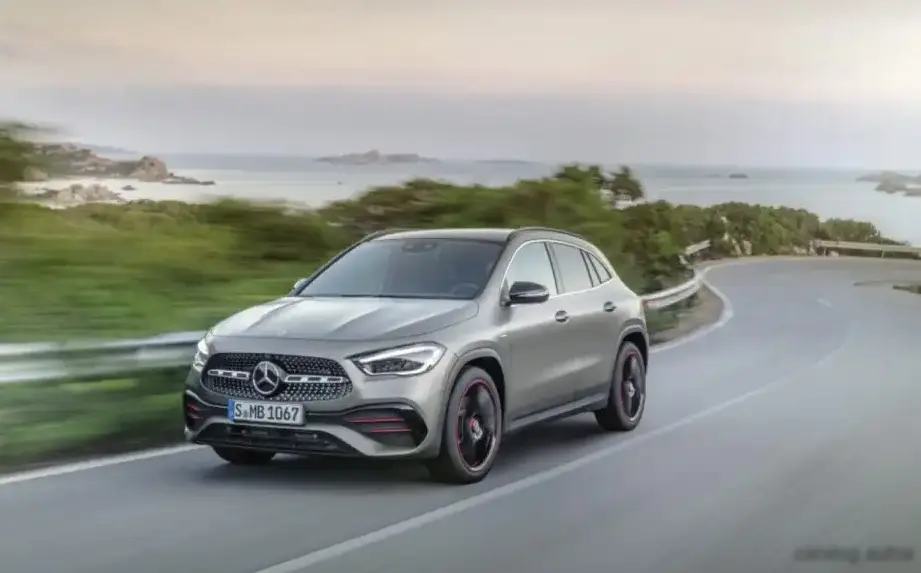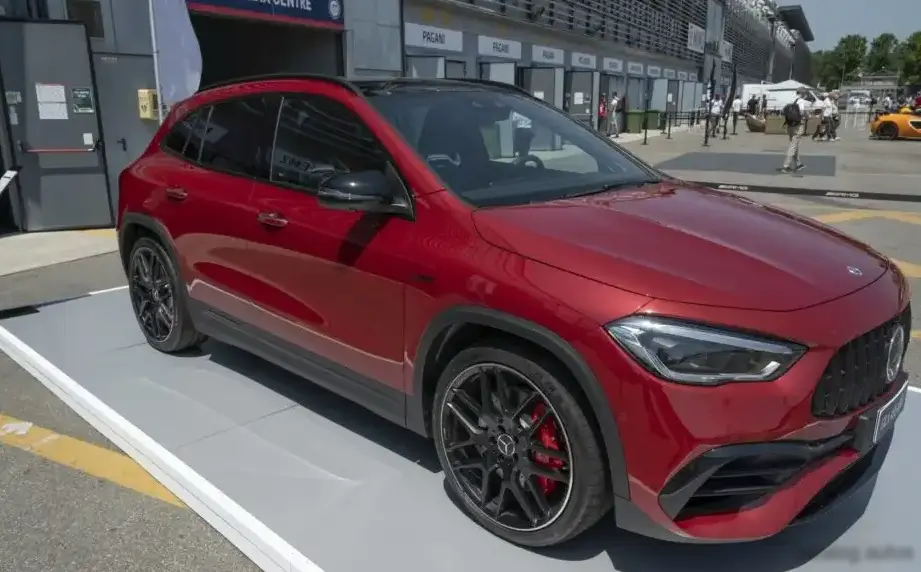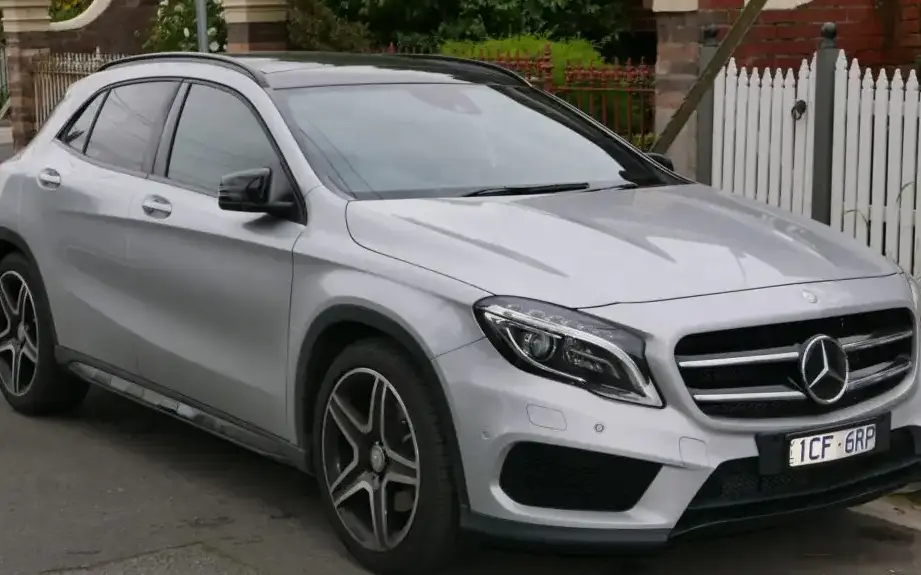
The Mercedes-Benz GLA 180 CDI, produced between September 2014 and 2017, was an entry-level variant of the X156 GLA-Class, a compact luxury crossover SUV. Positioned as the most fuel-efficient and accessible model in the GLA lineup, it aimed to attract buyers seeking a premium vehicle with low running costs. This variant utilized a 1.5-liter turbocharged diesel engine paired with a 7-speed dual-clutch transmission (7G-DCT), offering a balance between economy and usability. The GLA-Class itself was Mercedes-Benz’s attempt to capture a larger share of the growing compact SUV market, leveraging the robust 1HX0/A3 platform shared with other Mercedes-Benz and Renault vehicles.
Technical Specifications
| Brand | Mercedes-Benz |
| Model | GLA |
| Generation | GLA (X156) |
| Type (Engine) | GLA 180 CDI (109 Hp) 7G-DCT |
| Start of production | September, 2014 |
| End of production | 2017 |
| Powertrain Architecture | Internal Combustion engine |
| Body type | SUV |
| Seats | 5 |
| Doors | 5 |
| Fuel consumption (economy) – urban (NEDC) | 4.5-4.7 l/100 km (52.3 – 50 US mpg, 62.8 – 60.1 UK mpg, 22.2 – 21.3 km/l) |
| Fuel consumption (economy) – extra urban (NEDC) | 3.6-3.8 l/100 km (65.3 – 61.9 US mpg, 78.5 – 74.3 UK mpg, 27.8 – 26.3 km/l) |
| Fuel consumption (economy) – combined (NEDC) | 3.9-4.1 l/100 km (60.3 – 57.4 US mpg, 72.4 – 68.9 UK mpg, 25.6 – 24.4 km/l) |
| CO2 emissions (NEDC) | 103-109 g/km |
| Fuel Type | Diesel |
| Acceleration 0 – 100 km/h | 11.9 sec |
| Acceleration 0 – 62 mph | 11.9 sec |
| Acceleration 0 – 60 mph | 11.3 sec |
| Maximum speed | 190 km/h (118.06 mph) |
| Emission standard | Euro 6 |
| Weight-to-power ratio | 12.8 kg/Hp, 78.1 Hp/tonne |
| Weight-to-torque ratio | 5.4 kg/Nm, 186.4 Nm/tonne |
| Power | 109 Hp @ 4000 rpm |
| Power per litre | 74.6 Hp/l |
| Torque | 260 Nm @ 1750-2500 rpm (191.77 lb.-ft. @ 1750-2500 rpm) |
| Engine layout | Front, Transverse |
| Engine Model/Code | OM 607.951 |
| Engine displacement | 1461 cm3 (89.16 cu. in.) |
| Number of cylinders | 4 |
| Engine configuration | Inline |
| Cylinder Bore | 76 mm (2.99 in.) |
| Piston Stroke | 80.5 mm (3.17 in.) |
| Compression ratio | 15.1:1 |
| Number of valves per cylinder | 2 |
| Fuel injection system | Diesel Commonrail |
| Engine aspiration | Turbocharger, Intercooler |
| Valvetrain | SOHC |
| Engine oil capacity | 4.5 l (4.76 US qt | 3.96 UK qt) |
| Kerb Weight | 1395 kg (3075.45 lbs.) |
| Max. weight | 1960 kg (4321.06 lbs.) |
| Max load | 565 kg (1245.61 lbs.) |
| Trunk (boot) space – minimum | 421 l (14.87 cu. ft.) |
| Trunk (boot) space – maximum | 1235 l (43.61 cu. ft.) |
| Fuel tank capacity | 50 l (13.21 US gal | 11 UK gal) |
| Max. roof load | 75 kg (165.35 lbs.) |
| Permitted trailer load with brakes (12%) | 1200 kg (2645.55 lbs.) |
| Permitted trailer load without brakes | 750 kg (1653.47 lbs.) |
| Permitted towbar download | 75 kg (165.35 lbs.) |
| Length | 4417 mm (173.9 in.) |
| Width | 1804 mm (71.02 in.) |
| Width including mirrors | 2022 mm (79.61 in.) |
| Height | 1494 mm (58.82 in.) |
| Wheelbase | 2699 mm (106.26 in.) |
| Front track | 1569 mm (61.77 in.) |
| Rear (Back) track | 1560 mm (61.42 in.) |
| Front overhang | 906 mm (35.67 in.) |
| Rear overhang | 812 mm (31.97 in.) |
| Drag coefficient (Cd) | 0.30 |
| Minimum turning circle (turning diameter) | 11.84 m (38.85 ft.) |
| Approach angle | 15.8° |
| Departure angle | 21.5° |
| Drivetrain Architecture | The Internal combustion engine (ICE) drives the front wheels of the vehicle. |
| Drive wheel | Front wheel drive |
| Number of gears and type of gearbox | 7 gears, automatic transmission G-DCT |
| Front suspension | Independent, type McPherson with coil spring and anti-roll bar |
| Rear suspension | Wishbone, Transverse stabilizer, Trailing arm |
| Front brakes | Ventilated discs |
| Rear brakes | Disc |
| Assisting systems | ABS (Anti-lock braking system) |
| Steering type | Steering rack and pinion |
| Power steering | Electric Steering |
| Tires size | 215/60 R17; 215/55 R18; 235/50 R18; 235/45 R19 |
| Wheel rims size | 6.5J x 17; 6.5J x 18; 7J x 18; 8J x 19 |
Powertrain & Engine Architecture
The GLA 180 CDI was powered by the OM607.951, a 1.5-liter inline-four cylinder diesel engine. This engine was part of Mercedes-Benz’s modular engine family, designed for efficiency and compact packaging. It featured a turbocharger with an intercooler to boost power output, and a common-rail direct fuel injection system for precise fuel delivery. The engine produced 109 horsepower at 4000 rpm and 260 Nm (191.77 lb-ft) of torque between 1750 and 2500 rpm. The 7G-DCT dual-clutch transmission offered quick and smooth gear changes, contributing to both performance and fuel economy. This transmission featured seven forward gears and allowed for both automatic and manual shifting via steering wheel-mounted paddles.
Driving Characteristics
The GLA 180 CDI, with its relatively modest power output, prioritized fuel efficiency over outright performance. Acceleration from 0 to 100 km/h (0-62 mph) took approximately 11.9 seconds. While adequate for everyday driving, it was noticeably slower than higher-powered GLA variants like the GLA 250. The 7G-DCT transmission helped to maximize the available power, providing responsive shifts and keeping the engine in its optimal torque band. The gear ratios were tuned for economy, resulting in a comfortable but not particularly sporty driving experience. Compared to manual transmission versions of the same engine, the 7G-DCT offered greater convenience and ease of use, particularly in urban traffic.
Equipment & Trim Levels
The GLA 180 CDI typically came standard with features such as air conditioning, a multi-function steering wheel, a basic infotainment system with a central display screen, and cloth upholstery. Safety features included ABS, ESP (Electronic Stability Program), and multiple airbags. Optional extras included features like leather upholstery, a panoramic sunroof, a more advanced infotainment system with navigation, and various driver assistance systems such as parking assist and collision prevention assist. Trim levels varied by market, but generally offered packages that bundled together popular options.
Chassis & Braking
The GLA 180 CDI utilized a McPherson strut front suspension and a multi-link rear suspension, providing a comfortable ride and decent handling characteristics. The front brakes were ventilated discs, while the rear brakes were solid discs. The suspension was tuned to prioritize comfort over sporty handling, making it well-suited for everyday driving. The electric power steering provided light and precise steering feel. The GLA 180 CDI’s relatively low weight, at 1395 kg (3075.45 lbs), helped to mitigate the effects of its modest power output.
Market Reception & Comparison
The GLA 180 CDI was generally well-received by critics for its fuel efficiency and low running costs. However, some reviewers noted its lack of outright performance compared to other GLA variants. Its fuel economy figures of 3.9-4.1 l/100 km (60.3 – 57.4 US mpg) were a major selling point, making it an attractive option for buyers prioritizing economy. Compared to the GLA 200 or GLA 250, the 180 CDI offered a more affordable entry point into the GLA range, but at the expense of performance and some features. The 1.8L gasoline versions offered more power but significantly lower fuel economy.
Legacy
The GLA 180 CDI’s OM607.951 engine, while not known for being exceptionally powerful, proved to be relatively reliable. The 7G-DCT transmission also demonstrated good durability when properly maintained. In the used car market, the GLA 180 CDI remains a popular choice for buyers seeking a fuel-efficient and affordable compact SUV. However, potential buyers should be aware of the importance of regular maintenance, particularly regarding the diesel particulate filter (DPF) and the dual-clutch transmission. Overall, the GLA 180 CDI represents a practical and economical entry point into the Mercedes-Benz GLA lineup.