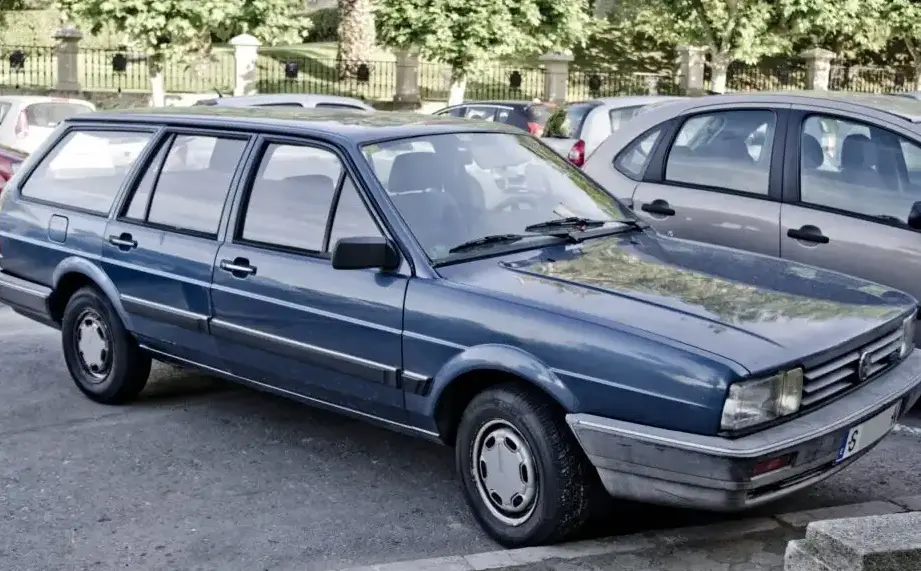
The Volkswagen Passat Variant (B2) 1.6, producing 85 horsepower, was a mainstay of the Passat lineup between 1981 and 1983. Representing an entry-level option within the second-generation Passat (B2) series, this variant offered practical family transportation in a station wagon (estate) body style. It played a significant role in establishing the Passat as a popular choice in the European market, known for its blend of affordability, space, and Volkswagen’s reputation for build quality. This model was positioned below the more powerful GL and GTI variants, appealing to buyers prioritizing economy and functionality over outright performance.
Technical Specifications
| Brand | Volkswagen |
| Model | Passat |
| Generation | Passat Variant (B2) |
| Type (Engine) | 1.6 (85 Hp) |
| Start of production | 1981 |
| End of production | 1983 |
| Powertrain Architecture | Internal Combustion engine |
| Body type | Station wagon (estate) |
| Seats | 5 |
| Doors | 5 |
| Fuel Type | Petrol (Gasoline) |
| Acceleration 0 – 100 km/h | 12.8 sec |
| Acceleration 0 – 62 mph | 12.8 sec |
| Acceleration 0 – 60 mph | 12.2 sec |
| Maximum speed | 170 km/h (105.63 mph) |
| Weight-to-power ratio | 10.9 kg/Hp, 91.4 Hp/tonne |
| Weight-to-torque ratio | 7.3 kg/Nm, 136.6 Nm/tonne |
| Power | 85 Hp @ 5600 rpm |
| Power per litre | 53.5 Hp/l |
| Torque | 127 Nm @ 3200 rpm (93.67 lb.-ft. @ 3200 rpm) |
| Engine layout | Front, Longitudinal |
| Engine Model/Code | YP |
| Engine displacement | 1588 cm3 (96.91 cu. in.) |
| Number of cylinders | 4 |
| Engine configuration | Inline |
| Cylinder Bore | 79.5 mm (3.13 in.) |
| Piston Stroke | 80 mm (3.15 in.) |
| Compression ratio | 8.2:1 |
| Number of valves per cylinder | 2 |
| Fuel injection system | Carburettor |
| Engine aspiration | Naturally aspirated engine |
| Valvetrain | OHC |
| Engine oil capacity | 2.84 l (3 US qt | 2.5 UK qt) |
| Coolant | 5.3 l (5.6 US qt | 4.66 UK qt) |
| Kerb Weight | 930 kg (2050.3 lbs) |
| Max. weight | 1350 kg (2976.24 lbs) |
| Max load | 420 kg (925.94 lbs) |
| Trunk (boot) space – minimum | 540 l (19.07 cu. ft.) |
| Trunk (boot) space – maximum | 1811 l (63.95 cu. ft.) |
| Fuel tank capacity | 70 l (18.49 US gal | 15.4 UK gal) |
| Length | 4545 mm (178.94 in.) |
| Width | 1695 mm (66.73 in.) |
| Height | 1385 mm (54.53 in.) |
| Wheelbase | 2555 mm (100.59 in.) |
| Front track | 1400 mm (55.12 in.) |
| Rear (Back) track | 1408 mm (55.43 in.) |
| Drivetrain Architecture | The Internal combustion engine (ICE) drives the front wheels of the vehicle. |
| Drive wheel | Front wheel drive |
| Number of gears and type of gearbox | 5 gears, manual transmission |
| Front suspension | Independent type McPherson |
| Rear suspension | Coil spring |
| Front brakes | Disc |
| Rear brakes | Drum |
| Steering type | Steering rack and pinion |
| Tires size | 175/70 R13 |
| Wheel rims size | 13 |
Powertrain & Engine Architecture
The heart of the Passat Variant 1.6 was the YP engine, a 1.6-liter inline four-cylinder unit. This engine utilized a single overhead camshaft (OHC) valvetrain with two valves per cylinder. Fuel delivery was managed by a carburetor, a common feature for vehicles of this era, prioritizing simplicity and cost-effectiveness over the more advanced fuel injection systems. The YP engine produced 85 horsepower at 5600 rpm and 127 Nm (93.67 lb-ft) of torque at 3200 rpm. The engine was mounted longitudinally in the front of the vehicle, driving the front wheels. The standard transmission was a five-speed manual gearbox, although a three-speed automatic transmission was offered as an option, albeit less common.
Driving Characteristics
The 1.6-liter engine, paired with the manual transmission, provided adequate, but not exhilarating, performance. Acceleration from 0 to 100 km/h (0-62 mph) took approximately 12.8 seconds, and top speed was around 170 km/h (105.63 mph). Compared to the more powerful Passat variants, such as those equipped with the 1.8-liter or even the GTI’s 1.6-liter fuel-injected engine, the 1.6 felt noticeably slower. The automatic transmission further diminished performance, resulting in slower acceleration times. However, the 1.6 offered a more relaxed driving experience, particularly suited for everyday commuting and long-distance journeys. The gear ratios in the five-speed manual were reasonably well-spaced, allowing for comfortable cruising at highway speeds.
Equipment & Trim Levels
The Passat Variant 1.6 typically came with a relatively basic level of equipment, reflecting its position as an entry-level model. Standard features generally included cloth upholstery, a basic instrument cluster, and manual windows and door locks. Optional extras included a sunroof, upgraded audio systems, and more comfortable seating. The interior design was functional and straightforward, prioritizing practicality over luxury. The trim level often dictated the quality of the interior materials and the availability of certain features.
Chassis & Braking
The Passat B2 featured an independent McPherson strut suspension at the front and a coil spring suspension at the rear. This setup provided a reasonable balance between ride comfort and handling. The front brakes were disc brakes, offering good stopping power, while the rear brakes were drum brakes, a cost-saving measure common in this class of vehicle. The steering was rack and pinion, providing precise and responsive steering feel. The relatively lightweight nature of the 1.6 variant (930 kg / 2050.3 lbs) contributed to its nimble handling characteristics.
Market Reception & Comparison
The Passat Variant 1.6 was generally well-received by critics as a practical and affordable family car. It was praised for its spacious interior, comfortable ride, and Volkswagen’s reputation for reliability. However, its relatively modest performance was often noted. Compared to the more powerful Passat variants, the 1.6 offered better fuel economy, making it an attractive option for budget-conscious buyers. The automatic transmission version, while offering convenience, was often criticized for its sluggish performance and reduced fuel efficiency.
Legacy
The YP engine, while not known for its high performance, proved to be a relatively reliable and durable unit. Many examples of the Passat Variant 1.6 are still on the road today, testament to its robust construction. In the used car market, these models are often sought after by enthusiasts looking for a classic Volkswagen estate car. Maintenance is generally straightforward, and parts availability is still reasonably good. However, as with any classic car, potential buyers should be aware of the possibility of age-related issues, such as corrosion and wear and tear on suspension components. The Passat Variant 1.6 remains a popular choice for those seeking a practical, affordable, and charmingly retro vehicle.