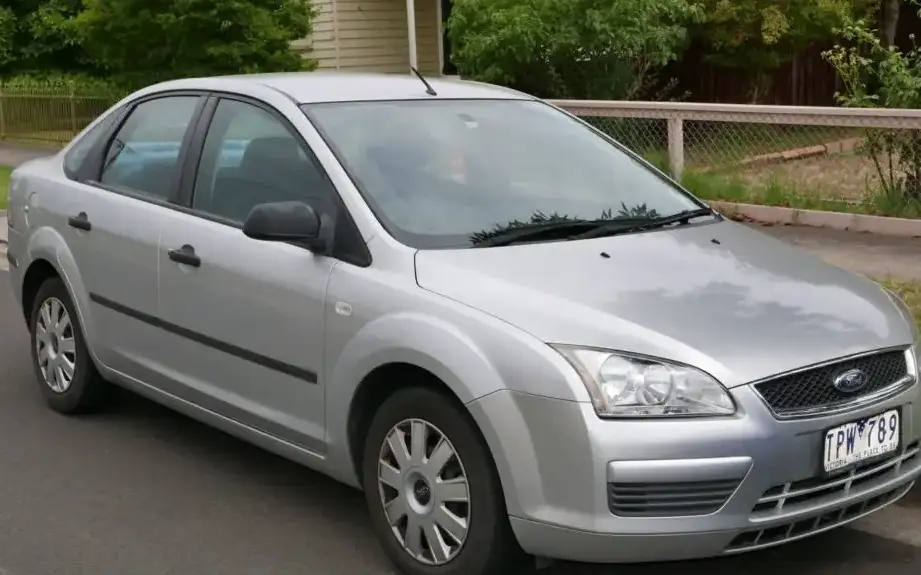
The Ford Focus II Sedan 2.0 TDCi, producing 136 horsepower, was a significant offering in the European Ford lineup from 2005 to 2010. Positioned as a practical and efficient option within the second generation Focus (internally designated the 2HX/DA platform), this variant aimed to balance fuel economy with respectable performance for drivers needing a versatile family sedan. While the Focus was never a major seller in the US market, the European model gained a strong reputation for its handling and build quality, and the 2.0 TDCi engine became a mainstay for those prioritizing diesel efficiency.
Technical Specifications
| Brand | Ford |
| Model | Focus |
| Generation | Focus II Sedan |
| Type (Engine) | 2.0 TDCi (136 Hp) |
| Start of production | 2005 |
| End of production | 2010 |
| Powertrain Architecture | Internal Combustion engine |
| Body type | Sedan |
| Seats | 5 |
| Doors | 4 |
| Fuel consumption (urban) | 7.5 l/100 km (31.4 US mpg) |
| Fuel consumption (extra urban) | 4.7 l/100 km (50 US mpg) |
| Fuel Type | Diesel |
| Acceleration 0 – 100 km/h | 9.4 sec |
| Acceleration 0 – 62 mph | 9.4 sec |
| Acceleration 0 – 60 mph | 8.9 sec |
| Maximum speed | 205 km/h (127.38 mph) |
| Weight-to-power ratio | 9.9 kg/Hp |
| Weight-to-torque ratio | 4.2 kg/Nm |
| Power | 136 Hp @ 4000 rpm |
| Torque | 320 Nm @ 2000 rpm (236.02 lb.-ft. @ 2000 rpm) |
| Engine layout | Front, Transverse |
| Engine Model/Code | G6DA, G6DB, G6DD |
| Engine displacement | 1997 cm3 (121.86 cu. in.) |
| Number of cylinders | 4 |
| Engine configuration | Inline |
| Cylinder Bore | 85 mm (3.35 in.) |
| Piston Stroke | 88 mm (3.46 in.) |
| Compression ratio | 18:1 |
| Number of valves per cylinder | 4 |
| Fuel injection system | Diesel Commonrail |
| Engine aspiration | Turbocharger, Intercooler |
| Engine oil capacity | 5.5 l (5.81 US qt | 4.84 UK qt) |
| Coolant capacity | 8.4 l (8.88 US qt | 7.39 UK qt) |
| Kerb Weight | 1350 kg (2976.24 lbs.) |
| Max. weight | 1905 kg (4199.81 lbs.) |
| Max load | 555 kg (1223.57 lbs.) |
| Trunk (boot) space – minimum | 467 l (16.49 cu. ft.) |
| Trunk (boot) space – maximum | 931 l (32.88 cu. ft.) |
| Fuel tank capacity | 53 l (14 US gal | 11.66 UK gal) |
| Length | 4488 mm (176.69 in.) |
| Width | 1840 mm (72.44 in.) |
| Height | 1497 mm (58.94 in.) |
| Wheelbase | 2640 mm (103.94 in.) |
| Front track | 1535 mm (60.43 in.) |
| Rear track | 1531 mm (60.28 in.) |
| Drivetrain Architecture | Front wheel drive |
| Number of gears | 6 |
| Gearbox type | Manual transmission |
| Front suspension | Spring Strut |
| Rear suspension | Transverse stabilizer |
| Front brakes | Disc |
| Rear brakes | Disc |
| Steering type | Steering rack and pinion |
| Tires size | 205/55 R16 |
Powertrain & Engine Architecture
The heart of the Focus II Sedan 2.0 TDCi was the G6DA/G6DB/G6DD series of 2.0-liter inline-four diesel engines. These engines were a product of Ford’s collaboration with Peugeot and Citroën (PSA), and were widely used across various European models. The 136 horsepower output was achieved through a turbocharger with an intercooler, coupled with a high-pressure common rail direct injection system. This system allowed for precise fuel delivery, optimizing combustion for both power and efficiency. The engine featured four valves per cylinder and a robust cast iron block, contributing to its durability. The 6-speed manual transmission was the standard offering, providing a good balance between fuel economy and driver control. The engine’s design prioritized low-end torque, making it well-suited for everyday driving and overtaking maneuvers.
Driving Characteristics
The 2.0 TDCi with the 6-speed manual transmission offered a practical and engaging driving experience. While not a performance-oriented variant, the 320 Nm (236 lb-ft) of torque available from 2000 rpm provided ample pulling power. Acceleration to 100 km/h (62 mph) took around 9.4 seconds, which was competitive for its class. The gear ratios were well-chosen, allowing for comfortable cruising on the highway and responsive acceleration in urban environments. Compared to the lower-powered 1.6 TDCi versions, the 2.0 TDCi felt noticeably more refined and capable, especially when fully loaded or tackling inclines. It didn’t possess the sporty character of the petrol-powered ST models, but it offered a more relaxed and fuel-efficient alternative.
Equipment & Trim Levels
The Focus II Sedan 2.0 TDCi was typically offered in mid-range trim levels, such as ‘Trend’ or ‘Titanium’ in many European markets. Standard equipment generally included air conditioning, power windows, central locking, an audio system with CD player, and ABS brakes. Higher trim levels added features like alloy wheels, climate control, rear parking sensors, and upgraded interior upholstery. Optional extras included a sunroof, leather seats, and a more advanced audio system with navigation. The interior design was functional and well-built, with a focus on ergonomics and practicality. The sedan body style offered a larger trunk capacity compared to the hatchback version, making it a popular choice for families.
Chassis & Braking
The Focus II Sedan featured a MacPherson strut front suspension and a multi-link rear suspension, providing a good balance between ride comfort and handling. The chassis was well-tuned, offering predictable and stable handling characteristics. The 2.0 TDCi models typically came equipped with disc brakes on all four wheels, providing adequate stopping power. Anti-lock Braking System (ABS) was standard, enhancing safety. Stabilizer bars were fitted to both the front and rear axles, reducing body roll during cornering. The suspension setup was generally tuned for comfort, but it still allowed for a reasonably engaging driving experience.
Market Reception & Comparison
The Ford Focus II Sedan 2.0 TDCi was well-received by automotive critics for its fuel efficiency, comfortable ride, and practical interior. It was often praised for its handling and build quality, which were considered to be among the best in its class. Compared to the petrol-powered versions, the 2.0 TDCi offered significantly better fuel economy, making it a popular choice for drivers covering long distances. The 1.6 TDCi models were more affordable but lacked the performance of the 2.0-liter engine. The higher-powered petrol engines offered more exhilarating performance but at the expense of fuel economy. Reliability was generally good, although some owners reported issues with the diesel particulate filter (DPF) and the fuel injection system.
Legacy
The Ford Focus II Sedan 2.0 TDCi remains a relatively common sight on European roads today. The G6DA/G6DB/G6DD engine proved to be durable and reliable when properly maintained. On the used car market, these models offer a good value proposition for buyers seeking a practical and fuel-efficient sedan. While modern cars offer more advanced technology and safety features, the Focus II Sedan 2.0 TDCi continues to be appreciated for its simplicity, reliability, and enjoyable driving experience. The engine’s robust design and readily available parts contribute to its continued longevity and affordability.