Technical Specifications
| Brand | Volkswagen |
| Model | Transporter |
| Generation | Transporter (T7) Panel Van |
| Type (Engine) | 2.0 TDI (150 Hp) L2H1 |
| Start of production | August, 2024 |
| Powertrain Architecture | Internal Combustion engine |
| Body type | Van |
| Seats | 2-3 |
| Doors | 4-5 |
| Combined fuel consumption (WLTP) | 7.1 l/100 km |
| Combined fuel consumption (US mpg) | 33.1 US mpg |
| Combined fuel consumption (UK mpg) | 39.8 UK mpg |
| Combined fuel consumption (km/l) | 14.1 km/l |
| CO2 emissions (WLTP) | 186 g/km |
| Fuel Type | Diesel |
| Acceleration 0 – 100 km/h | 13.4 sec |
| Acceleration 0 – 62 mph | 13.4 sec |
| Acceleration 0 – 60 mph | 12.7 sec |
| Maximum speed | 175 km/h (108.74 mph) |
| Emission standard | Euro 6e |
| Weight-to-power ratio | 12.3 kg/Hp, 81.4 Hp/tonne |
| Weight-to-torque ratio | 5.1 kg/Nm, 195.3 Nm/tonne |
| Power | 150 Hp |
| Power per litre | 75.2 Hp/l |
| Torque | 360 Nm (265.52 lb.-ft.) |
| Engine layout | Front, Transverse |
| Engine Model/Code | Panther |
| Engine displacement | 1996 cm3 (121.8 cu. in.) |
| Number of cylinders | 4 |
| Engine configuration | Inline |
| Cylinder Bore | 84.01 mm (3.31 in.) |
| Piston Stroke | 90.03 mm (3.54 in.) |
| Compression ratio | 16.5:1 |
| Number of valves per cylinder | 4 |
| Fuel injection system | Diesel Commonrail |
| Engine aspiration | Turbocharger, Intercooler |
| Valvetrain | DOHC |
| Engine systems | Start & Stop System, Particulate filter |
| Kerb Weight | 1843 kg (4063.12 lbs.) |
| Max. weight | 3025 kg (6668.98 lbs.) |
| Max load | 1182 kg (2605.86 lbs.) |
| Fuel tank capacity | 70 l (18.49 US gal | 15.4 UK gal) |
| AdBlue tank | 20 l (5.28 US gal | 4.4 UK gal) |
| Max. roof load | 170 kg (374.79 lbs.) |
| Permitted trailer load with brakes (12%) | 2800 kg (6172.94 lbs.) |
| Permitted trailer load without brakes | 750 kg (1653.47 lbs.) |
| Permitted towbar download | 100 kg (220.46 lbs.) |
| Length | 5450 mm (214.57 in.) |
| Width | 2032 mm (80 in.) |
| Width including mirrors | 2275 mm (89.57 in.) |
| Height | 1980 mm (77.95 in.) |
| Wheelbase | 3500 mm (137.8 in.) |
| Front overhang | 958 mm (37.72 in.) |
| Rear overhang | 992 mm (39.06 in.) |
| Minimum turning circle | 13.8 m (45.28 ft.) |
| Approach angle | 17.2° |
| Departure angle | 16.4° |
| Ramp-over angle | 11.7° |
| Drivetrain Architecture | Front wheel drive |
| Number of gears | 6 gears, manual transmission |
| Assisting systems | ABS (Anti-lock braking system) |
| Steering type | Steering rack and pinion |
| Power steering | Electric Steering |
| Tires size | 215/65 R16; 215/60 R17 |
| Wheel rims size | 6.5J x 16; 6.5J x 17 |
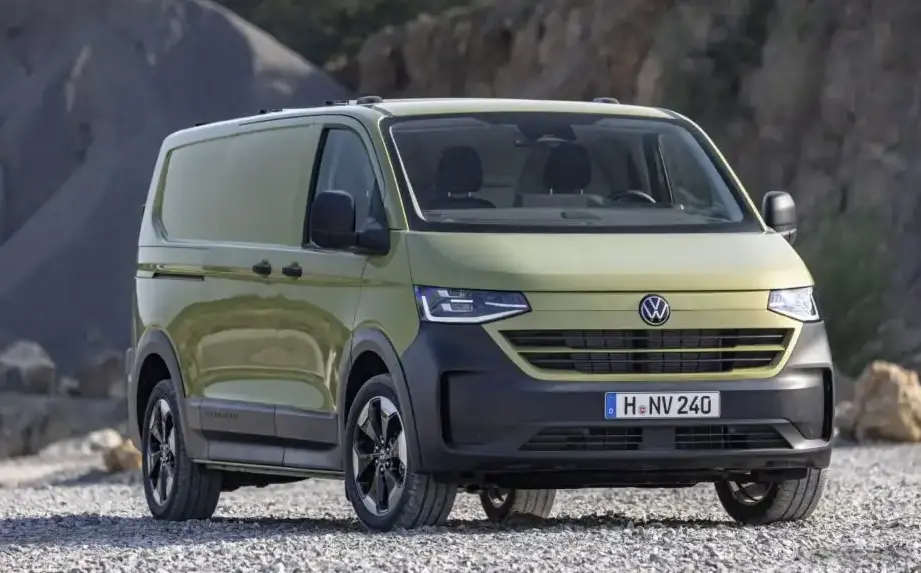
The Volkswagen Transporter (T7) Panel Van 2.0 TDI (150 hp) L2H1, launched in August 2024, represents the latest generation of Volkswagen’s enduring commercial vehicle. Building upon the foundations laid by the T6.1, the T7 introduces updated technology and improved efficiency. The “L2H1” designation signifies a long wheelbase and standard roof height, making it a versatile option for a wide range of commercial applications. This particular variant, powered by the 2.0-liter TDI engine producing 150 horsepower, is a core offering in the T7 lineup, targeted towards businesses and tradespeople who prioritize practicality and reliability in their daily operations.
Powertrain & Engine Architecture
At the heart of this T7 variant lies the 2.0-liter four-cylinder diesel engine, known internally as the “Panther” engine. This engine is part of the Volkswagen Group’s modular engine family, renowned for its efficiency and durability. It employs a common rail direct injection system, injecting fuel directly into the combustion chamber at high pressure for optimized combustion. A turbocharger and intercooler further enhance power and torque output. The 150 hp version utilizes a single turbocharger, carefully tuned to strike a balance between performance and fuel economy. The engine features a Double Overhead Camshaft (DOHC) valvetrain with four valves per cylinder, promoting efficient gas exchange. Power is delivered to the front wheels via a six-speed manual transmission. The inclusion of a diesel particulate filter (DPF) and a Start/Stop system demonstrates Volkswagen’s commitment to reducing emissions and maximizing fuel efficiency.
Driving Characteristics
The 150 hp 2.0 TDI, paired with the manual transmission, in the T7 L2H1 provides a practical and capable driving experience. While not focused on outright speed, it delivers sufficient power for everyday tasks, including cargo hauling and urban driving. Acceleration from 0-60 mph takes approximately 12.7 seconds. The engine generates a useful 360 Nm (265.52 lb.-ft.) of torque, readily available from lower engine speeds, simplifying load management. The six-speed manual transmission allows for precise gear selection and control. Compared to higher-output TDI versions, this variant prioritizes fuel economy over peak performance. It also offers a more manageable driving experience for those less familiar with high torque figures. Compared to previous Transporter generations, the T7 provides a more refined and comfortable ride, thanks to improvements in suspension tuning and sound insulation.
Equipment & Trim Levels
The T7 Panel Van 2.0 TDI (150 hp) L2H1 typically comes standard with features geared towards commercial use. These include a driver’s airbag, ABS brakes, electronic stability control, and a basic infotainment system with Bluetooth connectivity. The interior is functional and durable, featuring hard-wearing plastics and cloth upholstery. The driver’s seat is adjustable for height and lumbar support. Optional extras include a touchscreen infotainment system with navigation, parking sensors, a rearview camera, cruise control, and upgraded interior trim. Higher trim levels add features like climate control, heated seats, and advanced driver-assistance systems.
Chassis & Braking
The T7 utilizes a front-wheel-drive chassis with independent suspension at the front and a semi-independent suspension at the rear. The suspension is tuned to balance ride comfort and load-carrying capacity. Braking is provided by disc brakes at the front and drum brakes at the rear, assisted by ABS (Anti-lock Braking System) and electronic stability control. The steering is rack and pinion with electric power assistance, offering precise and responsive handling. The T7’s chassis is designed to handle a substantial payload, with a maximum load capacity of 1182 kg (2605.86 lbs.).
Market Reception & Comparison
The Volkswagen Transporter has consistently been a popular choice in the commercial vehicle segment, and the T7 continues this trend. Critics generally commend the T7 for its practicality, reliability, and technological advancements. The 2.0 TDI (150 hp) variant is often viewed as a sensible option for businesses seeking a balance between performance and fuel economy. Compared to more powerful engines in the T7 lineup, such as the 200 hp TDI, this variant offers lower running costs but sacrifices some performance. Its fuel economy of 7.1 l/100 km (33.1 US mpg) is competitive within its class. Reliability is generally good, although the diesel particulate filter may require periodic maintenance.
Legacy
The Volkswagen Transporter boasts a long and distinguished history, tracing back to the original Type 2 “Bus” of the 1950s. The T7 represents the latest iteration of this iconic vehicle, continuing to serve as a dependable and versatile workhorse for businesses and tradespeople. The 2.0 TDI engine, in its various forms, has proven to be a durable and efficient powerplant. While modern vans are increasingly adopting electric powertrains, the diesel-powered T7 remains a popular choice for those needing long range and substantial payload capacity. In the used car market, well-maintained T7s are expected to retain their value due to the Transporter’s established reputation for reliability and practicality.