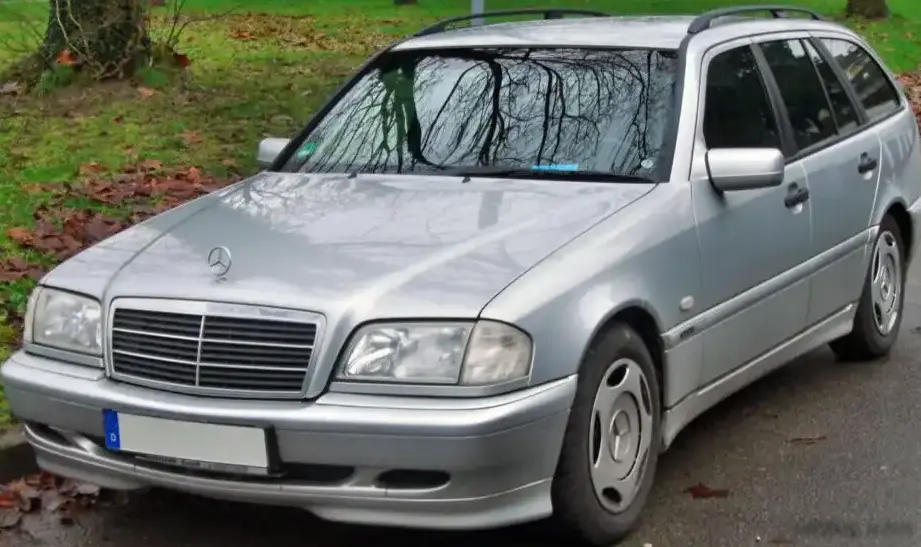
The Mercedes-Benz C-Class T-modell C 200 Kompressor, produced from March 2000 to January 2001, represents a compelling blend of practicality and performance within the S202 facelifted generation of the C-Class estate. Positioned as a mid-range offering, this variant aimed to provide a more accessible entry point into the world of Mercedes-Benz wagons, while still delivering the brand’s renowned comfort and build quality. It was a key model in the European market, where the station wagon (estate) body style enjoys significant popularity, offering a versatile vehicle for families and those requiring ample cargo space. This specific configuration – the 163 horsepower engine paired with the 5G-TRONIC automatic transmission – offered a balance between fuel efficiency and respectable acceleration.
Technical Specifications
| Brand | Mercedes-Benz |
| Model | C-Class |
| Generation | C-Class T-modell (S202, facelift 1997) |
| Type (Engine) | C 200 Kompressor (163 Hp) 5G-TRONIC |
| Start of production | March, 2000 |
| End of production | January, 2001 |
| Powertrain Architecture | Internal Combustion engine |
| Body type | Station wagon (estate) |
| Seats | 5 |
| Doors | 5 |
| Fuel consumption (urban) | 13.7 l/100 km (17.2 US mpg, 20.6 UK mpg, 7.3 km/l) |
| Fuel consumption (extra urban) | 7.2 l/100 km (32.7 US mpg, 39.2 UK mpg, 13.9 km/l) |
| Fuel consumption (combined) | 9.5 l/100 km (24.8 US mpg, 29.7 UK mpg, 10.5 km/l) |
| Fuel Type | Petrol (Gasoline) |
| Acceleration 0 – 100 km/h | 9.8 sec |
| Acceleration 0 – 62 mph | 9.8 sec |
| Acceleration 0 – 60 mph | 9.3 sec |
| Maximum speed | 212 km/h (131.73 mph) |
| Weight-to-power ratio | 9 kg/Hp, 110.5 Hp/tonne |
| Weight-to-torque ratio | 6.4 kg/Nm, 155.9 Nm/tonne |
| Power | 163 Hp @ 5300 rpm |
| Power per litre | 81.6 Hp/l |
| Torque | 230 Nm @ 2500-4800 rpm (169.64 lb.-ft. @ 2500-4800 rpm) |
| Engine layout | Front, Longitudinal |
| Engine Model/Code | M 111 E 20 ML EVO / 111.956 |
| Engine displacement | 1998 cm3 (121.93 cu. in.) |
| Number of cylinders | 4 |
| Engine configuration | Inline |
| Cylinder Bore | 89.9 mm (3.54 in.) |
| Piston Stroke | 78.7 mm (3.1 in.) |
| Compression ratio | 9.5:1 |
| Number of valves per cylinder | 4 |
| Fuel injection system | Multi-port manifold injection |
| Engine aspiration | Supercharger, Intercooler |
| Valvetrain | DOHC |
| Engine oil capacity | 5.5 l (5.81 US qt | 4.84 UK qt) |
| Coolant | 8.5 l (8.98 US qt | 7.48 UK qt) |
| Kerb Weight | 1475 kg (3251.82 lbs.) |
| Max. weight | 1955 kg (4310.04 lbs.) |
| Max load | 480 kg (1058.22 lbs.) |
| Fuel tank capacity | 62 l (16.38 US gal | 13.64 UK gal) |
| Length | 4516 mm (177.8 in.) |
| Width | 1723 mm (67.83 in.) |
| Height | 1460 mm (57.48 in.) |
| Wheelbase | 2690 mm (105.91 in.) |
| Front track | 1499 mm (59.02 in.) |
| Rear track | 1464 mm (57.64 in.) |
| Drivetrain Architecture | Rear wheel drive |
| Number of gears | 5 |
| Gearbox type | automatic transmission G-TRONIC |
| Front suspension | Double wishbone |
| Rear suspension | Independent multi-link spring suspension with stabilizer |
| Front brakes | Ventilated discs |
| Rear brakes | Disc |
| Assisting systems | ABS (Anti-lock braking system) |
| Steering type | Cone worm with recirculation balls |
| Power steering | Hydraulic Steering |
| Tires size | 195/65 R15 |
| Wheel rims size | 6.5J x 15 |
Powertrain & Engine Architecture
At the heart of the C 200 Kompressor lies the M111 E 20 ML EVO engine, a 1.998-liter inline-four cylinder powerplant. This engine is notable for its use of a mechanically driven supercharger (Kompressor in Mercedes terminology) and an intercooler. The supercharger, unlike a turbocharger, provides instant boost across the rev range, resulting in a more linear power delivery. Fuel is delivered via a multi-port fuel injection system, carefully managed by the engine control unit (ECU) to optimize combustion. The engine features a double overhead camshaft (DOHC) valvetrain with four valves per cylinder, enhancing breathing and contributing to its respectable power output. The 5G-TRONIC automatic transmission, a five-speed unit, was specifically tuned to complement the engine’s characteristics, offering smooth shifts and efficient operation. This transmission was a significant step up from older automatic designs, providing more precise control and a wider range of gear ratios.
Driving Characteristics
The C 200 Kompressor Automatic offered a comfortable and refined driving experience. While not overtly sporty, the supercharged engine provided ample power for everyday driving and overtaking maneuvers. The 0-60 mph time of around 9.3 seconds was respectable for the era, and the engine’s torque curve ensured strong acceleration from low to mid-range speeds. The automatic transmission, while smooth, did slightly diminish the overall performance compared to the available manual transmission. Gear ratios were optimized for fuel efficiency and cruising comfort, rather than outright acceleration. The rear-wheel drive configuration provided a balanced feel, although it could be less forgiving in slippery conditions compared to all-wheel drive variants.
Equipment & Trim Levels
The C 200 Kompressor T-modell typically came equipped with a solid base of standard features, including power windows, central locking, air conditioning, and an audio system. Interior upholstery was generally cloth, although leather options were available. The dashboard layout was typical of Mercedes-Benz at the time, emphasizing functionality and a sense of understated luxury. Optional extras included a sunroof, upgraded audio systems, automatic climate control, and various cosmetic enhancements. The T-modell designation, of course, meant a spacious cargo area accessible via a rear tailgate, making it a practical choice for families and those needing to transport larger items.
Chassis & Braking
The S202 C-Class featured a double wishbone front suspension and an independent multi-link rear suspension, providing a comfortable ride and good handling characteristics. Stabilizer bars were fitted to both axles to reduce body roll during cornering. The braking system consisted of ventilated discs at the front and solid discs at the rear, coupled with an Anti-lock Braking System (ABS) to enhance safety. The steering was a hydraulic power-assisted system, offering a good balance between feel and ease of use.
Market Reception & Comparison
The C 200 Kompressor T-modell was generally well-received by automotive critics. It was praised for its comfortable ride, refined engine, and practical wagon body style. However, some reviewers noted that the automatic transmission could feel slightly sluggish at times, and that the performance wasn’t as exhilarating as some of the higher-powered C-Class variants, such as the C 280 or C 320. In terms of fuel economy, the C 200 Kompressor offered a reasonable compromise between performance and efficiency, typically achieving around 24.8 US mpg in combined driving. Compared to the diesel-powered C 220 CDI, the C 200 Kompressor offered more power but lower fuel economy.
Legacy
The M111 engine, in its various iterations, proved to be a reliable and durable powerplant. The C 200 Kompressor T-modell, while not the most sought-after variant today, remains a relatively affordable and practical classic Mercedes-Benz. The 5G-TRONIC transmission, while requiring regular maintenance, is generally considered to be a robust unit. In the used car market, these vehicles are often appreciated for their build quality, comfortable ride, and spacious interior. However, potential buyers should be aware of the typical maintenance requirements of a vehicle of this age, including checking for rust, ensuring the supercharger is functioning correctly, and maintaining the automatic transmission fluid levels.