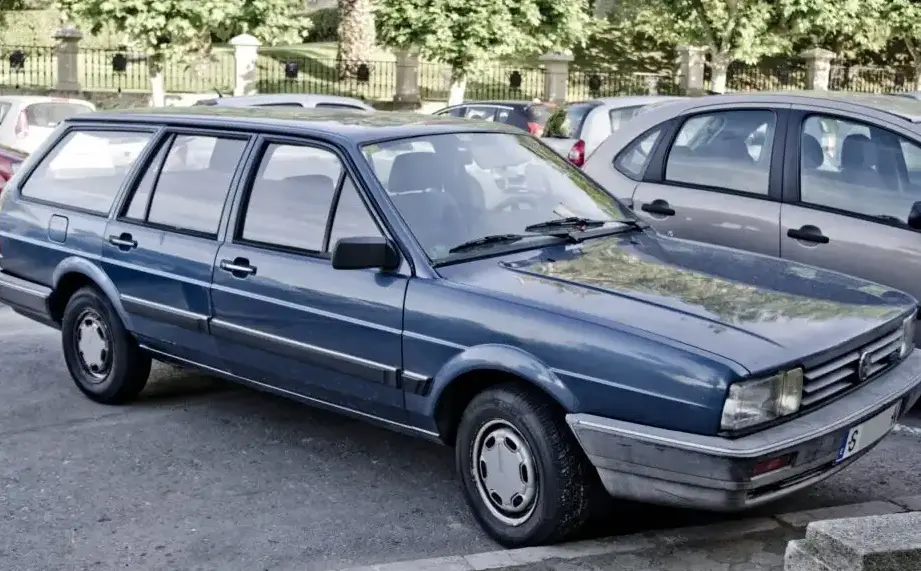
The Volkswagen Passat Variant (B2) 1.8, producing 90 horsepower, was a mainstay of the Passat lineup from 1983 to 1988. Positioned as an entry-to-mid-range offering, this variant catered to buyers seeking a practical and economical family vehicle within the broader B2 Passat generation (internally designated as the 1HX0/A3 platform). It represented a balance between affordability and usability, offering a larger cargo capacity than the sedan while remaining accessible to a wider customer base. This model was primarily sold in Europe, where station wagons, or “Variants” as Volkswagen termed them, were highly popular.
Technical Specifications
| Brand | Volkswagen |
| Model | Passat |
| Generation | Passat Variant (B2) |
| Type (Engine) | 1.8 (90 Hp) |
| Start of production | 1983 |
| End of production | 1988 |
| Powertrain Architecture | Internal Combustion engine |
| Body type | Station wagon (estate) |
| Seats | 5 |
| Doors | 5 |
| Fuel Type | Petrol (Gasoline) |
| Acceleration 0 – 100 km/h | 7.4 sec |
| Acceleration 0 – 62 mph | 7.4 sec |
| Acceleration 0 – 60 mph | 7 sec |
| Maximum speed | 173 km/h (107.5 mph) |
| Weight-to-power ratio | 10.3 kg/Hp, 96.8 Hp/tonne |
| Weight-to-torque ratio | 6.4 kg/Nm, 155.9 Nm/tonne |
| Power | 90 Hp @ 5200 rpm |
| Power per litre | 50.5 Hp/l |
| Torque | 145 Nm @ 3300 rpm (106.95 lb.-ft. @ 3300 rpm) |
| Engine layout | Front, Longitudinal |
| Engine Model/Code | JV |
| Engine displacement | 1781 cm3 (108.68 cu. in.) |
| Number of cylinders | 4 |
| Engine configuration | Inline |
| Cylinder Bore | 81 mm (3.19 in.) |
| Piston Stroke | 86.4 mm (3.4 in.) |
| Compression ratio | 10:1 |
| Number of valves per cylinder | 2 |
| Fuel injection system | Carburettor |
| Engine aspiration | Naturally aspirated engine |
| Valvetrain | OHC |
| Engine oil capacity | 3 l (3.17 US qt | 2.64 UK qt) |
| Kerb Weight | 930 kg (2050.3 lbs) |
| Max. weight | 1440 kg (3174.66 lbs) |
| Max load | 510 kg (1124.36 lbs) |
| Trunk (boot) space – minimum | 540 l (19.07 cu. ft.) |
| Trunk (boot) space – maximum | 1811 l (63.95 cu. ft.) |
| Fuel tank capacity | 70 l (18.49 US gal | 15.4 UK gal) |
| Length | 4545 mm (178.94 in.) |
| Width | 1695 mm (66.73 in.) |
| Height | 1385 mm (54.53 in.) |
| Wheelbase | 2555 mm (100.59 in.) |
| Front track | 1400 mm (55.12 in.) |
| Rear (Back) track | 1408 mm (55.43 in.) |
| Drivetrain Architecture | The Internal combustion engine (ICE) drives the front wheels of the vehicle. |
| Drive wheel | Front wheel drive |
| Number of gears and type of gearbox | 5 gears, manual transmission |
| Front suspension | Independent type McPherson |
| Rear suspension | Coil spring |
| Front brakes | Disc |
| Rear brakes | Drum |
| Assisting systems | ABS (Anti-lock braking system) |
| Steering type | Steering rack and pinion |
| Tires size | 175/70 R13 |
| Wheel rims size | 13 |
Powertrain & Engine Architecture
The heart of the Passat Variant 1.8 was the JV engine, an inline four-cylinder unit displacing 1781cc. This engine utilized a single overhead camshaft (OHC) valvetrain with two valves per cylinder. Unlike later Passat models that embraced fuel injection, the 1.8-liter engine in this variant relied on a carburetor for fuel delivery. This was a cost-saving measure, positioning it as a more affordable option. The carburetor, while simpler, resulted in slightly lower fuel efficiency and performance compared to fuel-injected counterparts. The engine produced 90 horsepower at 5200 rpm and 145 Nm (107 lb-ft) of torque at 3300 rpm. The engine was mounted longitudinally in the front of the vehicle, driving the front wheels. The transmission was typically a five-speed manual, although a three-speed automatic transmission was also available, albeit less common.
Driving Characteristics
The 90 hp 1.8-liter engine, paired with either the manual or automatic transmission, provided adequate, but not exhilarating, performance. Acceleration from 0 to 60 mph took around 7 seconds, which was respectable for the era, but noticeably slower than the more powerful GTI or VR6 variants. The automatic transmission, while offering convenience, further diminished acceleration and responsiveness. Gear ratios were tuned for fuel economy and everyday drivability rather than outright speed. The engine felt most comfortable in the mid-range, providing sufficient power for highway cruising and overtaking maneuvers, but lacked the punch of larger displacement engines. The front-wheel-drive configuration offered predictable handling, but could exhibit understeer when pushed hard.
Equipment & Trim Levels
The Passat Variant 1.8 typically came with a fairly basic level of equipment. Standard features included cloth upholstery, a simple dashboard layout, and manual windows and door locks. Power steering was often an optional extra. Higher trim levels, such as the GL, offered upgrades like upgraded upholstery, central locking, and electric windows. Optional extras also included a sunroof, alloy wheels, and a more sophisticated audio system. The interior was functional and spacious, prioritizing practicality over luxury.
Chassis & Braking
The B2 Passat Variant featured an independent McPherson strut suspension at the front and a coil spring suspension at the rear. This setup provided a comfortable ride, absorbing bumps and imperfections in the road effectively. The front brakes were discs, offering good stopping power, while the rear brakes were drums, a cost-saving measure common in this class of vehicle. ABS (Anti-lock Braking System) was available as an option, enhancing safety by preventing wheel lockup during hard braking. Stabilizer bars were fitted to both the front and rear axles to reduce body roll during cornering.
Market Reception & Comparison
The Passat Variant 1.8 was generally well-received as a practical and affordable family vehicle. Critics praised its spacious interior, comfortable ride, and reasonable fuel economy. However, the carburetor-equipped engine was often criticized for its slightly sluggish performance and higher emissions compared to fuel-injected alternatives. Compared to the more powerful Passat GL models with larger engines (like the 1.6 or 2.0 liter options), the 1.8 offered a more economical entry point into the Passat range. Against competitors like the Ford Sierra Estate or Opel Ascona Caravan, the Passat Variant 1.8 offered a similar blend of practicality and affordability.
Legacy
The Volkswagen Passat Variant (B2) 1.8, while not the most powerful or technologically advanced version of the B2 Passat, remains a popular choice among classic car enthusiasts. The JV engine, while simple, is generally considered reliable and relatively easy to maintain. Parts availability is still reasonable, making it a viable option for restoration projects. Today, well-maintained examples of the Passat Variant 1.8 are sought after by collectors and enthusiasts who appreciate its classic styling, practicality, and affordability. The automatic transmission versions, while less desirable to driving enthusiasts, offer a more accessible entry point into Passat ownership. The B2 Passat Variant, in all its forms, represents a significant chapter in Volkswagen’s history, solidifying its reputation for building practical and durable family vehicles.