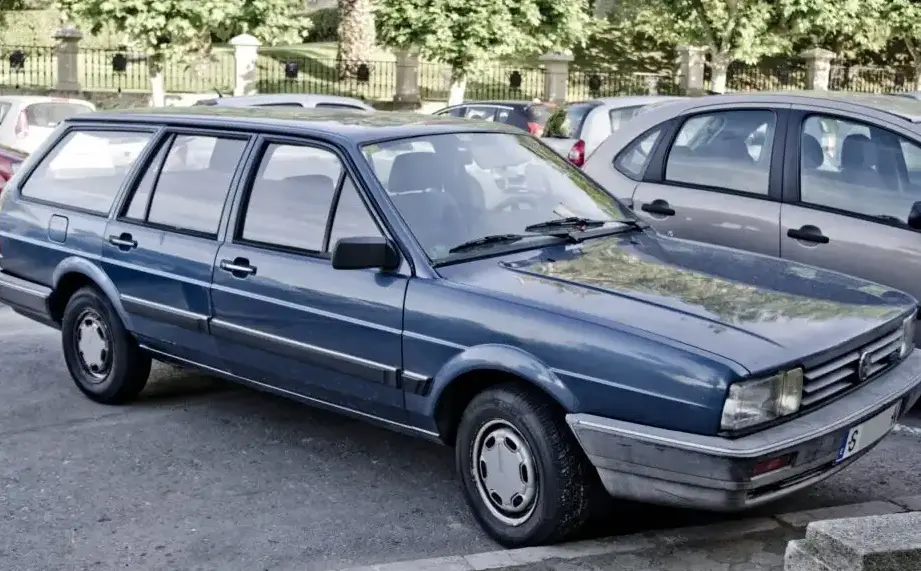
The Volkswagen Passat Variant (B2) 1.9, produced between 1981 and 1983, represents a significant iteration of Volkswagen’s popular mid-size offering. Positioned as a practical and versatile family vehicle, the B2 Passat Variant – Volkswagen’s designation for the station wagon (estate) body style – built upon the success of the original Passat (Type 32) and offered a more modern design and improved features. This particular 1.9-liter, 115 horsepower variant occupied a middle ground in the B2 Passat lineup, offering a balance between performance and fuel economy, appealing to buyers seeking a capable and comfortable daily driver. It was part of the larger B2 Passat range, which utilized the 1HX0/A3 platform shared with the Audi 80.
Technical Specifications
| Brand | Volkswagen |
| Model | Passat |
| Generation | Passat Variant (B2) |
| Type (Engine) | 1.9 (115 Hp) |
| Start of production | 1981 |
| End of production | 1983 |
| Powertrain Architecture | Internal Combustion engine |
| Body type | Station wagon (estate) |
| Seats | 5 |
| Doors | 5 |
| Fuel Type | Petrol (Gasoline) |
| Acceleration 0 – 100 km/h | 10.9 sec |
| Acceleration 0 – 62 mph | 10.9 sec |
| Acceleration 0 – 60 mph | 10.4 sec |
| Maximum speed | 188 km/h (116.82 mph) |
| Weight-to-power ratio | 8.9 kg/Hp, 112.2 Hp/tonne |
| Weight-to-torque ratio | 6.7 kg/Nm, 150.2 Nm/tonne |
| Power | 115 Hp @ 5900 rpm |
| Power per litre | 59.9 Hp/l |
| Torque | 154 Nm @ 3700 rpm (113.58 lb.-ft. @ 3700 rpm) |
| Engine Model/Code | WN |
| Engine displacement | 1921 cm3 (117.23 cu. in.) |
| Number of cylinders | 5 |
| Cylinder Bore | 79.5 mm (3.13 in.) |
| Piston Stroke | 77.4 mm (3.05 in.) |
| Compression ratio | 10:1 |
| Number of valves per cylinder | 2 |
| Fuel injection system | Multi-port manifold injection |
| Engine aspiration | Naturally aspirated engine |
| Valvetrain | OHC |
| Engine oil capacity | 3 l (3.17 US qt | 2.64 UK qt) |
| Coolant | 4 l (4.23 US qt | 3.52 UK qt) |
| Kerb Weight | 1025 kg (2259.74 lbs.) |
| Max. weight | 1550 kg (3417.17 lbs.) |
| Max load | 525 kg (1157.43 lbs.) |
| Trunk (boot) space – minimum | 540 l (19.07 cu. ft.) |
| Trunk (boot) space – maximum | 1811 l (63.95 cu. ft.) |
| Fuel tank capacity | 70 l (18.49 US gal | 15.4 UK gal) |
| Length | 4545 mm (178.94 in.) |
| Width | 1695 mm (66.73 in.) |
| Height | 1385 mm (54.53 in.) |
| Wheelbase | 2555 mm (100.59 in.) |
| Front track | 1400 mm (55.12 in.) |
| Rear (Back) track | 1408 mm (55.43 in.) |
| Drivetrain Architecture | The Internal combustion engine (ICE) drives the front wheels of the vehicle. |
| Drive wheel | Front wheel drive |
| Number of gears and type of gearbox | 5 gears, manual transmission |
| Front suspension | Independent type McPherson |
| Rear suspension | Coil spring |
| Front brakes | Ventilated discs |
| Rear brakes | Drum |
| Steering type | Steering rack and pinion |
| Tires size | 175/70 R13 |
| Wheel rims size | 13 |
Powertrain & Engine Architecture
The heart of this Passat Variant was the Volkswagen WN engine, a 1.9-liter inline-five cylinder gasoline engine. This engine was a relatively simple design, featuring a single overhead camshaft (OHC) operating two valves per cylinder. The WN engine utilized Bosch multi-port fuel injection, a significant advancement over earlier carbureted systems, contributing to improved fuel efficiency and smoother operation. The 10:1 compression ratio was typical for the era, balancing performance and fuel economy. The engine’s five-cylinder configuration provided a unique exhaust note and a relatively smooth power delivery. The five-speed manual transmission was the standard offering, providing drivers with good control over the engine’s power band.
Driving Characteristics
The 1.9-liter engine, producing 115 horsepower, provided adequate performance for the Passat Variant, though it wasn’t a particularly sporty configuration. Acceleration to 60 mph took around 10.4 seconds, and top speed was approximately 117 mph. The five-speed manual transmission allowed for efficient cruising at highway speeds. Compared to the more powerful (and expensive) four-cylinder or the later VR6 variants, the 1.9 offered a more economical driving experience. The gear ratios were tuned for practicality, prioritizing fuel economy and ease of driving over outright acceleration. The front-wheel-drive layout provided predictable handling, although it lacked the all-weather capability of a four-wheel-drive system.
Equipment & Trim Levels
The 1.9-liter Passat Variant typically came with a reasonable level of standard equipment. Interior features included cloth upholstery, a basic instrument cluster, and manually adjustable seats. Power steering was often an optional extra, as was air conditioning. Trim levels varied depending on the market, but generally, the 1.9 represented a mid-range offering. Optional extras could include upgraded audio systems, sunroofs, and alloy wheels. The interior design was functional and straightforward, reflecting the car’s focus on practicality.
Chassis & Braking
The B2 Passat Variant featured an independent McPherson strut front suspension and a coil spring rear suspension. This setup provided a comfortable ride and reasonable handling characteristics. Front brakes were ventilated discs, offering good stopping power, while the rear brakes were drums, a cost-saving measure common in this class of vehicle. The steering was rack and pinion, providing precise and responsive control. Stabilizer bars were typically fitted to improve body roll during cornering. The suspension was tuned for comfort, prioritizing a smooth ride over sporty handling.
Market Reception & Comparison
The 1.9-liter Passat Variant was generally well-received by automotive critics as a practical and reliable family car. It offered a good balance of space, comfort, and fuel economy. Compared to the more powerful Passat variants, the 1.9 was seen as a more sensible choice for buyers who prioritized affordability and efficiency. The 1.9 TDI diesel variant, introduced later in the B2 Passat’s lifecycle, offered even better fuel economy, but at the expense of performance. The 1.9 gasoline engine was considered relatively reliable, although regular maintenance was essential to ensure longevity.
Legacy
The Volkswagen Passat Variant (B2) 1.9 remains a popular choice among classic car enthusiasts today. The WN engine, while not particularly high-performance, is known for its durability and relatively simple maintenance requirements. Parts availability is generally good, making it a relatively easy car to keep on the road. Well-maintained examples command reasonable prices in the used car market. The B2 Passat Variant, particularly the 1.9-liter version, represents a significant chapter in Volkswagen’s history, showcasing the brand’s commitment to building practical, reliable, and versatile family vehicles. Its enduring popularity is a testament to its well-rounded design and enduring quality.