
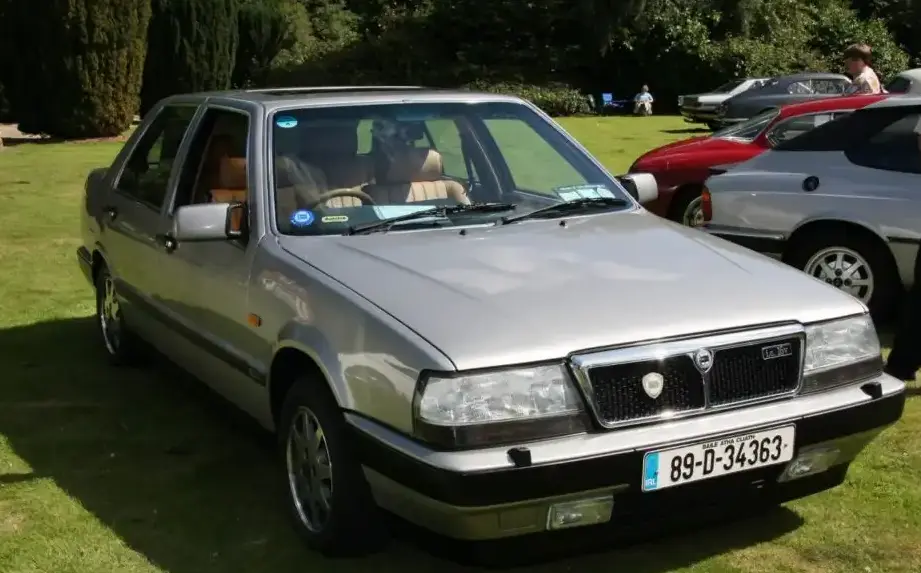
The Lancia Thema (834) 2500 Turbo DS represents a unique and often overlooked chapter in the storied history of the Italian automaker. Produced between 1988 and 1992, this variant of the second-generation Thema – internally designated the 834 series – combined a turbocharged diesel engine with a five-speed manual transmission. It occupied a specific niche within the Thema lineup, offering a blend of performance and fuel economy aimed at drivers seeking a more refined and efficient grand touring experience. The 834 generation Thema was built upon the Type Four platform, shared with the Saab 9000, Fiat Croma, and Alfa Romeo 164, representing a collaborative effort to reduce development costs and leverage economies of scale.
Technical Specifications
| Brand | Lancia |
| Model | Thema |
| Generation | Thema (834) |
| Type (Engine) | 2500 Turbo DS (118 Hp) |
| Start of production | 1988 |
| End of production | 1992 |
| Powertrain Architecture | Internal Combustion engine |
| Body type | Sedan |
| Seats | 5 |
| Doors | 4 |
| Fuel consumption (urban) | 8.6 l/100 km (27.4 US mpg) |
| Fuel consumption (extra urban) | 5.3 l/100 km (44.4 US mpg) |
| Fuel consumption (combined) | 7 l/100 km (33.6 US mpg) |
| Fuel Type | Diesel |
| Acceleration 0 – 100 km/h | 11 sec |
| Acceleration 0 – 62 mph | 11 sec |
| Acceleration 0 – 60 mph | 10.5 sec |
| Maximum speed | 195 km/h (121.17 mph) |
| Weight-to-power ratio | 11.4 kg/Hp |
| Weight-to-torque ratio | 5.4 kg/Nm |
| Power | 118 Hp @ 3900 rpm |
| Torque | 250 Nm @ 2200 rpm (184.39 lb.-ft. @ 2200 rpm) |
| Engine layout | Front, Transverse |
| Engine displacement | 2500 cm3 (152.56 cu. in.) |
| Number of cylinders | 4 |
| Engine configuration | Inline |
| Cylinder Bore | 93 mm (3.66 in.) |
| Piston Stroke | 92 mm (3.62 in.) |
| Compression ratio | 21:1 |
| Number of valves per cylinder | 2 |
| Fuel injection system | Precombustion chamber injection |
| Engine aspiration | Turbocharger |
| Kerb Weight | 1350 kg (2976.24 lbs.) |
| Max. weight | 1850 kg (4078.55 lbs.) |
| Max load | 500 kg (1102.31 lbs.) |
| Trunk (boot) space – minimum | 440 l (15.54 cu. ft.) |
| Trunk (boot) space – maximum | 1000 l (35.31 cu. ft.) |
| Fuel tank capacity | 70 l (18.49 US gal) |
| Length | 4590 mm (180.71 in.) |
| Width | 1750 mm (68.9 in.) |
| Height | 1435 mm (56.5 in.) |
| Wheelbase | 2660 mm (104.72 in.) |
| Front track | 1480 mm (58.27 in.) |
| Rear track | 1470 mm (57.87 in.) |
| Drivetrain Architecture | Front wheel drive |
| Number of gears | 5 gears, manual transmission |
| Front suspension | Coil spring |
| Rear suspension | Coil spring |
| Front brakes | Ventilated discs |
| Rear brakes | Disc |
| Assisting systems | ABS (Anti-lock braking system) |
| Steering type | Steering rack and pinion |
| Power steering | Hydraulic Steering |
| Tires size | 185/70 R 14 |
Powertrain & Engine Architecture
The heart of the Thema 2500 Turbo DS is its 2.5-liter inline-four diesel engine. This engine, identified by various codes depending on the specific market, utilized a sophisticated precombustion chamber injection system. This system, common in European diesel engines of the era, involved injecting fuel into a small pre-chamber within the cylinder head, where it was partially ignited before entering the main combustion chamber. This design promoted more complete combustion and reduced engine noise. The addition of a turbocharger significantly boosted power output to 118 horsepower at 3900 rpm and 250 Nm (184 lb-ft) of torque at 2200 rpm. The five-speed manual transmission provided precise control over the engine’s power band, allowing drivers to maximize both performance and fuel efficiency. The transmission was chosen to complement the engine’s torque characteristics, offering a balance between spirited driving and long-distance cruising.
Driving Characteristics
The 2500 Turbo DS offered a distinctly different driving experience compared to its gasoline-powered siblings, such as the 2.0-liter inline-four or the more potent V6 models. While lacking the outright acceleration of the V6, the diesel Thema delivered strong low-end torque, making it surprisingly capable in everyday driving situations. The manual transmission allowed for greater driver engagement and control, unlike the automatic options available on other Thema variants. The gear ratios were well-suited to both city driving and highway cruising, providing ample power for overtaking maneuvers. However, the diesel engine was noticeably louder and less refined than the gasoline engines, a characteristic common to diesel engines of that period. The car’s weight, around 1350 kg (2976 lbs), was well-managed by the engine’s torque, resulting in a respectable 0-60 mph time of around 10.5 seconds and a top speed of 195 km/h (121 mph).
Equipment & Trim Levels
The Thema 2500 Turbo DS was generally well-equipped, reflecting Lancia’s reputation for providing a luxurious driving experience. Standard features typically included power windows, central locking, power steering, and an anti-lock braking system (ABS). Interior upholstery was typically cloth, although leather options were available. The dashboard layout was clean and functional, with a focus on ergonomics. Optional extras included a sunroof, upgraded audio systems, and metallic paint finishes. The trim level aimed for a balance between comfort and practicality, appealing to drivers who valued both performance and refinement.
Chassis & Braking
The Thema 834 featured a coil spring suspension system at both the front and rear, providing a comfortable ride quality. The front suspension utilized independent coil springs, while the rear suspension employed a semi-independent twist beam setup. Braking duties were handled by ventilated discs at the front and solid discs at the rear, providing adequate stopping power for the car’s weight and performance. The steering system was a rack-and-pinion setup with hydraulic power assistance, offering precise and responsive steering feel.
Market Reception & Comparison
The Lancia Thema 2500 Turbo DS was generally well-received by automotive critics, who praised its fuel efficiency, strong torque, and comfortable ride. However, some critics noted the engine’s noise and lack of refinement compared to its gasoline counterparts. Compared to the gasoline-powered Thema variants, the diesel model offered significantly better fuel economy, making it an attractive option for drivers who covered long distances. It also provided a more affordable entry point into the Thema range. Against competitors like the BMW 524td and Mercedes-Benz 250D, the Thema offered a unique blend of Italian style and diesel efficiency.
Legacy
The Lancia Thema 2500 Turbo DS, while not a high-volume seller, has gained a cult following among enthusiasts. The engine, while robust, requires regular maintenance to ensure longevity. Parts availability can be challenging, but a dedicated community of Lancia owners and specialists exists to support these vehicles. Today, well-maintained examples of the Thema 2500 Turbo DS are increasingly sought after by collectors and enthusiasts who appreciate its unique character and blend of performance, efficiency, and Italian flair. The car represents a fascinating chapter in Lancia’s history, showcasing the brand’s willingness to experiment with different powertrain technologies and cater to a diverse range of customer needs.
