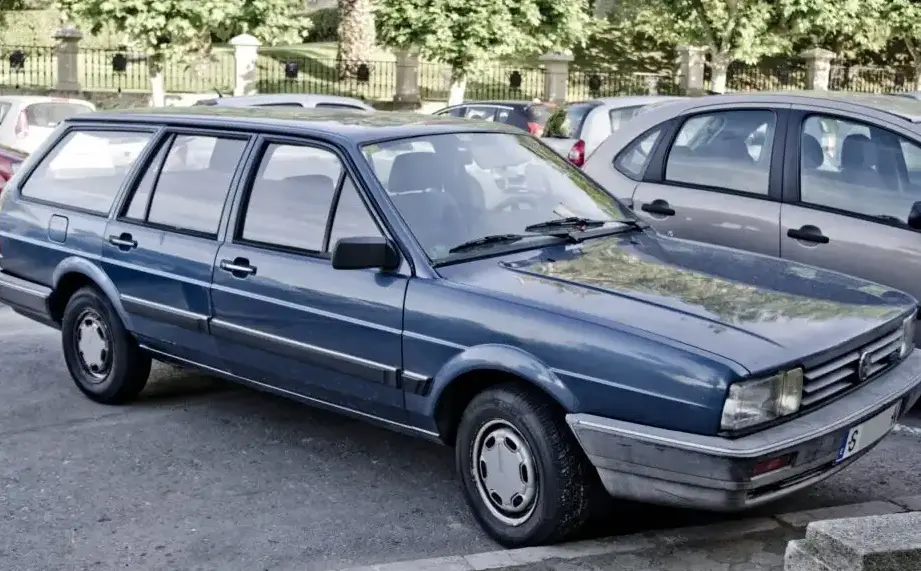
The Volkswagen Passat Variant (B2) 2.0, produced between 1983 and 1988, represented a significant evolution of Volkswagen’s popular mid-size offering. As the estate (wagon) version of the B2 Passat, it catered to buyers needing practicality without sacrificing the brand’s reputation for solid engineering. This particular 2.0-liter, 115 horsepower variant occupied a middle ground in the B2 Passat lineup, offering a balance between performance and economy. It was positioned above the base 1.6-liter models and below the more powerful and often more expensive GL versions, including those equipped with the larger 1.8 or 2.1-liter engines. The B2 Passat, and its Variant sibling, were crucial in establishing Volkswagen’s foothold in the competitive European market and began to gain traction in North America as well.
Technical Specifications
| Brand | Volkswagen |
| Model | Passat |
| Generation | Passat Variant (B2) |
| Type (Engine) | 2.0 (115 Hp) |
| Start of production | 1983 |
| End of production | 1988 |
| Powertrain Architecture | Internal Combustion engine |
| Body type | Station wagon (estate) |
| Seats | 5 |
| Doors | 5 |
| Fuel Type | Petrol (Gasoline) |
| Acceleration 0 – 100 km/h | 11.1 sec |
| Acceleration 0 – 62 mph | 11.1 sec |
| Acceleration 0 – 60 mph | 10.5 sec |
| Maximum speed | 182 km/h (113.09 mph) |
| Weight-to-power ratio | 7.9 kg/Hp, 126.4 Hp/tonne |
| Weight-to-torque ratio | 5.5 kg/Nm, 180.2 Nm/tonne |
| Power | 115 Hp @ 5500 rpm |
| Power per litre | 57.7 Hp/l |
| Torque | 164 Nm @ 3200 rpm (120.96 lb.-ft. @ 3200 rpm) |
| Engine layout | Front, Longitudinal |
| Engine Model/Code | JS, HP |
| Engine displacement | 1994 cm3 (121.68 cu. in.) |
| Number of cylinders | 5 |
| Engine configuration | Inline |
| Cylinder Bore | 81 mm (3.19 in.) |
| Piston Stroke | 77.4 mm (3.05 in.) |
| Compression ratio | 10:1 |
| Number of valves per cylinder | 2 |
| Fuel injection system | Multi-port manifold injection |
| Engine aspiration | Naturally aspirated engine |
| Valvetrain | OHC |
| Engine oil capacity | 3.5 l (3.7 US qt | 3.08 UK qt) |
| Coolant | 8 l (8.45 US qt | 7.04 UK qt) |
| Kerb Weight | 910 kg (2006.21 lbs) |
| Max. weight | 1350 kg (2976.24 lbs) |
| Max load | 440 kg (970.03 lbs) |
| Trunk (boot) space – minimum | 540 l (19.07 cu. ft.) |
| Trunk (boot) space – maximum | 1811 l (63.95 cu. ft.) |
| Fuel tank capacity | 70 l (18.49 US gal | 15.4 UK gal) |
| Length | 4545 mm (178.94 in.) |
| Width | 1695 mm (66.73 in.) |
| Height | 1385 mm (54.53 in.) |
| Wheelbase | 2555 mm (100.59 in.) |
| Front track | 1400 mm (55.12 in.) |
| Rear (Back) track | 1408 mm (55.43 in.) |
| Drivetrain Architecture | The Internal combustion engine (ICE) drives the front wheels of the vehicle. |
| Drive wheel | Front wheel drive |
| Number of gears and type of gearbox | 5 gears, manual transmission |
| Front suspension | Independent type McPherson |
| Rear suspension | Coil spring |
| Front brakes | Ventilated discs |
| Rear brakes | Drum |
| Steering type | Steering rack and pinion |
| Power steering | Hydraulic Steering |
| Tires size | 195/60 R14 |
| Wheel rims size | 14 |
Powertrain & Engine Architecture
The heart of this Passat Variant was the Volkswagen JS or HP engine, a 1.994-liter inline five-cylinder gasoline engine. This engine was a key part of Volkswagen’s modular engine family, known for its robustness and relatively simple design. The JS code typically denotes earlier versions, while HP represents later iterations with minor refinements. The engine featured a single overhead camshaft (OHC) operating two valves per cylinder. Fuel delivery was handled by Bosch multi-port fuel injection, a significant upgrade over earlier carbureted systems, improving fuel efficiency and reducing emissions. The five-cylinder configuration provided a smoother power delivery than a typical four-cylinder, though it wasn’t as refined as a six-cylinder. The engine’s longitudinal mounting, coupled with front-wheel drive, was a common layout for Volkswagen at the time. The five-speed manual transmission was the standard offering, providing a good balance of fuel economy and performance.
Driving Characteristics
The 2.0-liter, 115 hp Passat Variant offered respectable, if not exhilarating, performance. Acceleration to 60 mph took around 10.5 to 11.1 seconds, making it competitive with other family wagons of the era. The engine’s 164 Nm (121 lb-ft) of torque, available at 3200 rpm, provided adequate pulling power for everyday driving and hauling loads. Compared to the more powerful 1.8 or 2.1-liter versions, this 2.0-liter felt less strained during highway cruising and overtaking maneuvers. However, it lacked the outright punch of its larger-displacement siblings. The five-speed manual transmission was well-matched to the engine’s characteristics, offering precise shifts and allowing the driver to keep the engine in its optimal power band. The relatively long gearing contributed to decent fuel economy, but also meant the engine needed to be revved to extract maximum performance.
Equipment & Trim Levels
The 2.0-liter Passat Variant typically came with a reasonable level of standard equipment. Interior features included cloth upholstery, a basic instrument cluster, and manually adjustable seats. Power steering was often included, but air conditioning and central locking were usually optional extras. The trim level could vary depending on the market, but generally, this variant was positioned as a mid-range offering. Optional extras included a sunroof, upgraded stereo systems, and alloy wheels. The interior design was functional and straightforward, reflecting the car’s practical nature. The spacious cabin and large cargo area were key selling points for the Variant model.
Chassis & Braking
The B2 Passat Variant featured an independent McPherson strut front suspension and a coil-sprung rear axle. This setup provided a comfortable ride and decent handling characteristics. The front brakes were ventilated discs, offering good stopping power, while the rear brakes were drums, a cost-saving measure common in this class of vehicle. Stabilizer bars were typically fitted to both the front and rear axles, helping to reduce body roll during cornering. The steering was a rack-and-pinion system, providing precise and responsive steering feel. The suspension was tuned for comfort rather than outright sportiness, making it well-suited for long-distance driving.
Market Reception & Comparison
The Passat Variant 2.0 was generally well-received by automotive critics as a practical and reliable family wagon. It offered a good balance of space, comfort, and fuel economy. Compared to other wagons in its class, such as the Ford Sierra Estate or Opel Ascona Caravan, the Passat Variant was often praised for its build quality and refined driving experience. However, some critics noted that the 2.0-liter engine could feel underpowered when fully loaded or driving uphill. The 1.6-liter models were more affordable but lacked the performance of the 2.0, while the higher-spec 1.8 and 2.1-liter versions came at a premium price. Fuel economy was competitive for the time, averaging around 28-32 mpg depending on driving conditions.
Legacy
The Volkswagen Passat Variant (B2) 2.0 has proven to be a remarkably durable vehicle. Many examples are still on the road today, a testament to Volkswagen’s engineering and build quality. The JS/HP engine is known for its reliability, although regular maintenance is essential to prevent issues such as oil leaks and timing chain wear. In the used car market, these Passat Variants are sought after by enthusiasts and collectors who appreciate their classic styling and practical nature. Parts availability is generally good, although some specific trim pieces can be difficult to find. The B2 Passat Variant 2.0 remains a popular choice for those seeking a classic European wagon that offers a blend of style, comfort, and reliability.