
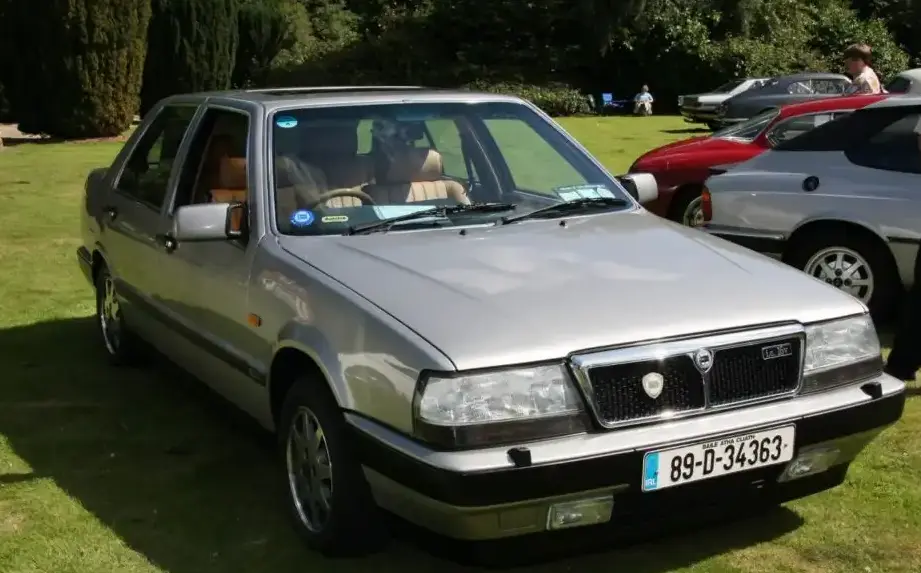
The Lancia Thema (834) 2850 V6 i.e. Automatic, produced between 1988 and 1992, represented a sophisticated offering in the executive sedan segment. Part of the second generation of the Thema, designated the 834 series, this variant featured a 2.8-liter V6 engine paired with a four-speed automatic transmission. It occupied a premium position within the Thema lineup, offering a blend of performance and comfort aimed at buyers seeking a more refined driving experience than the four-cylinder models. The 834 series Thema was a collaborative effort with Saab, Fiat, and Alfa Romeo, sharing the Type Four platform, and was Lancia’s flagship model during this period, intended to compete with the likes of the BMW 5 Series and Mercedes-Benz E-Class.
Technical Specifications
| Brand | Lancia |
| Model | Thema |
| Generation | Thema (834) |
| Type (Engine) | 2850 V6 i.e. (147 Hp) Automatic |
| Start of production | 1988 |
| End of production | 1992 |
| Powertrain Architecture | Internal Combustion engine |
| Body type | Sedan |
| Seats | 5 |
| Doors | 4 |
| Fuel consumption (urban) | 14 l/100 km (16.8 US mpg, 20.2 UK mpg, 7.1 km/l) |
| Fuel consumption (extra urban) | 7.4 l/100 km (31.8 US mpg, 38.2 UK mpg, 13.5 km/l) |
| Fuel consumption (combined) | 9.4 l/100 km (25 US mpg, 30.1 UK mpg, 10.6 km/l) |
| Fuel Type | Petrol (Gasoline) |
| Acceleration 0 – 100 km/h | 8.4 sec |
| Acceleration 0 – 62 mph | 8.4 sec |
| Acceleration 0 – 60 mph | 8 sec |
| Maximum speed | 205 km/h (127.38 mph) |
| Weight-to-power ratio | 8.7 kg/Hp, 114.8 Hp/tonne |
| Weight-to-torque ratio | 5.7 kg/Nm, 175.8 Nm/tonne |
| Power | 147 Hp |
| Power per litre | 51.6 Hp/l |
| Torque | 225 Nm (165.95 lb.-ft.) |
| Engine layout | Front, Transverse |
| Engine Model/Code | 834 E.146 |
| Engine displacement | 2849 cm3 (173.86 cu. in.) |
| Number of cylinders | 6 |
| Engine configuration | V-engine |
| Cylinder Bore | 91 mm (3.58 in.) |
| Piston Stroke | 73 mm (2.87 in.) |
| Compression ratio | 9.5:1 |
| Number of valves per cylinder | 2 |
| Fuel injection system | Multi-port manifold injection |
| Engine aspiration | Naturally aspirated engine |
| Engine oil capacity | 5.5 l (5.81 US qt | 4.84 UK qt) |
| Coolant capacity | 8.2 l (8.66 US qt | 7.21 UK qt) |
| Kerb Weight | 1280 kg (2821.92 lbs.) |
| Max. weight | 1780 kg (3924.23 lbs.) |
| Max load | 500 kg (1102.31 lbs.) |
| Trunk (boot) space – minimum | 440 l (15.54 cu. ft.) |
| Trunk (boot) space – maximum | 1000 l (35.31 cu. ft.) |
| Fuel tank capacity | 70 l (18.49 US gal | 15.4 UK gal) |
| Length | 4590 mm (180.71 in.) |
| Width | 1750 mm (68.9 in.) |
| Height | 1435 mm (56.5 in.) |
| Wheelbase | 2660 mm (104.72 in.) |
| Front track | 1480 mm (58.27 in.) |
| Rear (Back) track | 1470 mm (57.87 in.) |
| Drivetrain Architecture | The Internal combustion engine (ICE) drives the front wheels of the vehicle. |
| Drive wheel | Front wheel drive |
| Number of gears and type of gearbox | 4 gears, automatic transmission |
| Front suspension | Coil spring |
| Rear suspension | Coil spring |
| Front brakes | Disc |
| Rear brakes | Disc |
| Assisting systems | ABS (Anti-lock braking system) |
| Steering type | Steering rack and pinion |
| Power steering | Hydraulic Steering |
| Tires size | 205/60 R14 |
| Wheel rims size | 14 |
Powertrain & Engine Architecture
The heart of the Thema 2850 V6 i.e. was the 834 E.146 engine, a 2.8-liter (2849 cc) V6. This engine was based on a 90-degree V-block configuration, providing inherent smoothness. It featured a cast iron block and aluminum cylinder heads. The engine utilized a Bosch Motronic fuel injection system with multi-point injection, optimizing fuel delivery for improved performance and efficiency. The valvetrain employed two valves per cylinder, operated by a single overhead camshaft per bank. The four-speed automatic transmission, sourced from ZF, was chosen for its smoothness and reliability. This transmission featured electronic control, adapting shift points based on throttle position and vehicle speed. The engine produced 147 horsepower and 225 Nm (165.95 lb-ft) of torque, providing adequate power for comfortable highway cruising and spirited driving.
Driving Characteristics
The 147 hp V6 automatic Thema offered a distinctly different driving experience compared to the lower-powered, four-cylinder versions. While not a sports sedan, the V6 provided ample power for confident overtaking and merging onto highways. The automatic transmission, while smooth, did result in some power loss compared to the available five-speed manual. Gear ratios were tuned for comfort and fuel economy, rather than outright acceleration. The 0-60 mph time of around 8 seconds was respectable for the era, but noticeably slower than the manual transmission equipped models. The front-wheel-drive layout contributed to predictable handling, although it lacked the dynamic finesse of rear-wheel-drive competitors. The suspension, tuned for comfort, absorbed bumps effectively, providing a smooth ride on most road surfaces.
Equipment & Trim Levels
The 2850 V6 i.e. Automatic typically came well-equipped, reflecting its position as a premium trim level. Standard features included power windows, power locks, central locking, air conditioning, and an upgraded sound system. Interior upholstery was typically a high-quality cloth or optional leather. Dashboard configuration featured wood trim accents and a comprehensive instrument cluster. Optional extras included a sunroof, upgraded audio systems, and alloy wheels. Safety features, while limited by the standards of today, included ABS anti-lock brakes, which were a significant addition for the time.
Chassis & Braking
The Thema 834 utilized a monocoque chassis construction for rigidity and weight reduction. The suspension system employed independent coil springs at all four wheels, providing a comfortable ride. Front suspension utilized MacPherson struts, while the rear featured a semi-independent twist beam setup. Braking duties were handled by disc brakes on all four wheels, providing adequate stopping power. The ABS system helped to maintain steering control during hard braking. Stabilizer bars were fitted to both the front and rear axles to reduce body roll during cornering.
Market Reception & Comparison
The Lancia Thema V6 Automatic was generally well-received by automotive critics, who praised its comfortable ride, refined engine, and spacious interior. However, some critics noted the slightly sluggish performance of the automatic transmission compared to the manual. Fuel economy, at around 25 mpg combined, was typical for a V6-powered sedan of the era, but higher than the four-cylinder models. Reliability was generally good, although the Thema’s complex electronics could occasionally present issues. Compared to its rivals, the Thema offered a unique blend of Italian style and engineering, but lacked the brand recognition of German competitors like BMW and Mercedes-Benz.
Legacy
The Lancia Thema 2850 V6 i.e. Automatic remains a sought-after classic car among enthusiasts. The 834 E.146 V6 engine is known for its durability and smooth operation, although maintenance can be costly due to the engine’s complexity and the limited availability of parts. Well-maintained examples command a premium in the used car market. The Thema’s innovative design and engineering continue to be appreciated by those who value a unique and refined driving experience. The platform sharing with Saab, Fiat, and Alfa Romeo also makes it a fascinating example of automotive collaboration.
