
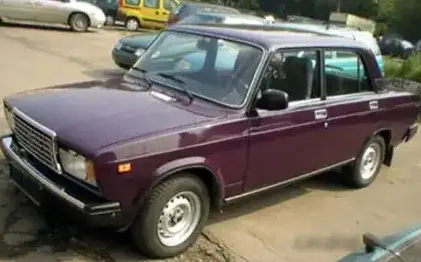
The Lada 21074 1.6, producing 79 horsepower, represents a significant iteration within the classic Lada 2107 series. Produced from 1982 to 2003, this variant was a mainstay of the Soviet and later Russian automotive market, offering affordable and relatively reliable transportation. The 2107, heavily based on the Fiat 124, became a symbol of personal mobility for generations. The “21074” designation specifically denotes the model equipped with the 1.6-liter engine. It occupied a middle ground in the 2107 lineup, offering a balance between performance and economy compared to the smaller 1.3-liter and larger 1.6-liter high-output versions.
Technical Specifications
| Brand | Lada |
| Model | 2107 |
| Generation | 21074 |
| Type (Engine) | 1.6 (79 Hp) |
| Start of production | 1982 |
| End of production | 2003 |
| Powertrain Architecture | Internal Combustion engine |
| Body type | Sedan |
| Seats | 5 |
| Fuel consumption (urban) | 10.5 l/100 km (22.4 US mpg, 26.9 UK mpg, 9.5 km/l) |
| Fuel consumption (extra urban) | 8 l/100 km (29.4 US mpg, 35.3 UK mpg, 12.5 km/l) |
| Fuel consumption (combined) | 9.5 l/100 km (24.8 US mpg, 29.7 UK mpg, 10.5 km/l) |
| Fuel Type | Petrol (Gasoline) |
| Acceleration 0 – 100 km/h | 15 sec |
| Acceleration 0 – 62 mph | 15 sec |
| Acceleration 0 – 60 mph | 14.3 sec |
| Maximum speed | 154 km/h (95.69 mph) |
| Power | 79 Hp @ 5400 rpm |
| Power per litre | 50.4 Hp/l |
| Torque | 116 Nm @ 3000 rpm (85.56 lb.-ft. @ 3000 rpm) |
| Engine layout | Front, Longitudinal |
| Engine Model/Code | 2106 |
| Engine displacement | 1569 cm3 (95.75 cu. in.) |
| Number of cylinders | 4 |
| Engine configuration | Inline |
| Cylinder Bore | 79 mm (3.11 in.) |
| Piston Stroke | 80 mm (3.15 in.) |
| Compression ratio | 8.5:1 |
| Number of valves per cylinder | 2 |
| Fuel injection system | Carburettor |
| Engine aspiration | Naturally aspirated engine |
| Valvetrain | OHC |
| Fuel tank capacity | 39 l (10.3 US gal, 8.58 UK gal) |
| Number of gears and type of gearbox | 5 gears, manual transmission |
| Front suspension | Independent coil spring |
| Rear suspension | dependent spring suspension |
| Front brakes | Disc |
| Rear brakes | Drum |
| Steering type | Worm-reduction unit |
Powertrain & Engine Architecture
The heart of the 21074 is the 1.6-liter inline-four cylinder engine, designated as the 2106. This engine, while derived from earlier designs, was a workhorse known for its durability. It featured a single overhead camshaft (OHC) valvetrain operating two valves per cylinder. Fuel delivery was managed by a carburetor, a common feature for vehicles of this era and market segment. The carburetor system, while simple, wasn’t known for precise fuel metering, contributing to the car’s relatively high fuel consumption. The engine’s longitudinal front-engine layout was a carryover from the Fiat 124 design. The 5-speed manual transmission was the standard offering, providing a reasonable spread of gears for both city driving and highway cruising. The transmission itself was relatively robust, though shift quality could be imprecise by modern standards.
Driving Characteristics
The 21074 1.6 offered modest performance. With 79 horsepower and 116 Nm (85.56 lb-ft) of torque, acceleration from 0 to 60 mph took around 14.3 seconds, and 0-100 km/h in 15 seconds. Top speed was around 95.69 mph (154 km/h). Compared to the smaller 1.3-liter engine, the 1.6 provided noticeably more power, especially at higher speeds and when carrying a full load. However, it wasn’t a sporty car by any means. The gear ratios were tuned for economy rather than outright acceleration. The car felt most comfortable cruising at moderate speeds, and the engine lacked the responsiveness of more modern powertrains. The manual transmission, while functional, required a deliberate hand and wasn’t known for its short throws.
Equipment & Trim Levels
The 21074 was generally sparsely equipped, reflecting its position as an affordable vehicle. Standard features typically included basic cloth upholstery, a simple dashboard layout with analog gauges, and manual windows and locks. The trim level was fairly consistent across the 21074 models, with options being limited. Available extras often included a radio, upgraded seat covers, and sometimes, a sunroof. The interior was functional but lacked the refinement of Western European or Japanese cars of the same era. The focus was on durability and ease of maintenance rather than luxury.
Chassis & Braking
The 21074 utilized a relatively simple chassis design. The front suspension was independent, employing coil springs, while the rear suspension was a dependent leaf spring setup. This configuration provided a reasonably comfortable ride, but handling was not particularly precise. The front brakes were disc brakes, offering adequate stopping power, while the rear brakes were drums. This combination was typical for cars in its class at the time. Steering was accomplished via a worm-reduction unit, which was known for being heavy and lacking in feel. Stabilizer bars were often absent or minimal, contributing to noticeable body roll during cornering.
Market Reception & Comparison
The Lada 21074 was immensely popular in the Soviet Union and post-Soviet states due to its affordability, simplicity, and readily available parts. It was often the only car accessible to the average citizen. Critics generally acknowledged its robustness and ease of repair, but also pointed to its outdated technology, poor fuel economy, and lack of refinement. Compared to the 1.3-liter version, the 1.6 offered a significant performance improvement, making it a more desirable option for those who frequently drove on highways or carried passengers. However, the 1.6 consumed more fuel. Compared to Western European cars, the 21074 was significantly less sophisticated, but also considerably cheaper.
Legacy
The Lada 21074, and the 2107 series as a whole, holds a significant place in automotive history, particularly in Eastern Europe. While no longer in production, it remains a common sight on the roads of Russia and surrounding countries. The 1.6-liter engine, while not particularly advanced, proved to be remarkably durable and relatively easy to maintain. In the used car market, the 21074 is valued for its simplicity and affordability. Parts are still readily available, and the car can be kept running with basic mechanical skills. It’s often seen as a nostalgic reminder of a bygone era, and a testament to the enduring appeal of simple, reliable transportation. Despite its age, a well-maintained 21074 can still provide years of service, making it a popular choice for those seeking a classic and affordable vehicle.
