
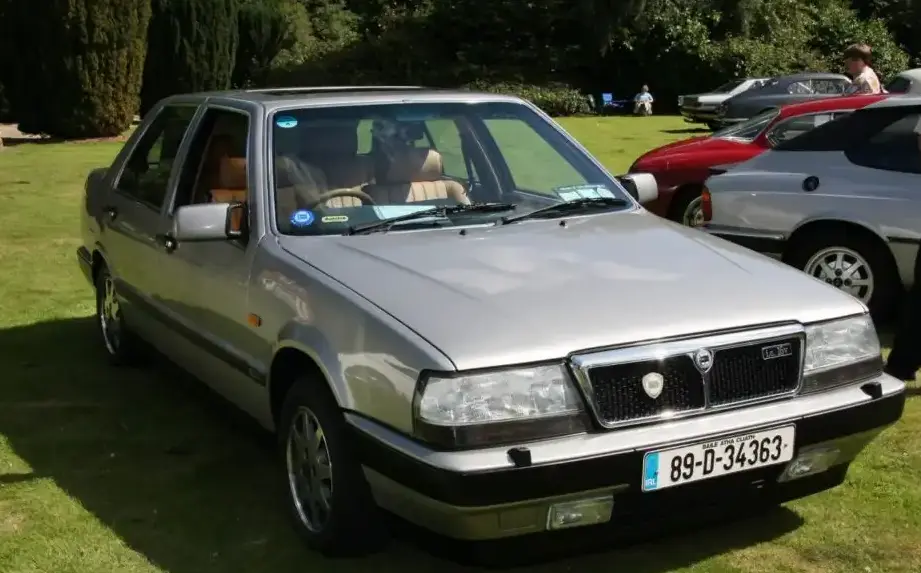
The Lancia Thema 834, specifically the 2850 V6 i.e. variant producing 150 horsepower, represented a significant step forward for the Italian automaker in the executive sedan segment. Produced from 1984 to 1988, this model was the flagship of Lancia’s lineup, designed to compete with established German and Swedish rivals. It was built on the Tipo Quattro platform, shared with the Fiat Croma, Alfa Romeo 164, and Saab 9000, a collaboration aimed at reducing development costs and offering a wider range of vehicles within the Fiat Group. The 2850 V6 i.e. occupied a premium position within the Thema range, offering a more powerful and refined experience than the four-cylinder options.
Technical Specifications
| Brand | Lancia |
| Model | Thema |
| Generation | Thema (834) |
| Type (Engine) | 2850 V6 i.e. (150 Hp) |
| Start of production | 1984 |
| End of production | 1988 |
| Powertrain Architecture | Internal Combustion engine |
| Body type | Sedan |
| Seats | 5 |
| Doors | 4 |
| Fuel consumption (urban) | 14 l/100 km (16.8 US mpg, 20.2 UK mpg, 7.1 km/l) |
| Fuel consumption (extra urban) | 7.4 l/100 km (31.8 US mpg, 38.2 UK mpg, 13.5 km/l) |
| Fuel consumption (combined) | 9.4 l/100 km (25 US mpg, 30.1 UK mpg, 10.6 km/l) |
| Fuel Type | Petrol (Gasoline) |
| Acceleration 0 – 100 km/h | 8.4 sec |
| Acceleration 0 – 62 mph | 8.4 sec |
| Acceleration 0 – 60 mph | 8 sec |
| Maximum speed | 205 km/h (127.38 mph) |
| Weight-to-power ratio | 8.5 kg/Hp, 117.2 Hp/tonne |
| Weight-to-torque ratio | 5.6 kg/Nm, 179.7 Nm/tonne |
| Power | 150 Hp @ 5000 rpm |
| Power per litre | 52.7 Hp/l |
| Torque | 230 Nm @ 3500 rpm (169.64 lb.-ft. @ 3500 rpm) |
| Engine layout | Front, Transverse |
| Engine Model/Code | 834 E.000 |
| Engine displacement | 2849 cm3 (173.86 cu. in.) |
| Number of cylinders | 6 |
| Engine configuration | V-engine |
| Cylinder Bore | 91 mm (3.58 in.) |
| Piston Stroke | 73 mm (2.87 in.) |
| Compression ratio | 9.5:1 |
| Number of valves per cylinder | 2 |
| Fuel injection system | Multi-port manifold injection |
| Engine aspiration | Naturally aspirated engine |
| Engine oil capacity | 6.6 l (6.97 US qt | 5.81 UK qt) |
| Coolant capacity | 6 l (6.34 US qt | 5.28 UK qt) |
| Kerb Weight | 1280 kg (2821.92 lbs.) |
| Max. weight | 1780 kg (3924.23 lbs.) |
| Max load | 500 kg (1102.31 lbs.) |
| Trunk (boot) space – minimum | 440 l (15.54 cu. ft.) |
| Trunk (boot) space – maximum | 1000 l (35.31 cu. ft.) |
| Fuel tank capacity | 70 l (18.49 US gal | 15.4 UK gal) |
| Length | 4590 mm (180.71 in.) |
| Width | 1750 mm (68.9 in.) |
| Height | 1435 mm (56.5 in.) |
| Wheelbase | 2660 mm (104.72 in.) |
| Front track | 1480 mm (58.27 in.) |
| Rear (Back) track | 1470 mm (57.87 in.) |
| Drivetrain Architecture | The Internal combustion engine (ICE) drives the front wheels of the vehicle. |
| Drive wheel | Front wheel drive |
| Number of gears and type of gearbox | 5 gears, manual transmission |
| Front suspension | Coil spring |
| Rear suspension | Coil spring |
| Front brakes | Disc |
| Rear brakes | Disc |
| Assisting systems | ABS (Anti-lock braking system) |
| Steering type | Steering rack and pinion |
| Power steering | Hydraulic Steering |
| Tires size | 185/70 R14 |
Powertrain & Engine Architecture
The heart of the Thema 2850 V6 i.e. was the 834 E.000 engine, a 2.8-liter, 60-degree V6. This engine was notable for its relatively compact size and smooth operation. It featured a cast iron block and aluminum cylinder heads, contributing to a favorable weight distribution. The engine utilized a Bosch Motronic fuel injection system, managing fuel delivery and ignition timing for optimal performance and emissions control. The valvetrain employed two valves per cylinder, operated by a single overhead camshaft. The Thema V6 was initially offered with a five-speed manual transmission, but a four-speed automatic transmission was also available, though less common. The automatic transmission was designed to provide smooth shifts and ease of driving, catering to a more comfort-oriented clientele.
Driving Characteristics
The 150 horsepower V6 engine provided a noticeable performance upgrade over the four-cylinder Thema models. Acceleration to 60 mph was achieved in around 8.4 seconds, and the car had a top speed of 127 mph. While not a sports car, the V6 Thema offered a relaxed and confident cruising experience. The front-wheel-drive layout provided good traction in most conditions, and the suspension offered a comfortable ride. The automatic transmission, while smooth, did slightly diminish acceleration compared to the manual version due to inherent drivetrain losses. The gear ratios were tuned for fuel efficiency and comfortable highway driving, rather than outright performance.
Equipment & Trim Levels
The 2850 V6 i.e. Thema typically came well-equipped, reflecting its position as the range-topping model. Standard features included power windows, central locking, power steering, and an anti-lock braking system (ABS). Interior upholstery was typically a high-quality cloth or optional leather. The dashboard featured a comprehensive instrument cluster with gauges for speed, engine temperature, fuel level, and other vital information. Optional extras included a sunroof, air conditioning, and upgraded audio systems. The Thema aimed for a luxurious feel, with attention paid to interior materials and build quality.
Chassis & Braking
The Thema 834 utilized an independent suspension system at all four wheels, employing coil springs and MacPherson struts at the front and a semi-independent twist beam setup at the rear. This configuration provided a good balance between ride comfort and handling. The braking system consisted of disc brakes on all four wheels, providing adequate stopping power. The ABS system helped to prevent wheel lockup during hard braking, enhancing safety and control. The steering was a rack-and-pinion system with hydraulic power assistance, offering precise and responsive steering feel.
Market Reception & Comparison
The Lancia Thema V6 was generally well-received by automotive critics, who praised its comfortable ride, refined engine, and spacious interior. However, it faced stiff competition from established German rivals like the BMW 5 Series and Mercedes-Benz E-Class, as well as the Saab 9000. The Thema offered a more affordable alternative to these premium brands, but its Italian origins sometimes led to concerns about reliability. Fuel economy was reasonable for a V6 engine of that era, averaging around 25 mpg in combined driving. Compared to the four-cylinder Thema models, the V6 offered significantly more power and refinement, but at a higher price point.
Legacy
The Lancia Thema 2850 V6 i.e. remains a sought-after classic car among enthusiasts. The engine is known for its durability and smooth operation, although maintenance can be more complex than with simpler four-cylinder engines. Parts availability can be a challenge, but a dedicated community of Lancia owners helps to keep these cars on the road. Today, the Thema V6 represents a unique blend of Italian style, engineering, and comfort, offering a distinctive alternative to the more common executive sedans of the 1980s. Well-maintained examples command a premium in the used car market, appealing to collectors and enthusiasts who appreciate its character and heritage.
