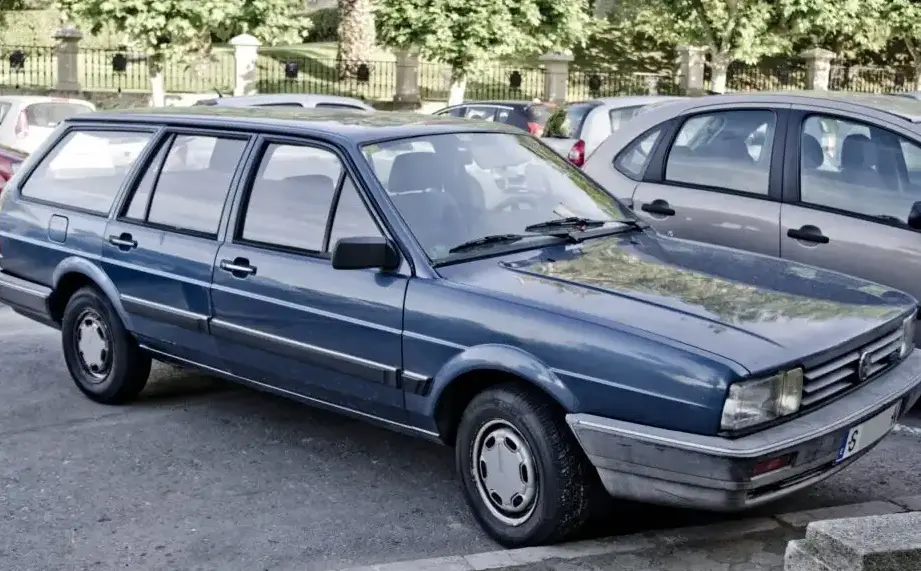
The Volkswagen Passat Variant (B2) 2.2 Syncro, produced between 1985 and 1988, represents a significant evolution of Volkswagen’s popular mid-size offering. This variant, distinguished by its all-wheel-drive system and 2.2-liter engine, was positioned as a premium option within the B2 Passat lineup, appealing to buyers seeking enhanced practicality and all-weather capability. It built upon the foundation of the B2 platform (internally designated as the 1HX0), which offered a more modern and spacious design compared to its predecessor, the B1 Passat. The Syncro models, in general, were a response to growing demand for vehicles capable of handling challenging road conditions, particularly in Northern Europe.
Technical Specifications
| Brand | Volkswagen |
| Model | Passat |
| Generation | Passat Variant (B2) |
| Type (Engine) | 2.2 Syncro (136 Hp) |
| Start of production | 1985 |
| End of production | 1988 |
| Powertrain Architecture | Internal Combustion engine |
| Body type | Station wagon (estate) |
| Seats | 5 |
| Doors | 5 |
| Fuel consumption (urban) | 12.1 l/100 km (19.4 US mpg) |
| Fuel consumption (extra urban) | 7.7 l/100 km (30.5 US mpg) |
| Fuel Type | Petrol (Gasoline) |
| Acceleration 0 – 100 km/h | 9.9 sec |
| Acceleration 0 – 62 mph | 9.9 sec |
| Acceleration 0 – 60 mph | 9.4 sec |
| Maximum speed | 191 km/h (118.68 mph) |
| Weight-to-power ratio | 9.3 kg/Hp |
| Weight-to-torque ratio | 6.9 kg/Nm |
| Power | 136 Hp @ 5700 rpm |
| Torque | 184 Nm @ 3550 rpm (135.71 lb.-ft. @ 3550 rpm) |
| Engine layout | Front, Longitudinal |
| Engine Model/Code | KV, HY |
| Engine displacement | 2226 cm3 (135.84 cu. in.) |
| Number of cylinders | 5 |
| Engine configuration | Inline |
| Cylinder Bore | 81 mm (3.19 in.) |
| Piston Stroke | 86.4 mm (3.4 in.) |
| Compression ratio | 10:1 |
| Number of valves per cylinder | 2 |
| Fuel injection system | Multi-port manifold injection |
| Engine aspiration | Naturally aspirated engine |
| Valvetrain | SOHC |
| Engine oil capacity | 3 l (3.17 US qt | 2.64 UK qt) |
| Coolant capacity | 4 l (4.23 US qt | 3.52 UK qt) |
| Kerb Weight | 1265 kg (2788.85 lbs.) |
| Max. weight | 1800 kg (3968.32 lbs.) |
| Max load | 535 kg (1179.47 lbs.) |
| Trunk (boot) space – minimum | 540 l (19.07 cu. ft.) |
| Trunk (boot) space – maximum | 1811 l (63.95 cu. ft.) |
| Fuel tank capacity | 70 l (18.49 US gal | 15.4 UK gal) |
| Max. roof load | 75 kg (165.35 lbs.) |
| Permitted trailer load with brakes (12%) | 1500 kg (3306.93 lbs.) |
| Permitted trailer load without brakes | 670 kg (1477.1 lbs.) |
| Permitted towbar download | 85 kg (187.39 lbs.) |
| Length | 4545 mm (178.94 in.) |
| Width | 1695 mm (66.73 in.) |
| Height | 1465 mm (57.68 in.) |
| Wheelbase | 2555 mm (100.59 in.) |
| Front track | 1413 mm (55.63 in.) |
| Rear track | 1436 mm (56.54 in.) |
| Minimum turning circle | 11.3 m (37.07 ft.) |
| Drivetrain Architecture | All wheel drive (4×4) |
| Number of gears | 5 |
| Gearbox type | Manual transmission |
| Front suspension | Double wishbone, Transverse stabilizer |
| Rear suspension | Trailing arm, Transverse stabilizer |
| Front brakes | Ventilated discs |
| Rear brakes | Disc |
| Assisting systems | ABS (Anti-lock braking system) |
| Steering type | Steering rack and pinion |
| Power steering | Hydraulic |
| Tires size | 195/65 R14 |
| Wheel rims size | 6J x 14 |
Powertrain & Engine Architecture
The heart of the Passat Variant 2.2 Syncro is the KV or HY inline five-cylinder engine. This engine, displacing 2226cc, utilizes a single overhead camshaft (SOHC) valvetrain operating two valves per cylinder. The engine featured multi-port fuel injection, a significant advancement over earlier carbureted designs, contributing to improved fuel efficiency and smoother power delivery. The KV and HY codes denote slight variations in engine management and specification, but both produce 136 horsepower at 5700 rpm and 184 Nm (136 lb-ft) of torque at 3550 rpm. The engine’s longitudinal mounting and the rear-biased all-wheel-drive system necessitated a robust drivetrain. The five-speed manual transmission was the standard offering, providing a balance between performance and fuel economy. The Syncro system itself employed a viscous coupling to distribute power between the front and rear axles, providing all-wheel drive capability when needed without a constant drain on fuel efficiency.
Driving Characteristics
The 2.2 Syncro offered a distinct driving experience compared to other Passat variants. While not a sports car, the 136 hp engine provided adequate power for comfortable cruising and overtaking. The five-speed manual transmission allowed drivers to effectively utilize the engine’s torque band. Acceleration from 0 to 60 mph took approximately 9.4 seconds, and the car could reach a top speed of around 119 mph. The Syncro system significantly enhanced traction, particularly on slippery surfaces, making it a capable all-weather vehicle. Compared to the base 1.6 or 1.8-liter Passats, the 2.2 Syncro offered noticeably more power and a more refined driving experience. However, it wasn’t as nimble as the lighter, front-wheel-drive models. The all-wheel-drive system added weight, impacting handling slightly, but the added stability was a worthwhile trade-off for many drivers.
Equipment & Trim Levels
The Passat Variant 2.2 Syncro was generally well-equipped for its time. Standard features typically included power steering, central locking, and a basic stereo system. Interior upholstery was usually cloth, with options for upgraded velour or leather. Trim levels varied depending on the market, but generally, the Syncro models were positioned as mid-to-high-range options. Optional extras included sunroofs, electric windows, and upgraded audio systems. The estate body style itself provided a significant level of practicality, with a generous cargo capacity of 540 liters (19.07 cu. ft.) with the rear seats up, expanding to 1811 liters (63.95 cu. ft.) with the seats folded down.
Chassis & Braking
The B2 Passat featured an independent suspension system, with double wishbones at the front and a trailing arm setup at the rear. A transverse stabilizer bar was fitted to both axles, helping to reduce body roll during cornering. Braking duties were handled by ventilated discs at the front and solid discs at the rear. The inclusion of ABS (Anti-lock Braking System) was a significant safety feature, particularly given the all-wheel-drive system’s enhanced grip. The Syncro models often featured slightly heavier-duty suspension components to cope with the added weight and stresses of the all-wheel-drive system.
Market Reception & Comparison
The Passat Variant 2.2 Syncro was generally well-received by automotive critics. It was praised for its practicality, all-weather capability, and comfortable ride. However, some critics noted that the engine could feel strained at higher speeds, and the all-wheel-drive system added to the vehicle’s weight and fuel consumption. Compared to the more common front-wheel-drive Passat variants, the Syncro commanded a premium price. Fuel economy was respectable for the time, averaging around 19.4 mpg in the city and 30.5 mpg on the highway. Reliability was generally good, although the Syncro system itself required periodic maintenance to ensure proper operation.
Legacy
The Passat Variant 2.2 Syncro remains a sought-after classic among Volkswagen enthusiasts. The combination of practicality, all-wheel-drive capability, and the distinctive five-cylinder engine makes it a unique and appealing vehicle. While finding well-maintained examples can be challenging, the 2.2 Syncro is known for its durability and relatively straightforward mechanical design. Parts availability is generally good, although some Syncro-specific components can be difficult to source. Today, these vehicles represent a piece of automotive history, showcasing Volkswagen’s commitment to innovation and practicality during the 1980s.