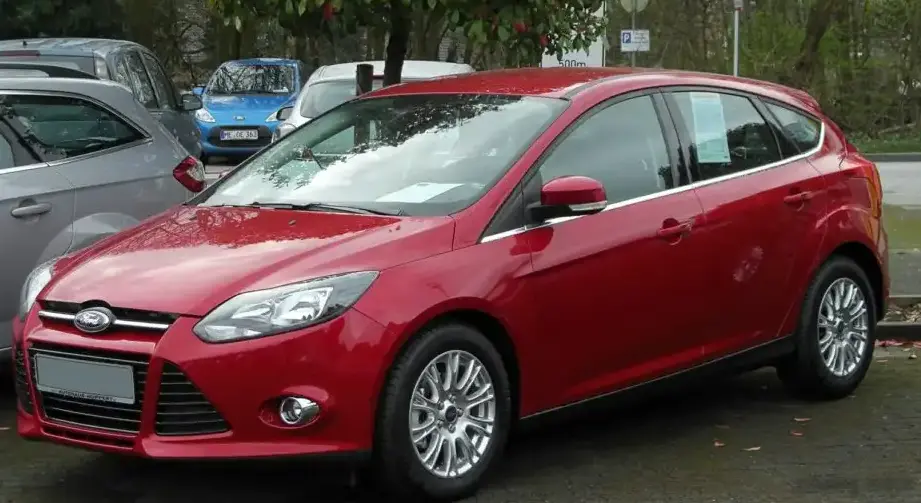
The Ford Focus III Hatchback, produced from late 2010 to September 2014, represented a significant step forward for Ford’s global compact car. The 1.6 Ti-VCT (125 horsepower) variant occupied a key position in the lineup, serving as a balance between affordability, fuel efficiency, and acceptable performance. This model was primarily aimed at the European market, where compact hatchbacks are exceptionally popular, but was also offered in other regions including North America. It was built on the C170 platform, also known as the global Focus platform, and represented the third generation of the Focus model.
Technical Specifications
| Brand | Ford |
| Model | Focus |
| Generation | Focus III Hatchback |
| Type (Engine) | 1.6 Ti-VCT (125 Hp) |
| Start of production | December, 2010 |
| End of production | September, 2014 |
| Powertrain Architecture | Internal Combustion engine |
| Body type | Hatchback |
| Seats | 5 |
| Doors | 5 |
| Fuel consumption (urban) | 8 l/100 km (29.4 US mpg, 35.3 UK mpg, 12.5 km/l) |
| Fuel consumption (extra urban) | 4.7 l/100 km (50 US mpg, 60.1 UK mpg, 21.3 km/l) |
| Fuel consumption (combined) | 5.9 l/100 km (39.9 US mpg, 47.9 UK mpg, 16.9 km/l) |
| CO2 emissions | 136 g/km |
| Fuel Type | Petrol (Gasoline) |
| Acceleration 0 – 100 km/h | 10.9 sec |
| Acceleration 0 – 62 mph | 10.9 sec |
| Acceleration 0 – 60 mph | 10.4 sec |
| Maximum speed | 196 km/h (121.79 mph) |
| Emission standard | Euro 5 |
| Weight-to-power ratio | 9.6 kg/Hp, 104.1 Hp/tonne |
| Weight-to-torque ratio | 7.6 kg/Nm, 132.4 Nm/tonne |
| Power | 125 Hp @ 6300 rpm |
| Power per litre | 78.3 Hp/l |
| Torque | 159 Nm @ 4000 rpm (117.27 lb.-ft. @ 4000 rpm) |
| Engine layout | Front, Transverse |
| Engine Model/Code | PNDA |
| Engine displacement | 1596 cm3 (97.39 cu. in.) |
| Number of cylinders | 4 |
| Engine configuration | Inline |
| Cylinder Bore | 79 mm (3.11 in.) |
| Piston Stroke | 81.4 mm (3.2 in.) |
| Compression ratio | 11:1 |
| Number of valves per cylinder | 4 |
| Fuel injection system | Multi-port manifold injection |
| Engine aspiration | Naturally aspirated engine |
| Valvetrain | DOHC |
| Engine oil capacity | 4.1 l (4.33 US qt | 3.61 UK qt) |
| Coolant | 5.8 l (6.13 US qt | 5.1 UK qt) |
| Kerb Weight | 1201 kg (2647.75 lbs.) |
| Max. weight | 1825 kg (4023.44 lbs.) |
| Max load | 624 kg (1375.68 lbs.) |
| Trunk (boot) space – minimum | 316 l (11.16 cu. ft.) |
| Trunk (boot) space – maximum | 1101 l (38.88 cu. ft.) |
| Fuel tank capacity | 55 l (14.53 US gal | 12.1 UK gal) |
| Permitted trailer load with brakes (12%) | 800 kg (1763.7 lbs.) |
| Permitted trailer load without brakes | 635 kg (1399.94 lbs.) |
| Length | 4358 mm (171.57 in.) |
| Width | 1823 mm (71.77 in.) |
| Width with mirrors folded | 1858 mm (73.15 in.) |
| Width including mirrors | 2010 mm (79.13 in.) |
| Height | 1484 mm (58.43 in.) |
| Wheelbase | 2648 mm (104.25 in.) |
| Front track | 1544-1559 mm (60.79 – 61.38 in.) |
| Rear (Back) track | 1534-1549 mm (60.39 – 60.98 in.) |
| Minimum turning circle | 11 m (36.09 ft.) |
| Drivetrain Architecture | The Internal combustion engine (ICE) drives the front wheels of the vehicle. |
| Drive wheel | Front wheel drive |
| Number of gears and type of gearbox | 5 gears, manual transmission |
| Front suspension | Independent, type McPherson with coil spring and anti-roll bar |
| Rear suspension | Independent multi-link spring suspension with stabilizer |
| Front brakes | Ventilated discs |
| Rear brakes | Drum |
| Assisting systems | ABS (Anti-lock braking system) |
| Steering type | Steering rack and pinion |
| Power steering | Electric Steering |
| Tires size | 205/55 R16; 215/55 R16; 215/50 R17 |
| Wheel rims size | 6.5J x 16; 7J x 16; 7J x 17 |
Powertrain & Engine Architecture
The heart of this Focus variant is the 1.6-liter PNDA inline-four cylinder engine. This engine belongs to the Duratec family, and the ‘Ti-VCT’ designation stands for Twin Independent Variable Camshaft Timing. This technology allows for optimized valve timing based on engine speed and load, improving both performance and fuel efficiency. The PNDA engine utilizes a multi-point fuel injection system, delivering fuel directly to the intake ports. The engine’s 16-valve DOHC (Double Overhead Camshaft) configuration further contributes to its breathing efficiency. The engine produces 125 horsepower at 6300 rpm and 159 Nm (117.27 lb-ft) of torque at 4000 rpm. The engine is transversely mounted, driving the front wheels. The standard transmission was a 5-speed manual, although a 6-speed automatic transmission was also available, though less common.
Driving Characteristics
The 1.6 Ti-VCT engine, paired with the 5-speed manual transmission, provided adequate, though not exhilarating, performance. Acceleration from 0-60 mph took around 10.4 seconds, and top speed was approximately 121.79 mph. The engine felt relatively responsive in the mid-range, making it suitable for everyday driving. Compared to the higher-output 1.6 EcoBoost or diesel variants, this engine lacked the punch for quick overtaking maneuvers. The 5-speed gearbox offered a reasonable spread of ratios, but some drivers found it slightly notchy. The automatic transmission, while offering convenience, further dulled the driving experience and slightly impacted fuel economy.
Equipment & Trim Levels
The 1.6 Ti-VCT typically came in mid-range trim levels, such as ‘Comfort’ or ‘Trend’ depending on the market. Standard equipment generally included air conditioning, power windows, power mirrors, a basic audio system with USB connectivity, and ABS brakes. Higher trim levels added features like alloy wheels, fog lights, cruise control, and a more advanced audio system. Interior upholstery was typically cloth, with options for upgraded materials. Safety features included multiple airbags and stability control.
Chassis & Braking
The Focus III utilized an independent McPherson strut suspension at the front and an independent multi-link suspension at the rear. This setup provided a good balance between ride comfort and handling. The front brakes were ventilated discs, while the rear brakes were drums on most variants. Stabilizer bars were fitted to both the front and rear axles to reduce body roll. The steering was electrically assisted, providing a light and precise feel.
Market Reception & Comparison
The 1.6 Ti-VCT Focus was generally well-received as a practical and economical choice. Critics praised its fuel efficiency and comfortable ride, but some found the engine to be underpowered, especially when compared to the more potent EcoBoost options. The diesel variants offered superior fuel economy and torque, but at a higher purchase price. The 1.6 Ti-VCT offered a compelling value proposition for buyers prioritizing affordability and everyday usability.
Legacy
The 1.6 Ti-VCT engine proved to be relatively reliable, with few major issues reported. The Focus III, in general, has a good reputation for durability. On the used car market, these models represent a good value, offering a well-rounded package at an affordable price. However, potential buyers should be aware of the typical wear and tear associated with any used vehicle, such as suspension components and brake wear. The availability of parts is generally good, and maintenance costs are reasonable.