
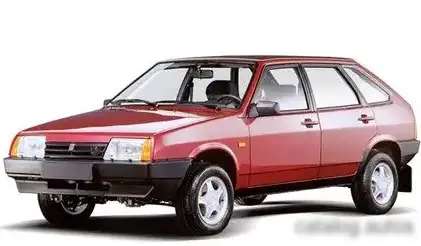
The Lada 2109 1.3, producing 64 horsepower, was a mainstay of the Soviet and later Russian automotive market from 1987 to 1997. Part of the second generation of the VAZ-2109 series, often referred to simply as the “9” or “Samara” in export markets, this variant represented an entry-level offering within the lineup. It was designed to provide affordable and reliable transportation, particularly for families, and played a significant role in motorizing the post-Soviet landscape. The 2109 was a substantial update to the earlier 2105 model, featuring a more modern, hatchback body style and improved interior appointments, though still retaining the fundamentally simple and robust engineering characteristic of Lada vehicles.
Technical Specifications
| Brand | Lada |
| Model | 2109 |
| Generation | 2109 |
| Type (Engine) | 1.3 (64 Hp) |
| Start of production | 1987 |
| End of production | 1997 |
| Powertrain Architecture | Internal Combustion engine |
| Body type | Hatchback |
| Seats | 5 |
| Doors | 5 |
| Fuel consumption (urban) | 8.6 l/100 km (27.4 US mpg, 32.8 UK mpg, 11.6 km/l) |
| Fuel Type | Petrol (Gasoline) |
| Acceleration 0 – 100 km/h | 16 sec |
| Acceleration 0 – 62 mph | 16 sec |
| Acceleration 0 – 60 mph | 15.2 sec |
| Maximum speed | 148 km/h (91.96 mph) |
| Weight-to-power ratio | 14.3 kg/Hp, 69.9 Hp/tonne |
| Weight-to-torque ratio | 9.7 kg/Nm, 102.7 Nm/tonne |
| Power | 64 Hp @ 5600 rpm |
| Power per litre | 49.7 Hp/l |
| Torque | 94 Nm @ 3500 rpm (69.33 lb.-ft. @ 3500 rpm) |
| Engine layout | Front, Transverse |
| Engine displacement | 1288 cm3 (78.6 cu. in.) |
| Number of cylinders | 4 |
| Engine configuration | Inline |
| Cylinder Bore | 76 mm (2.99 in.) |
| Piston Stroke | 71 mm (2.8 in.) |
| Compression ratio | 9.9:1 |
| Number of valves per cylinder | 2 |
| Fuel injection system | Carburettor |
| Engine aspiration | Naturally aspirated engine |
| Valvetrain | OHC |
| Kerb Weight | 915 kg (2017.23 lbs.) |
| Max. weight | 1340 kg (2954.19 lbs.) |
| Max load | 425 kg (936.96 lbs.) |
| Trunk (boot) space – minimum | 270 l (9.53 cu. ft.) |
| Trunk (boot) space – maximum | 1000 l (35.31 cu. ft.) |
| Fuel tank capacity | 43 l (11.36 US gal | 9.46 UK gal) |
| Length | 4006 mm (157.72 in.) |
| Width | 1650 mm (64.96 in.) |
| Height | 1402 mm (55.2 in.) |
| Wheelbase | 2460 mm (96.85 in.) |
| Front track | 1400 mm (55.12 in.) |
| Rear (Back) track | 1370 mm (53.94 in.) |
| Drivetrain Architecture | The Internal combustion engine (ICE) drives the front wheels of the vehicle. |
| Drive wheel | Front wheel drive |
| Number of gears and type of gearbox | 5 gears, manual transmission |
| Front suspension | Spring Strut |
| Rear suspension | Coil spring |
| Front brakes | Disc |
| Rear brakes | Drum |
| Steering type | Steering rack and pinion |
| Tires size | 165/70 SR13 |
Powertrain & Engine Architecture
The heart of the Lada 2109 1.3 was the VAZ-2108 engine, a 1.3-liter inline-four cylinder unit. This engine, while relatively simple in design, was known for its durability and ease of maintenance. It featured a single overhead camshaft (OHC) operating two valves per cylinder. Crucially, this variant utilized a carburetor for fuel delivery, a cost-saving measure that positioned it at the lower end of the 2109 range. Higher-spec 2109s received fuel injection. The carburetor, typically a K-126G type, was known for its relative simplicity but also for its less precise fuel metering compared to injection systems. The engine produced 64 horsepower at 5600 rpm and 94 Nm (69.33 lb-ft) of torque at 3500 rpm. The engine was transversely mounted, driving the front wheels. The standard transmission was a five-speed manual gearbox, designed for robustness rather than sporty performance.
Driving Characteristics
The 1.3-liter engine in the 2109 provided adequate, but not exhilarating, performance. Acceleration to 60 mph took around 15.2 seconds, and the top speed was approximately 92 mph. The carburetor contributed to a somewhat sluggish throttle response, and the engine needed to be revved to extract its maximum power. The five-speed manual transmission was geared for economy, with relatively tall ratios. Compared to the 1.5-liter and 1.6-liter versions of the 2109, the 1.3 felt noticeably slower, particularly when fully loaded or climbing hills. However, the lighter engine weight did contribute to slightly improved handling and fuel economy. The steering, while rack and pinion, lacked precision and feel, typical of Lada vehicles of the era.
Equipment & Trim Levels
The 1.3-liter 2109 was typically the base model, and as such, came with a relatively sparse equipment list. Standard features included basic cloth upholstery, a simple dashboard layout, and manual windows and door locks. Heating and ventilation were standard, but air conditioning was not typically offered on this trim level. Optional extras included a radio, upgraded seat covers, and sometimes, a sunroof. The interior plastics were durable but utilitarian, reflecting the car’s focus on affordability. The exterior trim was also basic, with steel wheels and minimal chrome accents.
Chassis & Braking
The Lada 2109 utilized a relatively simple chassis design. The front suspension consisted of MacPherson strut coil springs, while the rear suspension employed a trailing arm setup with coil springs. The braking system featured disc brakes on the front wheels and drum brakes on the rear. The brakes were adequate for normal driving conditions, but lacked the stopping power of more modern vehicles. The steering was a rack and pinion system, but as mentioned previously, lacked precision. The car’s relatively light weight helped to compensate for the limitations of the chassis and braking system.
Market Reception & Comparison
The Lada 2109 1.3 was primarily aimed at budget-conscious buyers. Critics generally acknowledged its affordability and reliability, but also pointed out its lack of refinement and performance. Compared to Western European hatchbacks of the same era, the 2109 1.3 was significantly less sophisticated, but also considerably cheaper. Within the Lada lineup, the 1.3 served as the entry point, appealing to those who prioritized cost over performance. The 1.5 and 1.6-liter versions offered more power and a slightly more refined driving experience, but at a higher price point. Fuel economy was a strong point for the 1.3, making it an attractive option for those seeking a low-cost vehicle to commute in.
Legacy
The Lada 2109 1.3, while not a performance icon, remains a significant vehicle in automotive history, particularly in Eastern Europe and Russia. Its simple, robust design made it relatively easy to maintain and repair, even in challenging conditions. Today, the 2109 1.3 is a popular choice among classic car enthusiasts and those seeking an affordable and nostalgic vehicle. The 1.3 engine, while not known for its longevity in the same way as some of Lada’s larger engines, is generally considered reliable if properly maintained. Parts availability can be a challenge in some regions, but a dedicated community of Lada enthusiasts continues to support the preservation of these vehicles.
